
 Shift News
IMPORTANT DISCLAIMER: EDUCATIONAL PURPOSES ONLY. This post is for educational and informational purposes only. It is not investment advice and not financial advice, and it is not a recommendation to buy, sell, or hold SPCX, TSLA or any other security. Do your own research and consult a licensed financial advisor before making any investment decision. Investing involves risk, including the possible loss of your money.
Morningstar, Inc.: "5 Stocks to Buy Trading at Big Discounts I October 26, 2026". Facts on this page cite the primary sources below, not the video.
Honest fence (read first): Morningstar's $70 is a fair value estimate: its own view of what the business is worth today. It isn't a 12-month price target like most bank numbers. Our Oct 21 post covered SpaceX's Q3 results, and our Oct 23 post covered the lock-up and the higher targets that followed. Today's SpaceX Friday flagships cover Starship Flight 15's static fires and the Florida Falcon 9 pause. This post is only about the valuation gap.
Editorial Thesis
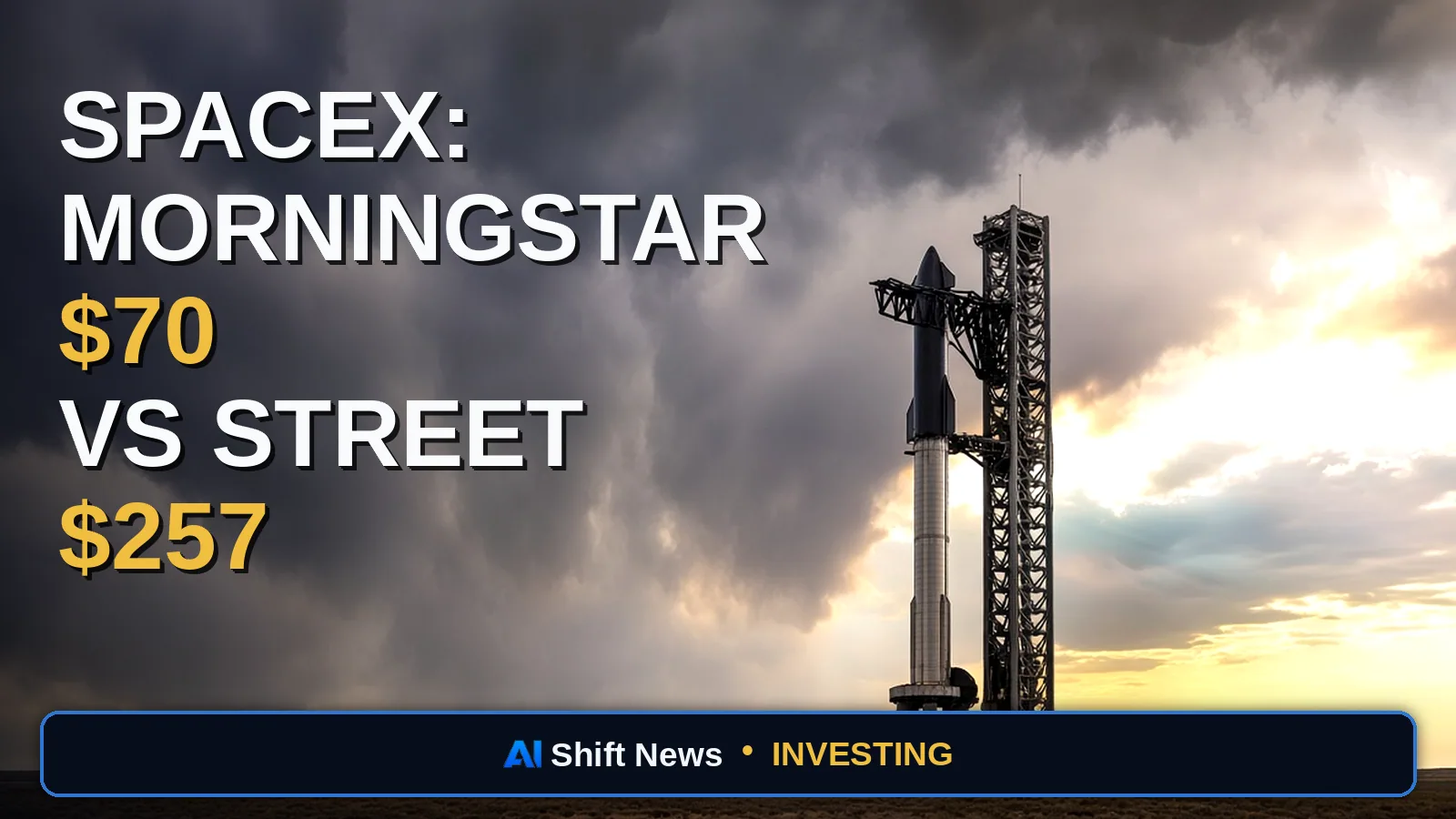
On Wednesday, Oct 21, the morning after SpaceX's third-quarter report, Morningstar analyst Nicolas Owens wrote: "We raised our fair value estimate for narrow-moat SpaceX to $70 per share from $62." In the same note: "We see SpaceX's shares as overvalued: They traded at around twice our fair value estimate after hours on Oct. 20."
On Thursday, Oct 29, Morningstar repeated it in a written version of its Morning Filter show: "our fair value is still only $70 a share."
That same day, SPCX closed at $143.89 (it closed at $134.72 on Friday, Oct 30; see below). Morningstar's estimate is about 51% below that. Meanwhile, the average of 39 analyst price targets tracked by S&P Global is $257.11, about 79% above it. The lowest target in that set is $70. The highest is $800.
Same company, same quarter, and a gap of more than 10 times from the low end to the high end. That's the story.
Honest Verdict
Proven (Morningstar's own publications): the $70 fair value estimate, up from $62; Morningstar's view that the shares are overvalued; the model inputs listed below. Proven (market data): SPCX closes of $150.86 (Sep 30), $171.92 (Oct 6), $159.31 (Oct 21), $144.75 (Oct 22), $143.89 (Oct 29) and $134.72 (Oct 30). That's down about 10.7% in October through Friday, and down about 22% from the Oct 6 close. Data-vendor figures, not ours: the $257.11 average, the $70 to $800 range and the 39-analyst count are S&P Global numbers shown on StockAnalysis. Other vendors show different averages. Not proven: anyone's 2030 forecast. Morningstar's numbers are projections, and so are every bank's.
What Morningstar's model assumes
Morningstar's Oct 29 piece lays out the inputs behind the $70:
| Morningstar SpaceX model | Figure |
|---|---|
| 2026 revenue | $41 billion (about double 2025) |
| Five-year revenue growth rate | 65% a year |
| 2030 revenue | $228 billion (about 5.5x 2026) |
| 2026 earnings per share | a loss of $0.12 |
| Operating margin by 2030 | 28% |
| 2030 earnings per share | $2 |
Those aren't bearish growth numbers. Morningstar is already modeling revenue growing more than fivefold in four years. Its point is that even that isn't enough at today's price: "they almost have to double what we're currently modeling in, and that's just to get to fair value."
The Oct 21 note explains where Morningstar is cautious. It credits SpaceX's quarter: revenue up 161% to $14.6 billion, Starlink up 69.5% with $2.4 billion in operating profit, and the AI business earning $431 million in operating income. But it warns: "we do not think it likely that demand will outstrip supply forever, especially the more capacity is deployed." In other words, Morningstar doubts that renting out AI computing power stays this profitable as more of it gets built.
What the higher targets assume
The banks at the top of the range are betting on exactly what Morningstar discounts. Recent moves, from StockAnalysis's TipRanks data and CNBC:
| Firm | Rating | Target | Date |
|---|---|---|---|
| Morgan Stanley | Buy | $300 | Oct 26 |
| Bernstein | Outperform | $268 (from $248) | Oct 26 |
| Argus | not shown | $265 (raised) | Oct 28 |
| Needham | Buy | $250 | Oct 27 |
| Goldman Sachs | Buy | $245 (from $230) | Oct 22 |
| DZ Bank | Sell | none listed | Oct 22 |
Bernstein's Douglas Harned wrote, per CNBC: "We believe the case for a multi-trillion dollar valuation rests on success of orbital data centers." That's a bet on something SpaceX hasn't built yet. Deutsche Bank's Edison Yu argued SpaceX's compute advantage is "underappreciated." CNBC counted 33 of 43 analysts at Buy or Strong Buy, using LSEG data.
So the split isn't really about Starlink, which most analysts agree is a strong business. It's about how much the AI build-out and future projects like orbital data centers are worth, and how sure you can be about them today.
What the stock has done
The market is sitting between the two camps and drifting lower. SPCX peaked this month at $171.92 on Oct 6. It jumped 7.79% to $159.31 the day after earnings, then fell 9.14% to $144.75 on Oct 22, when up to 1.3 billion shares came out of lock-up. It has traded between about $143 and $149 since.
Update, Friday Oct 30 close: SPCX fell 6.37% on Friday to close at $134.72. Stocktwits tied the overnight slide to Amazon saying on its Thursday earnings call that its Leo satellite internet service is still on track to start this year, a Starlink competitor. At $134.72, Morningstar's $70 is about 48% below the price and the $257.11 average target is about 91% above it. SPCX is now down about 10.7% in October (from $150.86 on Sep 30) and about 22% from the Oct 6 close.
How to read a fair value vs a price target
This is the most useful part for most readers.
- A price target is where an analyst thinks the stock will trade in about 12 months. It often includes momentum, sentiment and future catalysts.
- A fair value estimate (Morningstar's term) is what the analyst thinks the whole future stream of cash is worth today, discounted back. It doesn't try to predict what the market will pay next year.
That's why Morningstar can raise its number and still call the stock overvalued, and why a bank can raise its target while the stock falls. The two numbers answer different questions. Treat the $70 and the $257.11 as two different measuring sticks, not two guesses at the same thing.
The Tesla angle, in one paragraph
Morningstar also wrote that a Tesla to SpaceX combination "does make strategic sense" and that it would judge a deal "highly likely," while saying it isn't inevitable. Both companies have formed special committees, but there are no terms. A Tesla vote would need a majority of all outstanding shares. Our Oct 25 post covers that math. Nothing in Morningstar's $70 depends on a merger.
What to watch next
- The next quarterly report (SpaceX hasn't set a date). Morningstar's 2026 revenue forecast is $41 billion. The quarter will show how close SpaceX gets.
- AI rental pricing. Morningstar's main doubt is whether compute rental margins hold as more capacity comes online.
- The next lock-up dates. More insider shares become sellable over the coming months, which can weigh on the price.
- Starship. Flight 15 (today's flagship) is a technical test, not a revenue event, but a clean double catch would support the cost-cutting story bulls rely on.
The video
We embed Morningstar's Oct 26 Morning Filter episode (52 minutes), where Dave Sekera and Sarah Hansen recap the firm's new SpaceX and Tesla research. The SpaceX part is one segment of a longer show. We couldn't play it on our research machine, so the quotes here come from Morningstar's written Oct 21 note and Oct 29 article.
Bottom line
Morningstar's $70 fair value and Wall Street's $257.11 average target are both serious numbers built from the same Q3 report. They're far apart because they disagree about how much SpaceX's AI build-out will earn and how far ahead you can trust that. At Friday's $134.72 close (down from $143.89 on Thursday), the stock still sits between them. Neither number is a promise.
Bottom Line
Proven (Morningstar's own publications): the $70 fair value estimate, up from $62; Morningstar's view that the shares are overvalued; the model inputs listed below. Proven (market data): SPCX closes of $150.86 (Sep 30), $171.92 (Oct 6), $159.31 (Oct 21), $144.75 (Oct 22), $143.89 (Oct 29) and $134.72 (Oct 30). That's down about 10.7% in October through Friday, and down about 22% from the Oct 6 close. Data-vendor figures, not ours: the $257.11 average, the $70 to $800 range and the 39-analyst count are S&P Global numbers shown on StockAnalysis. Other vendors show different averages. Not proven: anyone's 2030 forecast. Morningstar's numbers are projections, and so are every bank's.Disclaimer: Educational Purposes Only
This post is for educational and informational purposes only. It is not investment advice, not financial advice, and not a recommendation to buy, sell, or hold SPCX, TSLA or any other security. Estimates, price targets and options figures belong to the firms and sources named, not to AI Shift News. AI Shift News is not a registered investment advisor. Do your own research and consult a licensed financial advisor before making any investment decision. Investing involves risk, including the possible loss of your money. Past performance and company claims are not guarantees of future results.
Sources
- Morningstar Equity Research (Nicolas Owens), Wed Oct 21 2026: 'We raised our fair value estimate for narrow-moat SpaceX to $70 per share from $62'; shares 'overvalued', about twice FVE after hours Oct 20
- Morningstar (Sarah Hansen, Dave Sekera), Thu Oct 29 2026: 'our fair value is still only $70 a share'; 2026 revenue $41B, 65% five-year CAGR, $228B in 2030, 28% operating margin, $2 EPS in 2030
- StockAnalysis (S&P Global Market Intelligence data), pulled Fri Oct 30 ~5:00 AM ET: 39 analysts, consensus Buy, average target $257.11, low $70, high $800
- StockAnalysis SPCX history: Sep 30 $150.86; Oct 6 $171.92; Oct 21 $159.31; Oct 22 $144.75; Oct 28 $145.23; Oct 29 $143.89; Oct 30 close $134.72 (-6.37%)
- StockAnalysis ratings (TipRanks data): Needham $250 (Oct 27), Morgan Stanley $300 (Oct 26), Bernstein $248 to $268 (Oct 26), Goldman Sachs $230 to $245 (Oct 22), DZ Bank Sell (Oct 22)
- CNBC (Liz Napolitano), Oct 26 2026: Bernstein $268 and Deutsche Bank $250 targets; 33 of 43 analysts Buy or Strong Buy (LSEG)
- Stocktwits via Yahoo Finance, Thu Oct 29 2026 9:34 PM ET: SPCX down about 4% overnight after Amazon reaffirmed Leo service begins this year
- Morningstar, Inc., The Morning Filter, Mon Oct 26 2026: recap of new SpaceX research (embed)