
 Shift News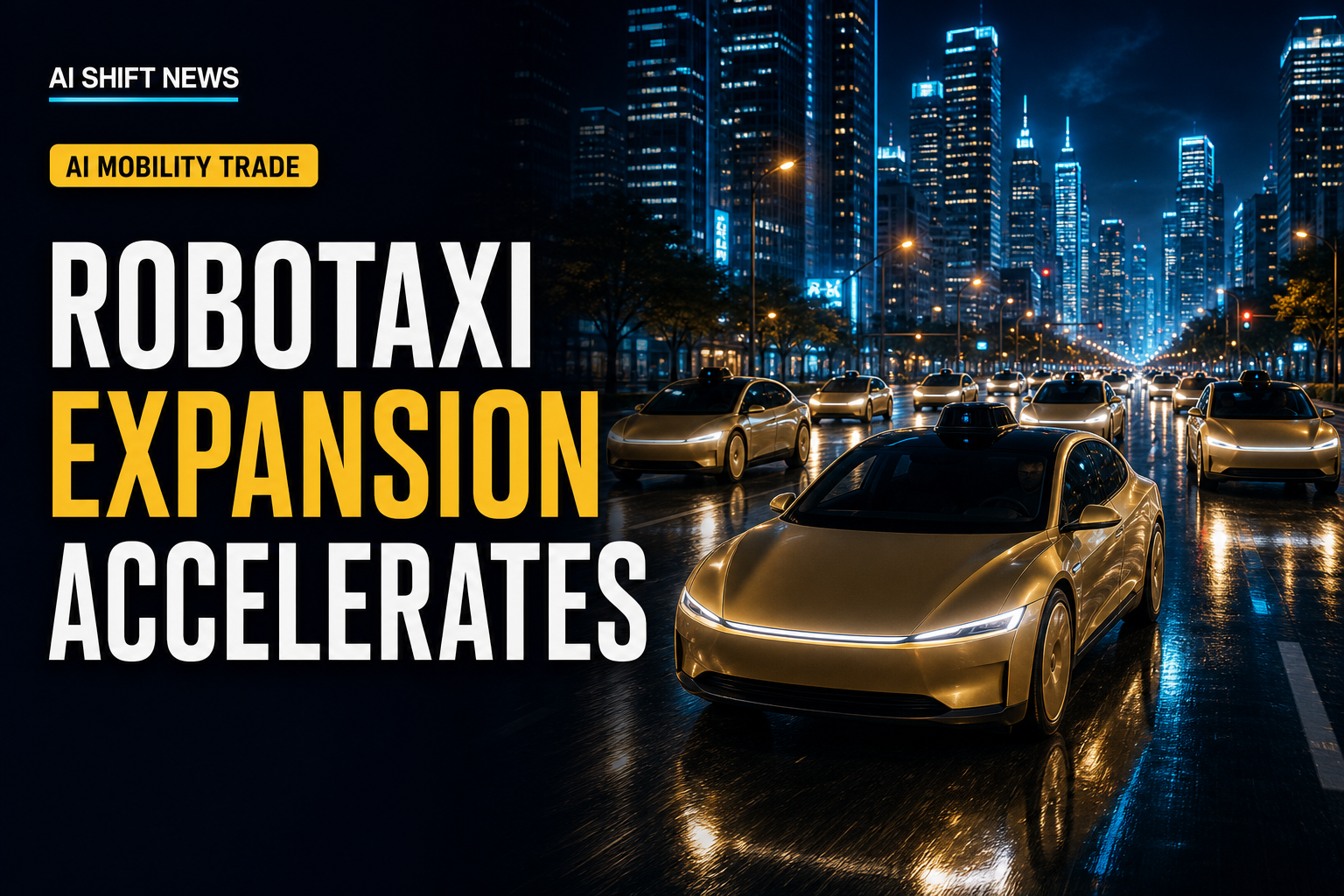
Tesla's Robotaxi expansion is starting to look less like a futuristic demo and more like a real operating strategy.
That does not mean the hard part is over. It does not mean Tesla has proven fully autonomous ride-hailing everywhere. And it definitely does not mean investors should blindly chase the headline.
But the story has changed. Tesla's own support page now says Robotaxi service is available in limited areas of Austin, Dallas, and Houston, Texas. The same page says rides currently operate from 6 AM to 2 AM Central Time, and that the initial fleet consists of Model Y vehicles.
That matters because it moves the conversation from "will Tesla ever launch this?" to "can Tesla scale this city by city?"
Why This Is a Bullish Signal
The bullish case is simple: Robotaxi is the cleanest way for Tesla to prove it is more than a car company.
If Tesla can turn its existing vehicles, FSD software, charging network, data flywheel, and future CyberCab fleet into a repeatable ride-hailing business, the upside is not just more vehicle sales. The upside is recurring mobility revenue, higher fleet utilization, and a credible AI platform narrative.
Austin alone could be dismissed as a controlled launch. Austin plus Dallas plus Houston is harder to ignore. Tesla's Q1 2026 shareholder deck also lists near-term planned Robotaxi coverage beyond Texas, including the San Francisco Bay Area with a safety-driver status and preparations underway in Phoenix, Miami, Orlando, Tampa, and Las Vegas.
The CyberCab Angle
The CyberCab is the emotional center of the story. It is the thumbnail. It is the future-facing product. It is the vehicle that makes Tesla's Robotaxi vision feel different from a normal ride-hailing app with EVs.
But the current service reality still matters. Tesla's support page says the initial Robotaxi fleet consists of Model Y vehicles. Tesla's Q1 2026 deck says CyberCab is expected to replace the existing Model Y fleet once in production and become the largest-volume vehicle in the fleet over time.
That is not bearish. It is just the honest timeline. The current Model Y rollout is the test of the software and operating model. CyberCab is the potential margin and scale story if Tesla can make the service work.
The City-by-City Read
Here is the practical map for readers:
- Live service: Austin, Dallas, and Houston.
- Safety-driver / controlled expansion: San Francisco Bay Area.
- Preparation markets: Phoenix, Miami, Orlando, Tampa, and Las Vegas.
- Global software/regulatory groundwork: Netherlands and China FSD Supervised progress.
The key is not to blend those together. Live Robotaxi service is one category. A safety-driver market is another. "Preparations underway" is another. FSD Supervised approval in a country is another. They all point in the same strategic direction, but they are not the same level of proof.
The Investment Case
The bull case for TSLA around Robotaxi has four parts.
Software leverage
If Tesla can improve autonomy through fleet data and deploy it across a large installed base, the business model could become more software-like over time.
Fleet economics
A successful Robotaxi network could increase the revenue potential of each vehicle far beyond a one-time sale.
CyberCab optionality
A purpose-built autonomous vehicle could lower cost, simplify the cabin, improve utilization, and give Tesla a more distinct ride-hailing product.
AI narrative reset
A real multi-city Robotaxi rollout would support the argument that Tesla is an AI mobility company, not just an EV manufacturer.
The Risk Case
- Safety and trust risk: Robotaxi expansion depends on safety, public trust, emergency response procedures, support systems, uptime, and incident transparency.
- Regulatory risk: Expansion is still city-by-city and state-by-state, with different rules and oversight requirements.
- Valuation risk: If investors already price TSLA as if Robotaxi becomes massive, even real progress may not be enough.
- CyberCab timing risk: The current public service is not yet a pure CyberCab fleet.
What Investors Should Watch Next
- Service-area growth inside Austin, Dallas, and Houston.
- Public ride availability beyond constrained zones.
- Concrete launch timing for Phoenix, Florida, Las Vegas, and the Bay Area.
- CyberCab production and deployment milestones.
- Safety data, incident reporting, and rider-volume metrics.
- Whether Tesla starts reporting Robotaxi economics in a way investors can model.
Bottom Line
Tesla Robotaxi expansion is accelerating, and the investment angle is legitimately exciting. The confirmed Texas rollout gives the story a stronger foundation. The planned U.S. markets suggest Tesla is trying to scale beyond a single-city experiment.
The bullish view: Tesla may be building the next major AI mobility platform. The disciplined view: investors should demand proof city by city, metric by metric, before treating Robotaxi as fully priced-in reality.