
 Shift News
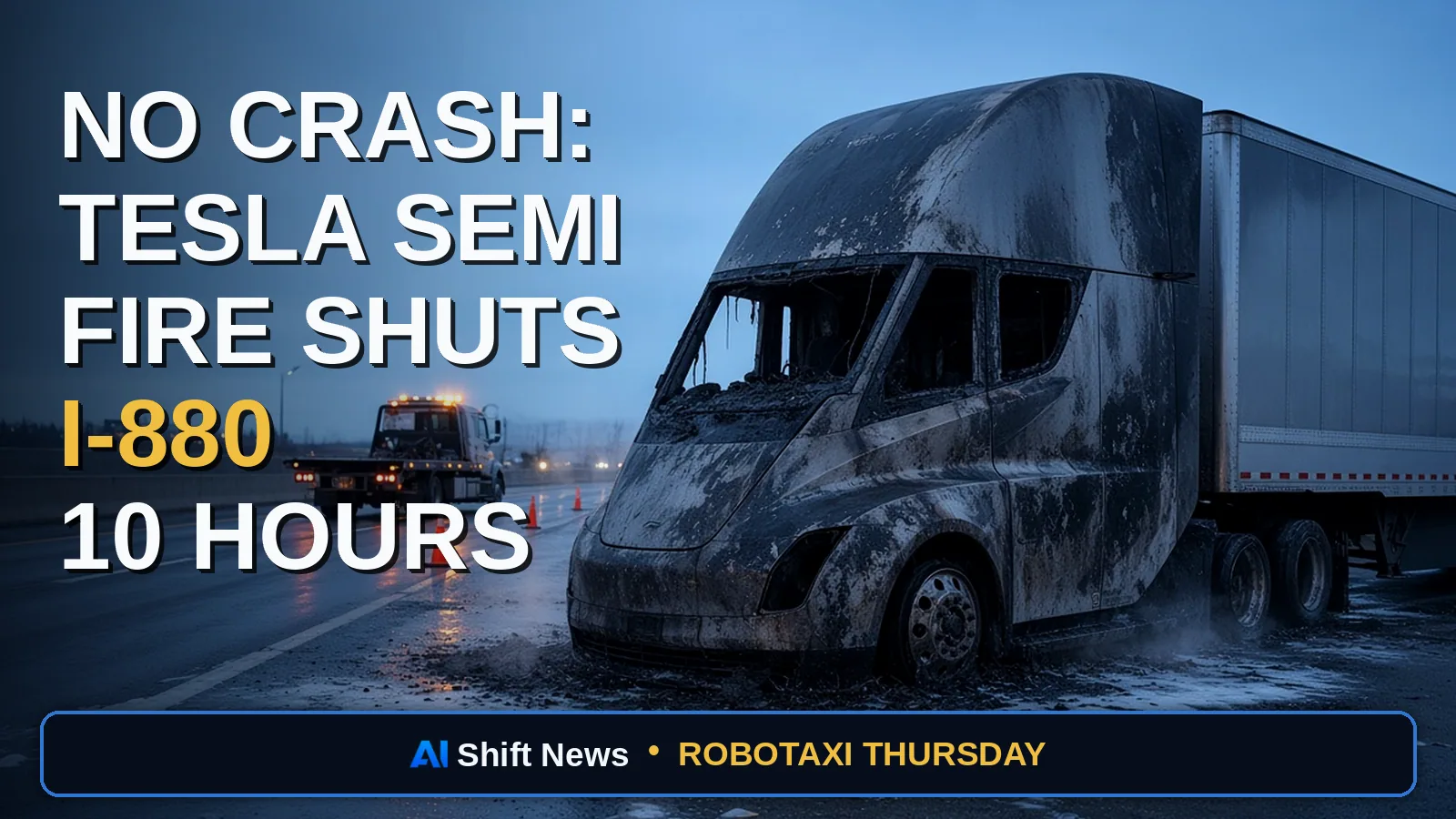
ABC7 News Bay Area: "Tesla semi-truck bursts into flames, shuts down I-880 in Hayward". Facts on this page cite the primary sources below, not the video.
Honest fence (read first): The facts here come from the California Highway Patrol, through its own X post and what it told ABC7. CHP hasn't said what started the fire, and Tesla hasn't commented. Reports that it was a PepsiCo/Frito-Lay pilot truck come from one outlet's reading of photos. Nobody official has confirmed that.
Editorial Thesis
At about 5:35 p.m. Pacific on Tuesday, Oct 27, a Tesla Semi caught fire in the southbound lanes of Interstate 880 near Route 92 in Hayward, California. By 5:45 p.m., CHP had closed both directions between Winton Avenue and Route 92. CHP Hayward posted: "A Tesla semi-truck has caught fire on I-880, resulting in a complete shutdown of both northbound and southbound lanes due to the potential risk of hazardous chemical smoke."
Northbound reopened at 8:40 p.m. Southbound stayed closed until about 3:30 a.m. Wednesday, about 10 hours after the fire started. CHP told ABC7 that the semi's "lithium battery flames were incredibly difficult to extinguish."
The driver got out unhurt. According to ABC7, the driver "only told patrol officers that the rig simply caught fire and didn't know why." No other vehicles were involved, and there was no crash.
That last part is why this matters. A truck that burns after hitting something is a crash story. A truck that catches fire on its own in traffic is a question about the truck.
Honest Verdict
Proven (CHP, via X and ABC7): a Tesla Semi fire on I-880 in Hayward on Oct 27; both directions closed over hazardous-smoke risk; southbound closed until about 3:30 a.m.; battery flames hard to put out; no injuries; driver didn't know the cause. Reported, not confirmed: that it was one of PepsiCo's early Frito-Lay pilot Semis (EVwire's reading of scene photos). Electrek says the operator hasn't been identified. Not proven: what caused the fire. A burning battery doesn't mean the battery started it. A tire, brake or trailer fire can spread to a battery.
What happened, minute by minute
| Time (PT) | What happened | Source |
|---|---|---|
| Tue ~5:35 p.m. | Semi catches fire, southbound I-880 near Route 92 | CHP via ABC7 |
| 5:45 p.m. | Both directions closed, Winton Ave to Route 92 | CHP via ABC7 |
| 8:40 p.m. | Northbound reopens | CHP via ABC7 |
| 8:46 p.m. | CHP Hayward posts the full-closure alert on X | CHP Hayward |
| Wed ~3:30 a.m. | Southbound fully reopens | CHP via ABC7 |
Electrek reports CHP had warned the battery could burn 15 to 18 hours. Crews got it done faster than that.
Whose truck was it?
We don't know for sure. EVwire wrote that the truck "looked to be among PepsiCo's test fleet": one of the early Frito-Lay Semis from the pilot program that started with Tesla's first deliveries in December 2022. If that's right, it's an older pre-production design, not one of the redesigned trucks now coming off Tesla's Nevada line.
That difference matters. Tesla's Q3 update says it "rolled out the updated Tesla Semi that is produced on our high-volume manufacturing line in Nevada," with installed capacity of 25,000 trucks a year. A fire in a four-year-old pilot truck says less about that new truck than a fire in a new one would. But CHP, PepsiCo and Tesla haven't said which it was.
Has this happened before?
Yes, once in a way that looked similar. In August 2024, a Tesla-operated Semi burned on I-80 near Emigrant Gap, and lanes stayed closed for up to 15 hours. Electrek notes the NTSB later found that truck had left the road and hit a post and a tree before its battery ignited. So that one followed a crash. Hayward, by every account so far, didn't.
For perspective, Electrek cites NFPA data: U.S. fire departments responded to an average of 15,462 large-truck fires a year from 2018 to 2022, almost all of them diesel. Truck fires aren't rare. What's unusual is a no-crash fire in a fleet as small as the Semi's. Tesla doesn't publish how many Semis are on the road.
Why it matters for Semi buyers
The timing is awkward. Tesla just started volume production, WattEV ordered 370 Semis for drayage near the Port of Oakland (a few miles up I-880), and Tesla was named lead supplier on a 2,500-truck order in September, Electrek reports. Fleet buyers and fire departments will want three things:
- The cause. Pack, high-voltage system, drive unit, tire, brake or trailer.
- Which truck. Pilot-fleet design or current production design.
- A response plan. A loaded truck burning on a freeway for most of a night is a cost even when nobody's hurt.
What would count as the next receipt
- A CHP or Hayward Fire statement on the cause.
- A Tesla or PepsiCo statement identifying the truck.
- Any NTSB or NHTSA decision to investigate. None has been announced as of Thursday morning.
The video
We embed ABC7 News Bay Area's Oct 28 report (49 seconds), which shows the truck burning on I-880 and the closure. KTVU's longer Oct 28 report is the alternate. We couldn't play either video on our research machine. The facts here come from CHP's post and ABC7's written story. NBC Bay Area's video description calls this a "fiery crash," which conflicts with CHP's account, so we don't use it.
Bottom line
A Tesla Semi caught fire on its own on I-880 and kept part of a major Bay Area freeway closed for about 10 hours. CHP confirms the fire, the closure and the hard-to-fight battery flames. Nobody has confirmed the cause or whose truck it was. Until Tesla or investigators say more, it's one serious data point, not a pattern.
Bottom Line
Proven (CHP, via X and ABC7): a Tesla Semi fire on I-880 in Hayward on Oct 27; both directions closed over hazardous-smoke risk; southbound closed until about 3:30 a.m.; battery flames hard to put out; no injuries; driver didn't know the cause. Reported, not confirmed: that it was one of PepsiCo's early Frito-Lay pilot Semis (EVwire's reading of scene photos). Electrek says the operator hasn't been identified. Not proven: what caused the fire. A burning battery doesn't mean the battery started it. A tire, brake or trailer fire can spread to a battery.Sources
- CHP Hayward on X, Tue Oct 27 2026 8:46 PM PT: 'A Tesla semi-truck has caught fire on I-880, resulting in a complete shutdown of both northbound and southbound lanes due to the potential risk of hazardous chemical smoke.'
- ABC7 San Francisco, Oct 28 2026: fire ~5:35 PM near Route 92; both directions closed by 5:45 PM Winton Ave to Route 92; northbound reopened 8:40 PM; southbound ~3:30 AM Wed; lithium battery flames hard to extinguish (CHP); driver didn't know why; no injuries
- Electrek (Fred Lambert), Oct 28 2026: no crash; ~10 hours; CHP warned 15 to 18 hours; operator unidentified; Tesla no comment; Aug 2024 I-80 Semi fire context
- EVwire (Simon Alvarez), Oct 28 2026: says the truck looked like an early PepsiCo/Frito-Lay pilot Semi, not a new production truck (photo-based, unconfirmed)
- Tesla Q3 2026 update (8-K Ex 99.1): updated Semi on the high-volume Nevada line; installed Semi capacity 25,000, status Production
- ABC7 News Bay Area, Oct 28 2026: Tesla semi-truck bursts into flames, shuts down I-880 in Hayward (embed)