
Cinematic breakthroughs, missing mornings, crashes, rebuilds, and a refusal to give up. The real story behind AI Shift News reaching post #250.
Quick Take
Getting AI Shift News to its 250th post has been incredible, infuriating, and nothing like effortless automation. There have been cinematic thumbnails that blew me away, mornings when Hermes had the content waiting, and crashes that sent me back into days of repairs. The tools are getting much better. The system still isn't perfect. This is the real story of building it—and why I'm still here.
This was no Fucking Cakewalk
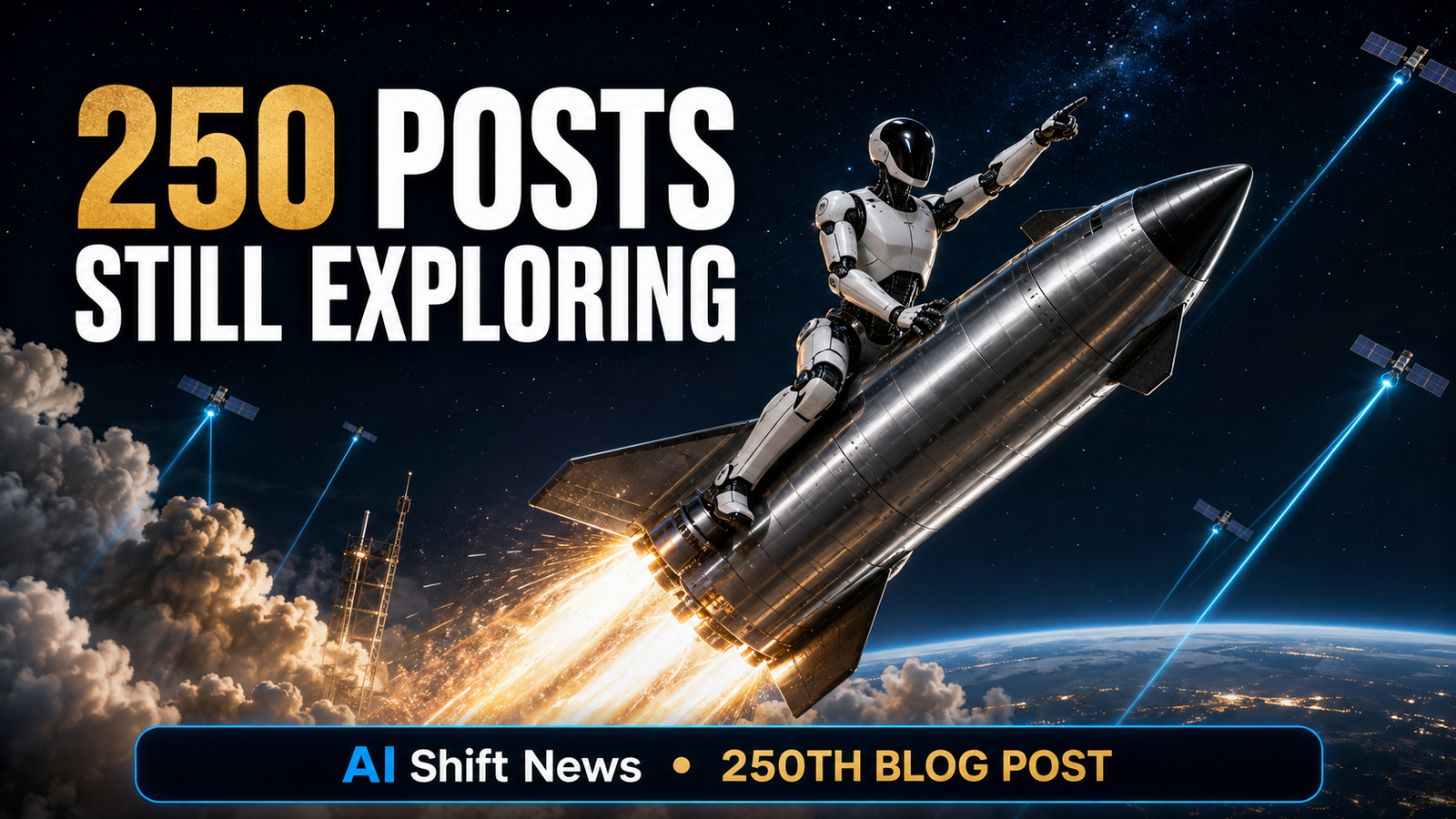
You see the finished article. You see the cinematic thumbnail: the robot, the rocket, the electric-blue light, the image that makes you stop scrolling.
What you don't see is the evening spent trying to get a system working again after it did almost exactly what I wanted the day before. Or the morning when I expected a fresh content package and got nothing. Or the moment an AI confidently told me everything was ready, and I found yesterday's work, missing images, or something that looked nothing like the standard we'd already spent hours getting right.
That's the story behind this milestone. If I'm going to celebrate 250 blog posts, I want to celebrate the real thing.
Some of this journey has been absolutely fantastic. Some of it has been absolutely atrocious. Sometimes I've looked at what these tools can do and thought, *Holy shit. That's incredible.* Other times I've stared at the screen and said, *What the fuck happened now?*
Both belong in this article.
Where the journey actually began
The first article I can verify in the original Netlify production history went live on May 21, 2026, at 9:27 p.m. Toronto time. It was called “Model Updates That Actually Matter.”
The site itself had first gone live on May 18, with an editorial pipeline and article placeholders. The May 21 deployment is where the first full linked blog article appears. That original page survives in [Netlify’s historical deployment](https://6a0fb0d73b78e1d3097a61b5--ai-shift-news.netlify.app/news/model-updates-that-actually-matter/).
There is a wrinkle in the current archive: that page was later rewritten and is now numbered #9. The article currently numbered #1 arrived later. Even reconstructing the beginning meant checking the original deployments instead of trusting today's numbering.
From that first article on May 21, 2026, to today, September 8, 2026, it's been 110 days. By my reckoning, hundreds and hundreds of hours have gone into creating what we have so far: building the system, shaping the content, getting the artwork right, fixing failures, and learning how to make the pieces work together. The preparation started before that first article, and the work certainly didn't stop once the site was live.
Looking back, that first title feels appropriate. A model update can look impressive. Finding out whether it actually improves your work—whether your content will be waiting when you wake up tomorrow—is a different test. I've had plenty of opportunities to learn the difference.
The mornings that made it worth it
The idea was straightforward: Hermes starts at 5 a.m. By the time I wake up, the content is ready for me to review. Articles, sources, thumbnail options—the pieces together in one place so I can make the final decisions.
And there have been mornings when it worked beautifully.
You wake up, open the review, and there it is. The content is there. The thumbnails look fantastic. You can spend your time reading, choosing, and improving the work instead of fighting the machinery that was supposed to produce it.
That feeling is hard to explain until you've built something yourself. It's excitement, but it's also relief. All those instructions, revisions, and late nights have finally turned into something useful.
Then you do it again. Another good morning. Then another. You start thinking, *We've got this. We've finally got it locked down.*
Then comes the morning it crashes. And another failure after that.
That's how the cycle felt: a few mornings of starting to trust the system, followed by another failure that knocked that trust out from under me. What was supposed to save time suddenly became the thing consuming it.
Six weeks to build it. Then back into the wreckage.
My recollection is that I spent about six weeks getting the original system close to where I wanted it. Six weeks of building, testing, correcting, and trying again.
The writing needed direction. The thumbnails needed a recognizable style. The daily job needed to run. Research had to turn into usable articles. The review page had to show the actual work. Publication had to use the version I'd approved.
When those pieces finally worked together, it felt almost seamless.
And then it fell apart badly enough that I spent roughly another week putting the pieces back together. That's how I remember that stretch: hours disappearing into repairs, trying to recover something I'd already spent weeks building.
It was frustrating as hell.
I joked that I was getting close to needing anger-management classes. You can laugh about that afterward, but sitting there at the time, re-explaining something you'd already fixed over and over, it wasn't particularly funny.
The hardest part wasn't that a new problem existed. It was having to fight an old problem again after being told it was solved.
The receipts aren't pretty
I keep an Obsidian vault with notes about this work. Reading back through it makes one thing clear: this wasn't just me having a bad day and deciding the technology was useless.
On June 21, the 5 a.m. job ran, but that day's drafts, review page, and thumbnail folder were missing. There was still a page called “today,” but it was the previous day's repaired package. A reassuring filename didn't mean fresh work existed.
On July 28, the morning run stopped before content generation because a research-service timeout didn't trigger the fallback that was supposed to keep things moving. The recovery then uncovered more trouble: thumbnail wording had drifted from Grok to xAI, the flagship had an unsuitable Spanish-language video, and raw formatting marks had made it into the article page. One morning, several different things to untangle.
On August 7, the notes record a stale Codex task associated with a 4.77 GB transcript and an app-server using roughly 3.8 GiB of RAM. In the same recovery session, a separate Hermes process conflict was preventing the scheduler from starting properly.
Those were two distinct problems; the memory incident wasn't established as the cause of the scheduler conflict. But from my side of the screen, they were more technical problems I needed help understanding before I could get back to making content.
Then a September 6 audit found that the original September 1–5 scheduled runs had stopped on command-line errors before the writing even began. A repaired package later in the day could exist while the original morning automation had still failed.
Getting something rescued eventually is useful. It doesn't mean it was ready when I woke up.
The thumbnails became a milestone of their own
Through all of this, the artwork has given me some of the biggest moments of amazement.
I love the cinematic look we've developed for AI Shift News: dark backgrounds, electric cyan, clean white lettering, a little gold, and a subject that feels like it belongs in a movie frame.
Getting there took work. My June 26 thumbnail notes alone include repeated adjustments to text placement, branding, spacing, and elements that looked fine at one size but wrong when viewed as a small card.
Eventually, we started producing images that made me stop and look at my own screen. *We made that? That's ours?*
Those are real achievements. So are the four thumbnails for this milestone. I love them. Optimus riding a rocket is an imagined celebration, but it captures how the good moments feel: ambitious, a little ridiculous, and full of possibility.
What drove me crazy was the regression. We'd establish a style, get it right, and then another run would produce something generic or badly composed. Back came the explanations. Back came the references. Back came another round of revisions.
Creating one fantastic image is a breakthrough. Producing that quality consistently, without another hour of correction, is the goal I'm still chasing.
Better tools have made a real difference
Hermes deserves a proper place in this story. For all the frustration, we built a lot with it. It has been central to the agent team, the content workflow, and the ambition of having a complete morning package waiting for me. Those achievements count, even when the reliability has fallen short.
Honestly, I expected Hermes to be further along by now. I wish it would improve faster. But I'm still learning how to improve it, and the progress has come from a combination of tools: mainly ChatGPT and Codex, Hermes itself, and, since I started using it in August, GrokBot. Other agents have played a part along the way too.
ChatGPT/Codex and GrokBot have been helping me make Hermes better—working through problems, putting pieces back together, and improving the system around it. So the credit belongs across that combination, along with the time I've put into directing it, checking it, and refusing to abandon it.
Lately, I've felt a major improvement in what we're able to get done together.
That's my experience of using them on this project, not a laboratory ranking or a promise that they'll do the same for everyone. Over the past couple of weeks, the difference has felt substantial: better results, more useful help putting things back together, and more of those moments where an idea becomes something I actually want to use.
With ChatGPT/Codex, Hermes, and GrokBot working as parts of that bigger effort, we're starting to make real progress again.
I'm deliberately saying “starting.” I don't want to write another victory speech declaring the whole system solved, only to open it tomorrow and discover that something else has fallen over.
The models can still hallucinate. They can misunderstand the assignment, produce weak copy, or confidently report success without checking the right thing. Even this anniversary article needed another round of direction: the first version was a polished celebration, but it missed the messy building story I actually wanted to tell.
You still have to know what you're trying to say. You still have to look at the result. And sometimes you have to say, “That's good work, but it isn't what I asked for.”
What I've learned the hard way
I've learned more technical things than I ever expected to learn while building a news blog. Memory usage. Background processes. Scheduled jobs. Broken connections. Saved files that aren't the current files. The difference between a draft being generated and a post actually being published.
I didn't arrive knowing how to diagnose all of that. I learned along the way, with help, usually because something stopped working and I needed to understand why.
I've learned to keep the good versions. To save the reference image instead of trusting that a description will recreate it. To keep records of what broke and what fixed it. To check the actual page and image rather than accept “done” as evidence.
And I've learned that a few successful mornings are encouraging, but they aren't proof of lasting reliability.
None of those lessons makes for a glamorous demo. They make a huge difference when you're the person responsible for getting the work out.
Still building. Still amazed. Still here.
Would I rather have avoided the crashes, the missing mornings, and the hours spent rebuilding? Absolutely.
Do I still love building AI Shift News? Absolutely.
That's why I keep going. This project inspires me. I love following the technology, shaping the stories, and seeing an idea turn into an article with artwork I couldn't have imagined making this way before.
Compared with where I was a few months ago, things are much better. Compared with the reliable system I want, there is still work to do. I don't know when I'll be able to say we've nailed it. We're not there yet.
But here we are, at the 250th post.
There has been wonder. There has been bullshit. There have been breakthroughs, crashes, rebuilds, and more iterations than I care to count. There has also been a lot of learning—and enough excitement to keep pulling me forward.
To everyone reading AI Shift News: thank you for being part of it. When you see the next cinematic thumbnail or read the next article, now you know a little more about what happened behind the screen.
250 posts. One hell of a journey. And I'm still building.
Bottom Line
250 posts. One hell of a journey. And I’m still building.