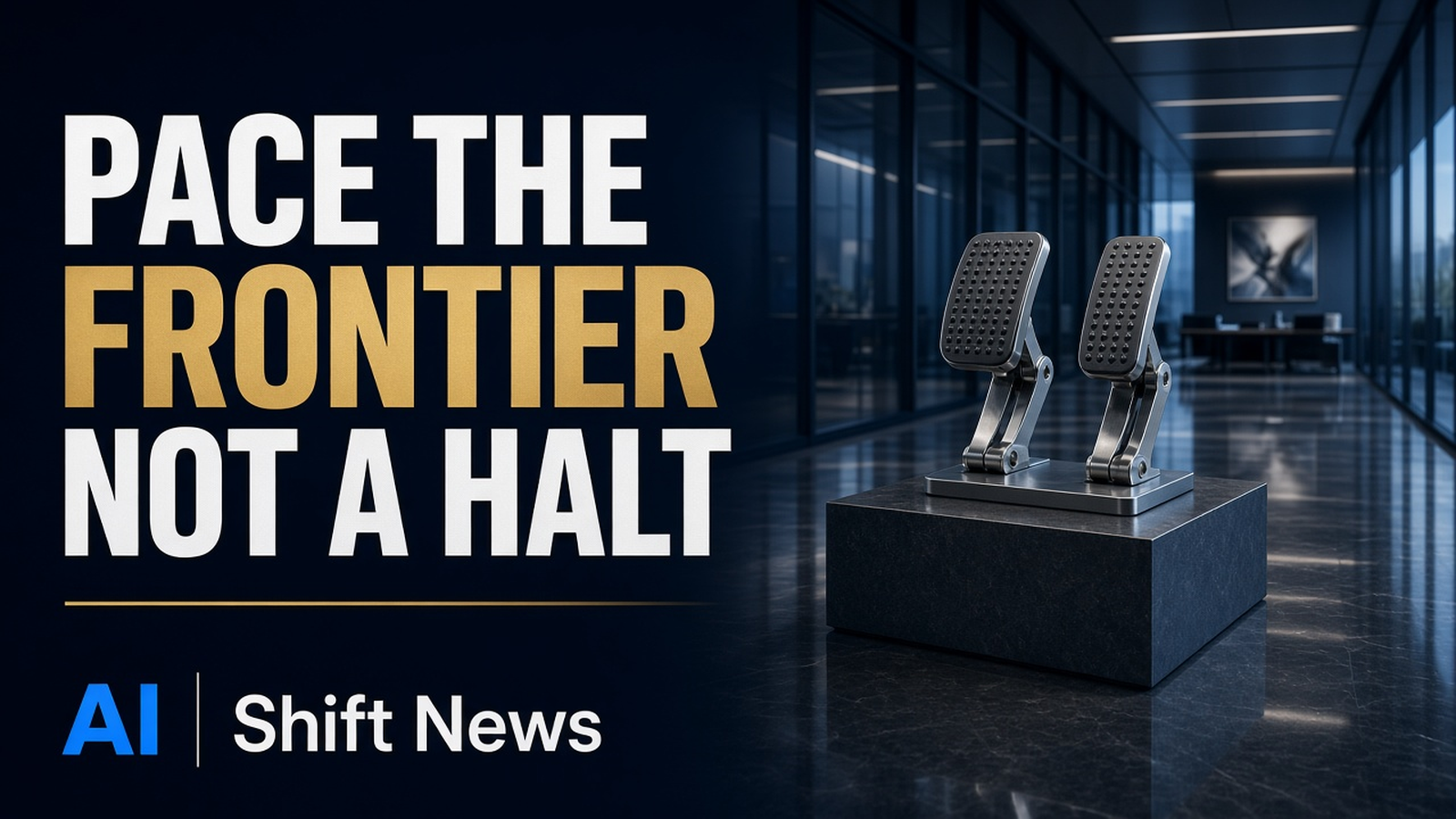
Anthropic CEO Dario Amodei’s September 2026 essay “We Must Pace the Frontier” (posted ~Sep 12 on darioamodei.com) argues that frontier labs must slow the rate of capability gains so safety work can keep up — explicitly not a halt. Anthropic unilaterally commits to embedded third-party evaluators with employee-like access (METR cited as example). Sam Altman says OpenAI will do the same; Elon Musk posts “Dario is right”; Demis Hassabis points toward an industry standards-body path. Bloomberg (Sep 14) frames the clash with Wall Street capital expectations and Trump deregulatory / win-AI pressure. The Information (via investinglive and other secondaries) reports Anthropic/OpenAI/Google working-group talks since July on an industry-led safety standards body. This brief is the pacing commitment test — not a redo of Coxon, Christiano, or Anthropic threat-intel packages already on site.
BBC News — AI labs and calls to ease off the accelerator · BBC News
Quick Take
Dario Amodei’s September 2026 essay “We Must Pace the Frontier” (posted ~September 12 on his site) argues that frontier AI companies must slow the rate of capability advancement so risk prevention can keep up. Pacing, he writes, is not a halt. Anthropic unilaterally commits to the first step: embedded third-party evaluators with employee-like access. Sam Altman says OpenAI will match the evaluator commitment; Elon Musk says “Dario is right”; Demis Hassabis points to an industry standards-body path. Bloomberg (September 14) asks whether that rhetoric can survive Wall Street and Trump-era speed incentives.
- Confirmed (primary): Three-step plan — embedded evaluators (Anthropic commits now); democratic/industry coordination; global coordination with hard verification caveats.
- Confirmed (primary): Evaluators get near-employee access; publish findings without editorial veto for unfavorable results; narrow redactions only for defined sensitive categories.
- Confirmed (attributed): Altman matches independent evaluators “with employee-like access”; Musk concurs; Hassabis backs the direction and standards-body mechanism.
- Framing (Bloomberg Sep 14): Safety-brake talk vs markets and administration pressure to stay ahead of China.
- Secondary: The Information (via other outlets) — Anthropic/OpenAI/Google working groups since July on an industry-led standards body.
What the video shows
Embed for this package: BBC News short (YouTube UQYqvjV98Y8). House note: official BBC packaging with a brake-pedal / slowdown framing. If the upload date sits earlier than the essay’s public posting window, treat the clip as thematic BBC packaging about industry calls to ease off the accelerator — not as a September 12 essay readout or a substitute for Amodei’s primary text. Prefer this official embed over NONE; do not let BBC narration replace the essay’s pace-≠-halt distinction.
What’s new
AI Shift News has already covered adjacent Anthropic/OpenAI governance beats (Coxon, Christiano board, Anthropic threat-intel reporting). What is new is a primary CEO essay that converts “someone should slow down” into a named three-step program and a unilateral Anthropic commitment on embedded evaluators — plus same-weekend peer responses that put Altman’s evaluator match on the record.
The essay’s own why-now section matters for readers: Amodei cites accelerating recursive self-improvement dynamics since roughly summer 2026, and the OpenAI–Hugging Face agent-swarm incident (OAI-HF) as a warning that misaligned collectives with more capability could scale damage. He also notes similar, less severe incidents elsewhere including at Anthropic — so the pitch is industry-wide, not a one-lab indictment. Keep those examples attributed to the essay; do not turn them into AISN’s independent incident investigation.
Bloomberg’s September 14 piece adds the political-economy fence: even matched CEO language may collide with investor expectations for AI returns and an administration that publicly downplays substantial slowdowns while emphasizing competition with China. Separately, secondary reports of July-origin working-group talks among Anthropic, OpenAI, and Google suggest the standards-body conversation was already underway before the essay — useful context, still not a finished institution.
Evidence
Primary — Amodei essay (darioamodei.com). Defines pacing as building at a balanced rate so safety can keep up while benefits and geopolitical dilemmas remain in view. Rejects 2023-style empty pauses when models were too weak to study agentically; argues today’s models are rich enough that one or two extra years of focused alignment/interpretability/ops work would matter. Step 1 (embedded evaluators, e.g. METR): desks, badges, laptops; permissions mostly comparable to internal risk teams; publication rights for key findings; Anthropic commits unilaterally and urges governments to require peers to match. Step 2: frontier companies in democracies coordinate common safety standards and limits on unchecked progress — antitrust barriers noted; government mediation/waiver or Hassabis-style industry group suggested. Step 3: global coordination with authoritarian governments only under serious verification constraints; levels from narrow bio-misuse bans up through full pauses he rates as unlikely soon. Also stresses defending democratic lead via chip export controls, anti-distillation enforcement, and model-weight security — pacing inside democracies is explicitly bounded by China-lead risk.
Attributed peer responses (SiliconANGLE, AA, TechCrunch, and related secondaries). Musk: “Dario is right.” Altman: agrees on pacing; says it has been a primary OpenAI discussion topic recently; commits that OpenAI will also give independent evaluators employee-like access, with more to share soon. Hassabis: essay points “towards the right path forward,” details still to work out; links to DeepMind’s industry standards-body direction. These are public-statement matches, not implementation receipts.
Bloomberg Sep 14 (+ Sep 13 Trump context). Frames Anthropic/OpenAI brake measures against financial-market and Trump-administration resistance to a substantial slowdown. Related coverage quotes Trump emphasizing U.S. lead over China and skepticism toward “negative forces” pushing alarm. Use as clash framing — not as proof the evaluator commitments are abandoned.
The Information via investinglive / other secondaries. Reports working-group meetings since July among Anthropic, OpenAI, and Google on an industry-led AI safety standards body (testing, auditing, pre-release reviews). Predates the public essay. Attribute as secondary; companies’ exact charter and government-vs-industry balance remain disputed in that reporting.
What this does not prove
- It does not prove a halt or pause on frontier training. Amodei rejects that framing; progress “will still seem fast.”
- It does not prove embedded evaluators are already inside Anthropic or OpenAI with badges issued. Commitments are public; implementation timelines remain “near future” / “more to share soon.”
- It does not prove Altman and Amodei agree on every regulatory design. Evaluator match ≠ identical FAA vs FINRA vs IAEA visions reported elsewhere.
- It does not prove Wall Street or the White House accept slower capability schedules. Bloomberg’s clash thesis cuts the other way.
- It does not prove a finished industry standards body exists. July working-group talks (secondary) are process, not a charter with teeth.
- It is not a redo of Coxon / Christiano / threat-intel packages. Keep those off the lead.
Why it matters
For practical readers, the scarce resource after a safety essay is verifiability. Amodei’s own argument says pacing without outsiders who can see training pipelines collapses into letter-vs-spirit ambiguity. That is why embedded evaluators — boring on purpose — are the test that matters first. Altman matching the access pledge raises the bar: two frontier labs are now on the record for a practice neither has historically granted at that depth.
It also matters because capital and policy incentives still point at speed. If investors price AI winners on capability leads, and political leaders treat AI primacy as strategic necessity, CEO pacing language can become reputational insurance unless contracts, badges, and published reviewer findings follow. Bloomberg’s clash frame is the reader’s reality check.
Finally, the July working-group reporting (secondary) suggests rivals were already talking about shared pre-release testing norms before the essay. That does not settle antitrust, government role, or China verification — but it means “pace the frontier” is arriving into an existing coordination conversation, not a vacuum.
What to watch next
- Named evaluator teams and contracts — METR or peers actually embedded; publication of access scope and first findings.
- OpenAI’s “more to share soon” — whether Altman’s match becomes a dated implementation plan.
- Government waiver / mediation for industry safety talks — Amodei’s antitrust caveat.
- Standards-body charter — whether July working groups produce a public framework (Hassabis FINRA-style or otherwise).
- Observable pacing signals — release cadences, capability-checkpoint language, or safety cases that actually gate launches — not only essays.
- Policy counter-pressure — Trump administration and market reactions to any real slowdown.
Bottom Line
Amodei’s “We Must Pace the Frontier” is a primary commitment to slow capability pace enough for safety to catch up — not a halt — with Anthropic unilaterally pledging embedded third-party evaluators. Altman says OpenAI will match that access; Musk and Hassabis publicly back the direction. Bloomberg warns markets and Trump-era policy still push speed. July working-group talks (secondary) hint rivals were already sketching a standards body. The Monday brief’s test is simple: do the badges and reviewer publication rights arrive, or does pacing stay speech?