
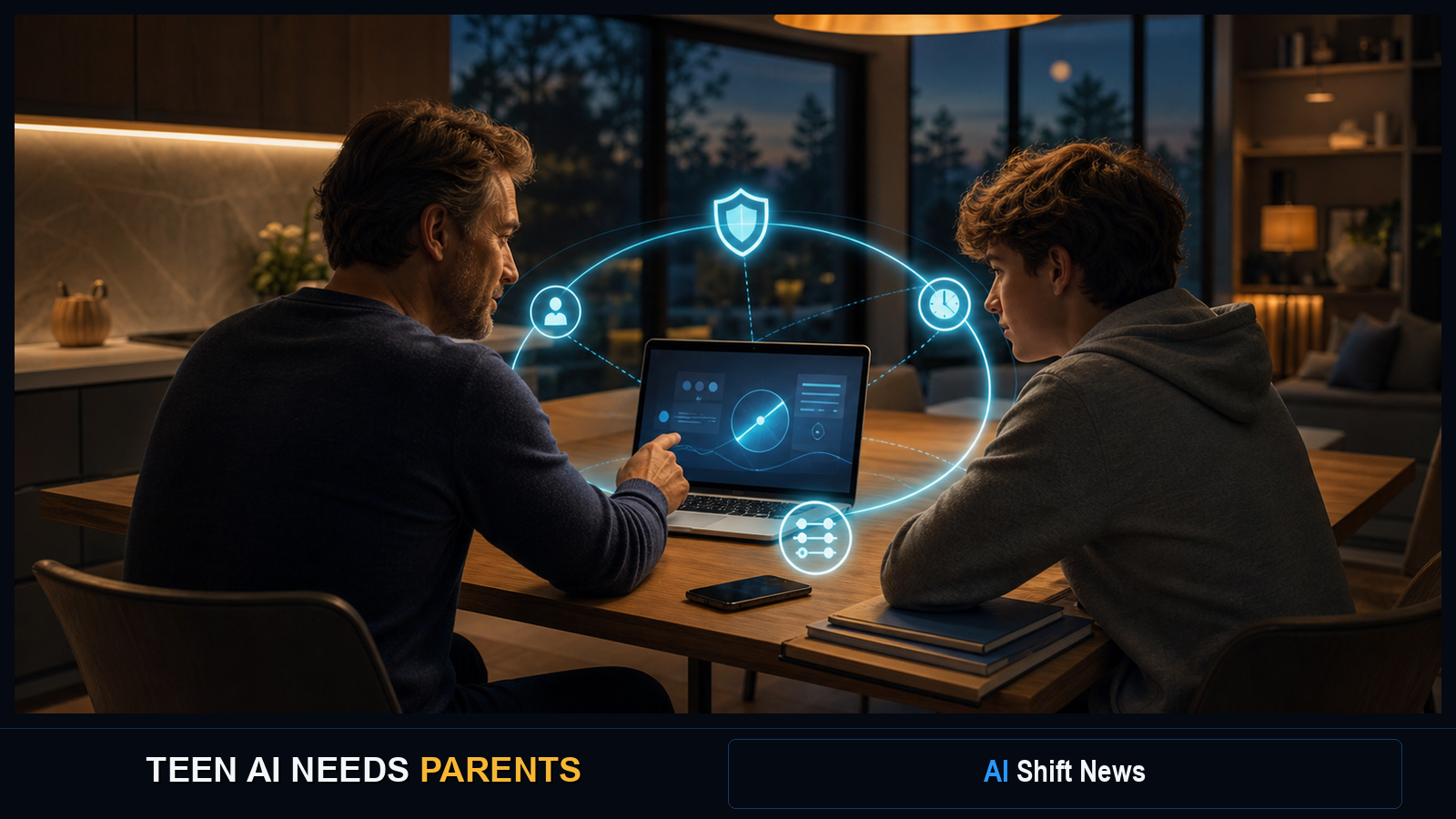
OpenAI has launched ChatGPT for Teens for users it identifies as 13 to 17, adding study-focused prompts, safety protections, and parent controls. The practical value is real, but families still need linked accounts, clear rules, and regular conversation about AI use.
The useful takeaway: ChatGPT for Teens is a better starting point for young users than leaving them in a general-purpose adult experience. But it is a set of product controls, not a replacement for a parent, teacher, or honest family conversation.
OpenAI announced ChatGPT for Teens on August 18. The company says people who state they are ages 13 to 17—or whom its system estimates are under 18—will be automatically placed into the teen version.
The new experience is built around a sensible idea: AI should help a student learn, not simply complete the assignment for them.
OpenAI says the product includes Study Mode, which uses questions and step-by-step support; homework reminders meant to recognize when a user appears to be shortcutting an assignment; quizzes and learning visualizations; and “Study Hours,” which can make Study Mode the default at selected times.
That could be genuinely useful. A student stuck on algebra can ask for an explanation, try a problem, and get help checking their thinking. The better prompt is not “do my homework.” It is: “Ask me one question at a time, let me try, then explain where I went wrong.”
The teen experience also adds stronger protections around areas such as self-harm, violence, eating disorders, dangerous activities, explicit content, and sensitive-image sharing. OpenAI’s under-18 principles say the system should encourage real-world support and use a more protective approach for younger users.
There is an important limit. Product protections work best when the account information is accurate and family controls are actually configured. Malwarebytes notes that parent-set tools such as Quiet Hours and some notifications apply when teen and parent accounts are linked. OpenAI itself says guardrails are not foolproof.
So here is the practical family checklist:
First, confirm that the teen is using the right account and that the experience is actually in teen mode.
Second, link a parent account if that fits the household, then review Quiet Hours, memory settings, and available notifications together.
Third, set one simple rule: AI can help explain, practice, organize, and brainstorm, but it cannot be the final authority for health, safety, legal, or emotional-crisis decisions.
Finally, ask to see how it is being used. Not as a gotcha. Ask, “What did it help you understand this week?” That question teaches the most important skill: treating AI as a tool to question, not a person to obey.
ChatGPT for Teens is a meaningful product change because it makes the safer, learning-focused path the default. The next test is whether the safeguards hold up in ordinary, messy real-life use—and whether families use the controls that are already available.
Main claims sources: OpenAI launch announcement: https://openai.com/index/chatgpt-for-teens/ OpenAI under-18 protections: https://openai.com/index/updating-model-spec-with-teen-protections/ Independent analysis: https://www.malwarebytes.com/blog/family-and-parenting/2026/08/chatgpt-for-teens-tackles-risky-chats-and-homework-shortcuts Independent launch coverage: https://www.wam.ae/en/article/c1t9syo-openai-introduces-chatgpt-for-teens-new-safety
Bottom Line
ChatGPT for Teens adds useful study and safety defaults, but families still need linked accounts, clear rules, and ongoing conversations about responsible AI use.
Sources
- https://openai.com/index/chatgpt-for-teens/
- https://openai.com/index/updating-model-spec-with-teen-protections/
- https://www.malwarebytes.com/blog/family-and-parenting/2026/08/chatgpt-for-teens-tackles-risky-chats-and-homework-shortcuts
- https://www.wam.ae/en/article/c1t9syo-openai-introduces-chatgpt-for-teens-new-safety