
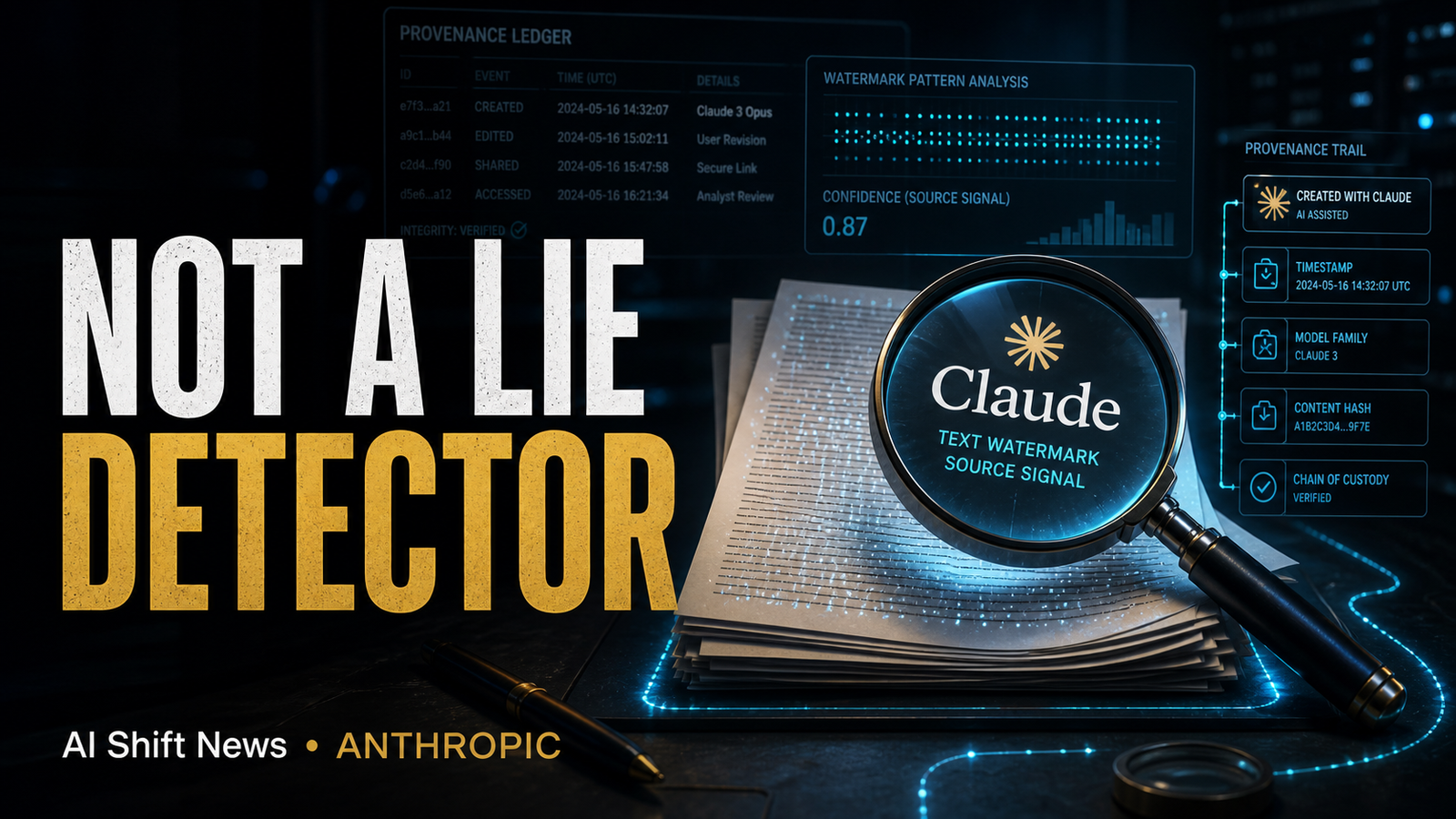
Anthropic published a detailed explanation of how future Claude models will watermark generated text. The company says the watermark uses statistical word-choice patterns, adds no hidden characters, does not identify users or organizations, and cannot determine whether a passage is human-written. For operators, the change is a reason to improve content records—not a reason to trust AI-detection scores blindly.
Anthropic is putting a watermark into future Claude-generated text. The important part is what that watermark can do—and what it cannot.
On August 14, Anthropic explained that future Claude models will use a statistical watermark based on a version of Google DeepMind’s SynthID-Text approach. The company says the mark does not add hidden characters, does not visibly alter the writing, does not add tokens or cost, and does not contain information about an individual user, organization, or chat.
In plain English: Claude can make small, low-stakes choices among reasonable next words in a way that creates a pattern. A party with the right key can test a long enough piece of text for evidence that Claude likely contributed to it.
That is a provenance signal. It is not a lie detector.
A positive result would not prove that Claude wrote every word. Anthropic says it can indicate that Claude was likely involved at some point. A negative result does not prove a person wrote the text. Another model might have created it. The text may be too short. It may have been heavily rewritten. Or there may have been too few flexible word choices for a detectable pattern.
That last point matters more than it first appears.
Watermarking works best when a model has room to choose between several good wording options. It has less room in highly factual material, exact answers, proofreading, and code. If the only correct next token is “4,” the model cannot quietly choose a different plausible word just to maintain a watermark. Anthropic says code will generally contain less watermarking for the same reason.
For a business owner or content operator, do not turn this into another “AI score” obsession.
The useful workflow is to keep your own provenance record. If a team uses Claude to draft, edit, translate, summarize, or brainstorm, document that in the working file or content system. Keep a human reviewer accountable for factual checks, approvals, and final publishing. A watermark may someday help confirm that a model was involved; it does not replace a record of how the work was made.
Anthropic also says it will offer a watermark-detection API in the future, but it has not provided the final implementation details. That means there is no reason to promise customers, schools, publishers, or employees that a universal Claude checker is ready today.
The bigger lesson is simple: provenance is useful, but it is narrower than trust. A watermark can help answer “was Claude probably involved?” It cannot answer “is this true?”, “who is responsible?”, “does this infringe someone’s work?”, or “should we publish it?”
What to watch next: the actual detection API, independent testing for false positives and false negatives, rollout details for older Claude models, and whether other model providers build compatible ways to signal AI involvement.
Bottom Line
This is a more concrete transparency step than a vague “AI detector” promise. Its limits are substantial, especially for short text, factual passages, proofreading, code, and heavily rewritten output.