
 Shift News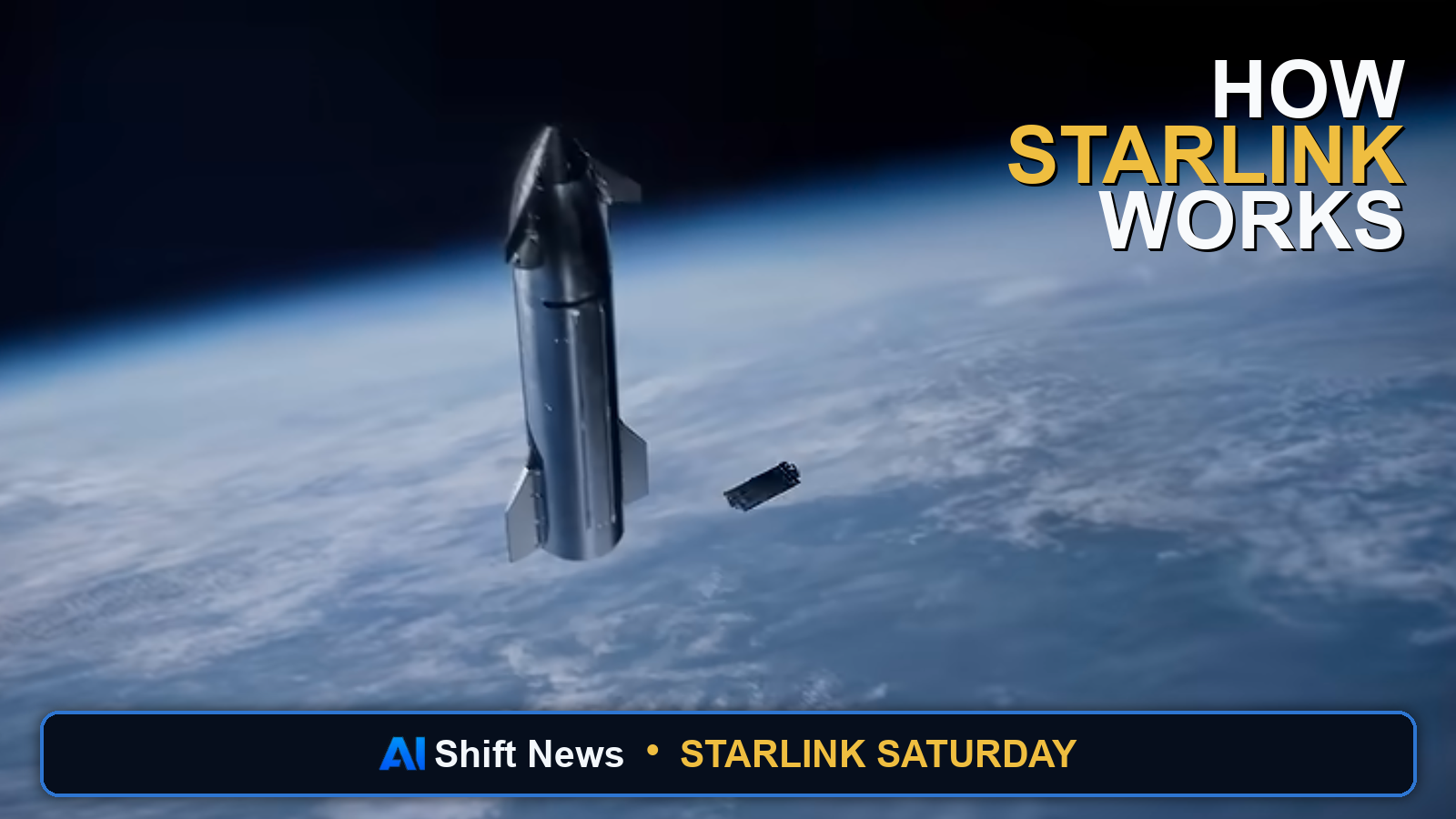
The Space Race maps dish → satellite → gateway — and lasers when Earth blocks the view. LEO physics and company docs are teachable. YouTube headcounts and endgame mythology are not the receipt.
The Space Race — How Starlink Actually Works · The Space Race
What the video shows
The selected clip opens on May 23, 2019 — the first Starlink “train” in the night sky — then compresses constellation growth into a three-piece chain: receiver (“Dishy”), satellite, and gateway. The host contrasts flat phased-array user terminals with older parabolic TV dishes locked to geostationary spacecraft. In the narration, a Starlink terminal electronically steers a radio beam toward a satellite roughly 500 km overhead; the satellite hands traffic to gateway antennas; gateways connect into terrestrial internet. When a single satellite cannot see both user and gateway, the video says the constellation uses lasers between satellites until a gateway is in view. That is a coherent explainer arc. House voice inventories the mechanism, then demotes the leaps.
What evidence supports
Low Earth orbit is the product thesis — company framing. Starlink’s Technology page states traditional geostationary satellite internet sits near 35,786 km with 600+ ms latency, while Starlink satellites orbit about 550 km with latency described around 25 ms. That altitude choice is why a single satellite races across the sky in minutes and why continuous service needs dense relay choreography. Treat ~25 ms / ~550 km as company claim, not an independent AISN lab measurement.
Phased arrays and seamless handoff — company framing. Company materials describe each satellite using multiple Ku-band phased-array antennas for customers and dual-band Ka/E antennas toward the ground network, plus optical inter-satellite links. Starlink’s beam-switching update describes terminals automatically switching among many satellites in view so handoffs stay imperceptible when the sky is clear enough. The Space Race’s “flat dish tracks without mechanically slewing like an old TV dish” story matches that company story at a high level. Exact element counts spoken on camera stay host claim.
Gateways still matter — reporting + physics. Even with a laser mesh, most of the public internet still lives on Earth. SpaceNews and CNBC reported in May 2021 that SpaceX would install Starlink ground stations inside Google data centers so satellite traffic could enter high-capacity terrestrial fiber and cloud networks. Separately, SpaceNews’s 2015 reporting on Google’s ~$900 million SpaceX investment is real history — and it is not identical to the 2021 gateway partnership.
Licensed shells are public — FCC primary. The December 2022 Gen2 Starlink order (FCC-22-91) authorized up to 7,500 Gen2 satellites at 525, 530, and 535 km in a partial grant, with later Space Bureau actions on lower-altitude shells and a January 2026 Gen2 upgrade news release. Those documents prove regulatory permission — not how many satellites are healthy overhead today.
Constellation scale is large — secondary tracker, dated. KeepTrack’s Starlink count page (snapshot attributed Sep 18, 2026) puts on-orbit numbers in the low eleven thousands — useful context beside the host’s rounded “11,000,” still secondary and moving daily.
What it does not prove
- It does not prove every on-camera headcount — live satellite totals, gateway counts, and per-dish element counts stay host packaging unless matched to a dated primary.
- It does not prove laser-vs-fiber percentage advantages as measured fact. Vacuum vs glass physics is real; a specific “~30% New York–London” or “10–100× per beam” claim needs a cited measurement.
- It does not prove a gateway-free internet exists today. “Majority of traffic lives in space” is ambition language — not present architecture.
- It does not prove Direct-to-Cell is full streaming broadband on every phone. That is a different product layer; same-Saturday Mobile thesis coverage owns that fight.
- It does not create investment advice. Launch cadence and Starship payload framing in the video are outside this explain slot.
Why this matters
Starlink headlines now travel in two speeds. Primary speed is slow: FCC shells, company technology pages, gateway partnerships, beam-switching notes. Commentary speed is fast: a night-sky train becomes “the internet moved to space,” and a channel title becomes a finished mental model.
Readers who only need the mechanism can keep a short stack: flat terminal → LEO satellite → gateway (or optical relay until a gateway) → terrestrial internet. Handoffs are continuous because the birds are low and fast. That is enough to understand why Starlink feels different from old GEO service — and why capacity, spectrum, and ground infrastructure still bound what any one user can get.
What happens next
Watch the primaries, not the endgame reel: Starlink Technology and Network Update pages for company capacity framing; FCC Gen2 modification dockets for authorized shells; partner Direct-to-Cell pages when the question is phones rather than dishes. For this locked explainer, AISN’s house stance stays narrow — teach the path, fence the numbers, leave the investment thesis to its own slot.
Bottom Line
Starlink’s path is teachable: dish to LEO satellite to gateway (or laser hops until a gateway), then terrestrial internet. Company docs and FCC shells support that mechanism; YouTube headcounts and “internet entirely in space” endgames are packaging, not the receipt.
Sources
- https://www.youtube.com/watch?v=DW-aL_MiUz4
- https://www.starlink.com/technology
- https://www.starlink.com/updates/network-update
- https://www.starlink.com/ag/updates/starlink-beam-switching
- https://www.starlink.com/public-files/starlinkProgressReport_2024.pdf
- https://docs.fcc.gov/public/attachments/FCC-22-91A1.pdf
- https://www.fcc.gov/document/fcc-approves-next-gen-satellite-constellation
- https://spacenews.com/starlink-teams-up-with-google-for-ground-infrastructure/
- https://www.cnbc.com/2021/05/13/google-cloud-wins-spacex-deal-for-starlink-internet-connectivity.html
- https://spacenews.com/google-spacex-investment-is-900-million/
- https://keeptrack.space/starlink-satellite-count
- https://www.starlink.com/us/business/direct-to-cell