
 Shift News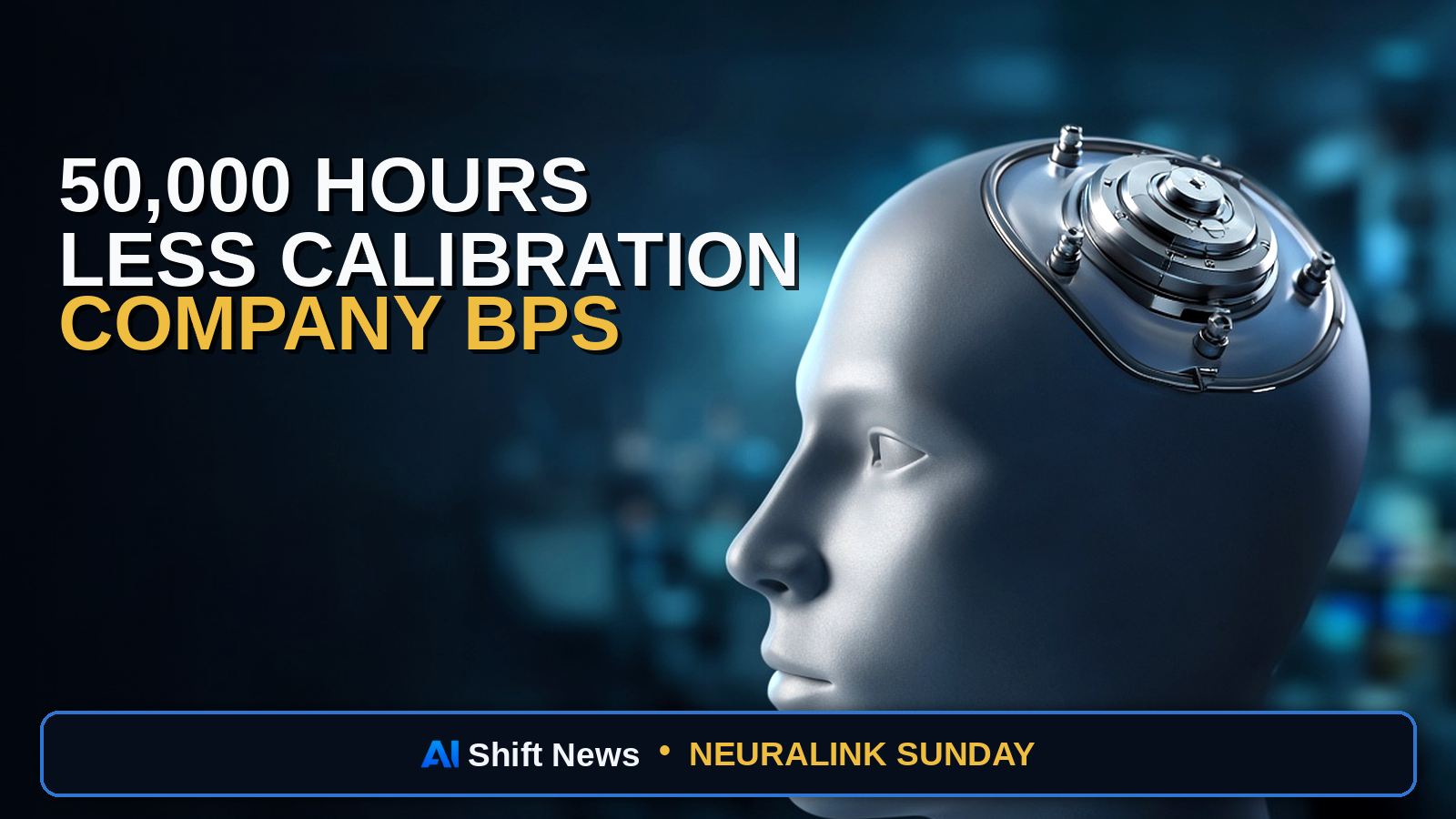
Honest fence (read first): This Neuralink Sunday flagship is Neuralink’s October 1, 2026 company engineering update on pretraining participant-specific neural encoders from unlabeled freeform recordings. Primaries are the Neuralink blog (50,000+ hours streamed since the clinical trial began; first participant alone >9,000 hours) and the company’s own BPS / calibration claims. Devices remain investigational — Neuralink’s footer says they have not been approved by the FDA or other regulators. A company-claimed 11.32 BPS cursor-control peak and “some users toward ~10 minutes of calibration per week” are not peer-reviewed multi-lab benchmarks, not proof every participant got the same cut, and not proof multi-participant pooled foundation models already beat single-participant models in live use (the post says pooled live wins are still missing). Soft-re-cover ban: this is not a redo of Sep 27 VOICE Terry, Sep 27 DJ Seo interview packaging, or the older careers-page “Neural Foundation Models” hiring brief — those pages sold language; this page sells an engineering receipt with numbers. Embed: Entrelligence JQQjX6E-vtk (Oct 3). Alt short: Beam42 Ht1dHGs5eQ0.
Entrelligence — “Neuralink Is Training AI on Human Brain Recordings” (published October 3, 2026). Visual match for the Oct. 1 engineering post. BPS and calibration figures cite Neuralink’s blog, not the YouTube title.
Editorial Thesis
The scarce file for practical readers is not “Neuralink invented AI for brains.” It is that after two years of trial use, Neuralink says it finally put the unused freeform spike stream to work as self-supervised pretraining, and the company links that change to longer-lived decoders, less daily calibration theater, and a new internal BPS high. Claim vs proof stays sharp: company blog + participant quotes inside that blog vs independent clinical publication.
Honest Verdict
Believe the company engineering narrative as packaging of what Neuralink wants operators and candidates to understand: unlabeled hours → participant-specific encoders → steadier embeddings → decoders that last longer and, for some users, need far less weekly calibration. Treat 11.32 BPS and median-about-10 as Neuralink’s own cursor test framing, with the post itself noting cross-lab BPS tasks compare loosely. Prefer the investigational disclaimer and the open questions (pooled models, consent for everyday recordings, peer review) over “BCI problem solved” thumbnails.
What the primary card actually says
Neuralink blog — Pretraining on 50,000 Hours (Oct 1, 2026)
- Trial participants have streamed over 50,000 hours of unlabeled freeform neural data; first participant alone >9,000 hours / ~22.4 billion spikes.
- Until recently nearly all of that stream went unused; decoders leaned on short labeled calibration sets.
- Participant-specific encoders pretrained on each person’s own hours turn noisy spikes into stabler embeddings for decoding.
- Users previously averaged about 55 minutes/week calibrating; some now described as closer to 10 minutes/week.
- Six participants set personal BPS records; three beat prior 10.39; one (P15) reached 11.32 BPS — company-called BCI record.
- Some decoders stayed strong >3 weeks; one case of usable control from a calibration >20 months old is shown as an extreme longevity example.
- Live results in the post came from single-participant pretraining; multi-participant pooled models have not yet beaten single-participant counterparts online.
- Roadmap language: pooling brains, one-shot / zero-shot calibration goals, “API for the motor cortex.”
- Explicit investigational / not FDA-approved disclaimer at the end of the article.
Why this is today’s Neuralink Sunday flagship
AI Shift News already told readers the careers page was selling foundation-model hiring language. The Oct 1 post is the first company engineering memo that attaches hour counts, calibration minutes, and BPS to that thesis. Cover the receipt. Fence the verdict.
Human review risks
- Collapsing company BPS into a universal scientific ranking against other implants/species tasks.
- Implying FDA clearance or commercial availability.
- Soft-re-covering VOICE speech demos as if they were this story.
- Over-claiming multi-user foundation-model wins the post itself withholds.
Bottom Line
Believe the company engineering narrative as packaging of what Neuralink wants operators and candidates to understand: unlabeled hours → participant-specific encoders → steadier embeddings → decoders that last longer and, for some users, need far less weekly calibration. Treat 11.32 BPS and median-about-10 as Neuralink’s own cursor test framing, with the post itself noting cross-lab BPS tasks compare loosely. Prefer the investigational disclaimer and the open questions (pooled models, consent for everyday recordings, peer review) over “BCI problem solved” thumbnails.