
 Shift News
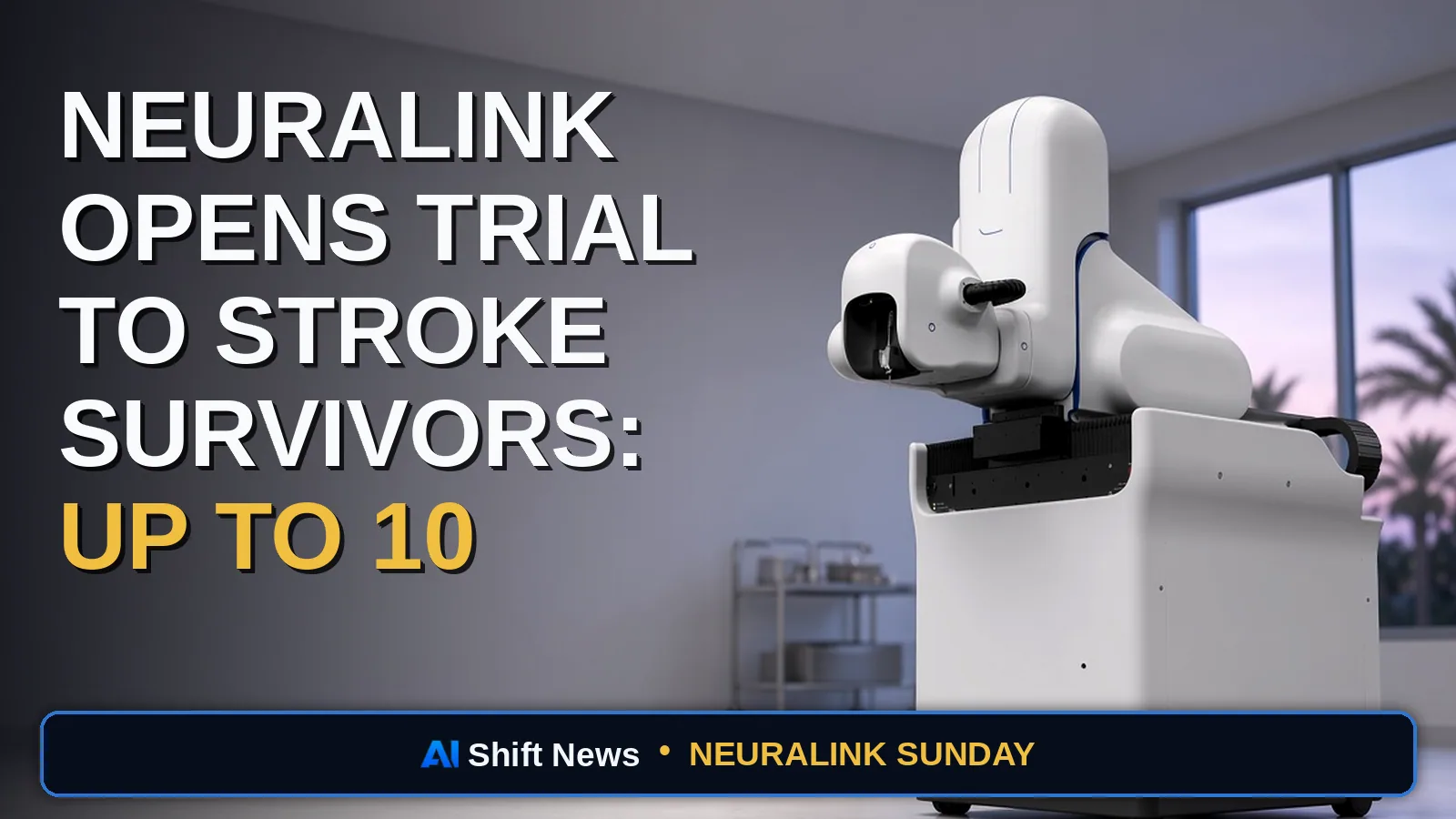
Bradford Smith | Neuralink P3 | Future Link Pod: "Neuralink Opens a New Trial to Stroke Patients | Neuralink This Week, Ep. 4". Facts on this page cite the primary sources below, not the video.
The claim: Neuralink is now treating stroke.
The proof: On Tuesday, Nov. 10, 2026, ClinicalTrials.gov posted PRIME2 (NCT07929792), a new Neuralink early feasibility study. It enrolls adults with ALS, spinal cord injury or chronic ischemic stroke whose arms and hands are so weak they can't use a computer or phone on their own. It plans up to 10 participants at up to 5 U.S. sites. The University of Miami is the only site listed so far, and it is recruiting. Participants would use the N1 implant to move a cursor or type on a virtual keyboard. That is a registered trial, not a treatment. Nobody has been implanted in it yet, and it does not try to make a weak arm move again.
Editorial Thesis
The new part is who can apply. Neuralink's first U.S. study, PRIME, was for people with severe quadriplegia from spinal cord injury or ALS, aged 22 to 75. PRIME2 adds people living with the after-effects of a chronic ischemic stroke and opens the age range to adults 18+, with no upper age limit. Stroke is far more common than either ALS or spinal cord injury, so this is a bigger potential patient group. But the job of the study is narrow: is the implant safe, and can people use it to control a computer?
Honest Verdict
- Confirmed (ClinicalTrials.gov record): PRIME2, protocol N1-EFS-300, first posted Nov. 10, updated Nov. 11 (posted Nov. 12). Status: recruiting. Up to 10 participants, up to 5 U.S. sites, University of Miami listed (principal investigator Jonathan Jagid, MD).
- Confirmed (record): the N1 implant goes in the motor cortex, placed by the R1 surgical robot. Participants control a computer cursor or virtual keyboard.
- Confirmed (record): the main measure is serious adverse device effects from surgery through the 90-day visit. People are followed for about 2 years (about 3 with extended follow-up). Estimated start November 2026; primary completion November 2027. There is no comparison group.
- Reported (Inside BCI): the first version of the listing required the stroke to have happened at least 12 months before screening and spelled out a hand-dexterity test. The Nov. 11 version shortened the eligibility section to a one-line summary and short lists.
- Not shown: any PRIME2 implant, result, or restored arm movement. Neuralink hasn't said why it added stroke.
What the listing actually says
| PRIME (first U.S. study) | PRIME2 (posted Nov. 10) | |
|---|---|---|
| Conditions | Spinal cord injury, ALS | Spinal cord injury, ALS, chronic ischemic stroke |
| Ages | 22-75 | 18+, no upper limit |
| Size | 15 (estimated) | Up to 10 |
| Sites | Phoenix, Miami | Up to 5 U.S. sites; Miami listed |
| What participants do | Control a computer by thought | Cursor or virtual keyboard by thought |
| Main safety measure | Adverse events at 12 months | Serious device effects through 90 days |
Exclusions in the current listing include a body mass index over 40, poorly controlled seizures, needing MRI for an ongoing condition, a prior brain implant, and blood thinners that can't be paused for surgery.
Why stroke matters here
A stroke can leave one arm weak for good. For many survivors, that means typing, swiping and texting get hard or impossible. PRIME2 is testing whether reading movement signals from the brain can give those people back control of a computer or phone. It is not testing whether the implant can make the weak arm move again. Those are very different promises, and only the first one is in this study.
Stroke isn't brand new to Neuralink's paperwork. Its UK and UAE computer-control studies list brainstem stroke, a rarer kind that can paralyze all four limbs, and its U.S. speech study, VOICE, lists stroke for people who can't speak. PRIME2 is the first U.S. computer-control study to take stroke survivors, and the first listing built around chronic ischemic stroke, the common kind that often weakens one side.
What this does not prove
- It does not prove the implant helps stroke survivors. The study hasn't started implanting yet.
- It is not FDA approval. The N1 is investigational.
- It does not test restoring arm or hand movement.
- It does not mean every stroke survivor qualifies. The criteria are strict and doctors make the final call.
- It does not change Neuralink's last official participant count, which was 21 on its website in January 2026.
What to watch next
- More PRIME2 sites added beyond Miami (the listing allows up to five).
- The first PRIME2 implant, and whether the first participant has a stroke, ALS or spinal cord injury.
- Any Neuralink explanation of why it added stroke and changed the eligibility text.
- The 90-day safety readout, which the record targets for completion in November 2027.
Bottom Line
PRIME2 is real and recruiting: up to 10 adults, up to 5 U.S. sites, and, for the first time in a U.S. Neuralink computer-control study, stroke survivors. It is a small safety study about using a computer by thought. It is not a stroke cure, not an approval, and not a promise to move a weak arm again.
Source notes
Trial details from the ClinicalTrials.gov records for PRIME2 (NCT07929792) and PRIME (NCT06429735), read through the registry's API on Nov. 15 at about 5:00 AM ET. Version history from Inside BCI (Nov. 13). Video: Neuralink participant Bradford Smith's weekly roundup, "Neuralink This Week, Ep. 4" (Nov. 11), with PRIME2 at 0:42. It's a participant's news show, not an official Neuralink video. Alternate: Pre-IPO TV's Nov. 12 explainer on how Neuralink patients use computers.
Sources
- ClinicalTrials.gov NCT07929792 (PRIME2, protocol N1-EFS-300; read via API Nov. 15 ~5:00 AM ET): first posted Nov. 10 2026, last update posted Nov. 12; recruiting; up to 10 participants at up to five U.S. sites; University of Miami (PI Jonathan Jagid, MD) recruiting; adults 18+ with ALS, spinal cord injury or chronic ischemic stroke and severe arm/hand weakness; cursor or virtual keyboard control; primary outcome serious adverse device effects through the 90-day visit; ~2 years follow-up (~3 extended); est. start Nov. 2026, primary completion Nov. 2027; no comparison group
- ClinicalTrials.gov NCT06429735 (PRIME, Neuralink's first U.S. study): severe quadriplegia from spinal cord injury or ALS; ages 22-75; Phoenix and Miami
- Inside BCI (Nov. 13 2026): version history — first version (cleared QC Nov. 5, posted Nov. 10) required a chronic ischemic stroke at least 12 months before screening plus a Nine-Hole Peg Test threshold and motor-cortex exclusions; Nov. 11 version shortened eligibility; Neuralink's last website count 21 participants (January 2026)
- ClinicalTrials.gov GB-PRIME (NCT07127172) and UAE-PRIME (NCT06992596): conditions include brain stem stroke (read via API Nov. 15)
- TeslaNorth (Nov. 10 2026): PRIME2 posted and recruiting; up to 10 adults; no completed implants or results reported
- Bradford Smith (Neuralink participant 3), 'Neuralink This Week, Ep. 4' (Nov. 11 2026, 3:47): PRIME2 segment at 0:42 — participant-run news roundup, not a Neuralink channel