
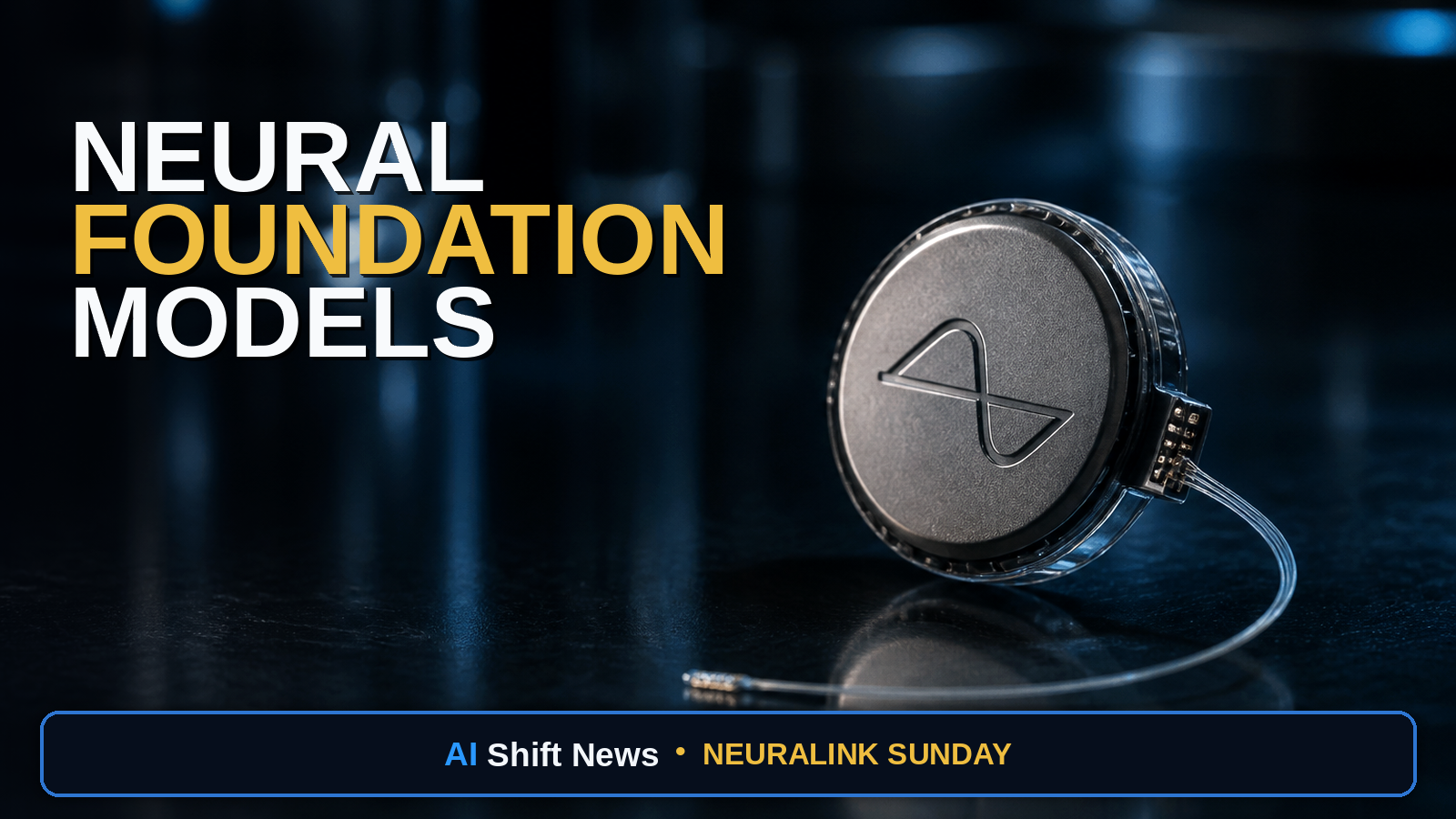
Neuralink’s careers page now pitches machine-learning work as “foundation models that directly decode neural signals instead of text,” alongside the implant and surgical robot. Neura Pod’s August 2026 update highlights that hiring language and pairs it with Neuralink President DJ Seo’s earlier Sequoia remark that, even at roughly 20 participants, the company sees early results fine-tuning transformers on neural data. N1 remains investigational. This package is about a data-scale hiring thesis — not a new implant demo, and not a rehash of Audrey’s mind-art clip.
Neuralink Update — August 2026 (Neura Pod) · Neura Pod — creator monthly update, not Neuralink official
What the video shows
Required embed for this package: Neura Pod — “Neuralink Update — August 2026” (YouTube aZvjdUYL0UA). House note: this is a creator monthly update, not an official Neuralink channel upload. Use it for the careers-page walkthrough and the Seo neural-foundational-model clip context.
Do not lead on Audrey. The same video includes Neuralink’s August post about Audrey (Patient P9) creating art with her mind. AI Shift News already covered that Aug 30. For this package, the flagship beat is careers ML language + data-scale / foundation-model framing. Mention Audrey only if needed as “also in the monthly wrap — already covered,” then return to the hiring thesis.
Supporting (optional deep link, not the primary embed): DJ Seo at Sequoia — by7Y9KoErTw (May 28; older testimony). Chronology: Seo’s ~20-participant foundational-model remarks pre-date the August careers packaging Neura Pod highlights; they support the claim, they are not an August product launch.
What’s new
What is newsworthy for Neuralink Sunday is not another surgery montage. It is that Neuralink’s careers surface now markets ML work the way frontier labs market LLMs: foundation models, but trained to read neural signals rather than tokens of text. Neura Pod flags that section as the long-term tell — implant and robot are the hardware stack; the ML block is the bet that scale of neural data becomes a model advantage.
That framing matches Seo’s Sequoia argument as summarized by Orply: AI was “central to the origin story”; the bottleneck is bandwidth between human cognition and machine capability; the eventual ceiling he described is direct, high-fidelity transfer of concepts — computing on “raw intent” instead of translating thought into keyboard, mouse, and language. Scale is the hinge. Without it, the idea sounds impossible; with it, Seo suggested, some outcomes start to look inevitable. Even at a tiny ML scale of ~20 participants, he said the company is already fine-tuning transformers on neural data and seeing non-obvious structure.
Readers should hear the difference between hiring language + early internal results and a shipped, evaluated foundation model. The careers page is what Neuralink wants applicants to build toward. Seo’s clip is testimony that experiments have started. Neither is a peer-reviewed model card, a public benchmark suite, or a new N1 implant demo.
Evidence
Careers page (primary company). Neuralink.com/careers presents tracks around the implant (enclosure, battery, electronics, threads), the surgical robot, and machine learning. The ML pitch, as quoted in Neura Pod’s August update and consistent with the live careers framing: decode intent in milliseconds; foundation models that directly decode neural signals instead of text. That is documented recruiting copy — confirmed as messaging, not as performance claims.
Neura Pod August 2026 (creator primary for packaging). The blog and video summarize the careers overhaul, reproduce the Seo foundational-model quote, and situate ML beside implant and robot. Neura Pod also covers Audrey mind-art, Brad’s ALS speech, Ice Bucket archival clip, Grok Bot long-term essay, skull-drill explainers, and employee/social metrics (LinkedIn page employees ~711; patient table still “27+” in that wrap). For this article, only the careers + Seo / foundation-model thread is the lead evidence chain.
DJ Seo / Sequoia (supporting testimony; older). Orply’s article on the Sequoia conversation records Maguire’s “over 20 human patients” and Seo’s “20 or so participants” foundational-model line: SOTA LLM or transformer networks fine-tuned with neural data; interesting / counterintuitive patterns; “scale is key.” Seo also framed the harder ML problem: neural data is not automatically labeled; knowing “true intent” for supervision is itself an engineering problem. Those are attributed remarks, not independent measurements.
Investigational status (confirmed fence). Public Neuralink patient work (Telepathy / N1) remains investigational under trial supervision. Careers language does not change regulatory status. Approximate participant counts in talk tracks (~20 / 20+ / Neura Pod’s 27+ table) are public approximations — useful for “still small by ML standards,” not a substitute for registry data.
What this does not prove
- It does not prove Neuralink shipped a neural foundation model. Careers copy describes the job. Seo describes early fine-tuning results. Neither is a public model release with evals.
- It does not prove generalization across participants, tasks, or time. “Interesting patterns” at ~20 people is an existence hint, not a claim that one model transfers cleanly person-to-person.
- It does not prove thought→AI bandwidth is inevitable or near-term product. Seo’s bandwidth / exocortex framing and Maguire’s “think into Grok” prompt are ambition and analogy. Keep them attributed.
- It does not prove Neura Pod’s Grok Bot alignment essay is Neuralink policy. The creator update argues long-term brain↔Grok piping as alignment. That is Neura Pod packaging and hype context — not a confirmed Neuralink product roadmap item for this draft.
- It is not a new implant demo and not an Audrey redo. Do not rewrite this flagship as PRIME patient art or a surgery clip package. Hardware status is background; the news is the ML hiring thesis.
- It does not clear N1 for commercial use. Investigational remains the operative word.
Why it matters
For practical readers, “foundation models” on a BCI careers page is a tell about where the competitive race is moving. Implant channel count and surgical robotics still matter — Neura Pod and Seo both stress vertical integration and the robot as scale infrastructure — but the ML framing says the scarce resource Neuralink wants talent for is learning systems over neural data, not only better thread insertion.
That matters because BCI decoding has historically been brittle: per-patient calibration, session drift, and interfaces that still dump intent into cursors and keyboards. If transformer-style models trained across a growing participant fleet can skip some of that translation layer, the product story changes from “assistive mouse” toward “intent interface.” Seo’s Sequoia remarks make that ambition explicit: the breakthrough is computing on raw intent, not polishing legacy UI mappings.
It also matters as an honesty check against hype. Twenty-ish participants is enormous for invasive BCI history and tiny for foundation-model lore. Seo said so himself by stressing scale. Treating early fine-tuning results as ChatGPT-for-thoughts would mislead readers who need medical-device reality: surgery risk, investigational limits, labeling hard problems, and no public proof of cross-person generalization.
Competitive context stays narrow. Peers are racing on implants, speech, and everyday-device control. Neuralink’s public differentiator in this package is not a new FDA letter — it is that the company’s own hiring page now speaks fluent foundation-model dialect about neural decoding. That is signal for engineers and investors watching AI×BCI; it is not a finished decoder product review.
What to watch next
- Any primary Neuralink technical disclosure — papers, model cards, or trial updates that name foundation-style decoders with measurable metrics (not only careers adjectives).
- Participant / data scale — whether public patient counts and multi-site trial footprints move in a way that makes cross-person training credible.
- Labeling / intent supervision — concrete methods for cleaning neural data so “true intent” is not a hand-wave (Seo flagged this as central).
- Careers vs. product pages — whether neuralink.com/technology or trial materials start echoing the foundation-model line outside recruiting.
- Keep Audrey / speech demos as separate packages — patient capability clips remain important Neuralink Sunday material; they are not this careers/ML beat.
Bottom Line
Neuralink’s careers page now sells neural foundation models that decode signals instead of text — a data-scale hiring claim sitting next to the implant and surgical robot. DJ Seo’s ~20-participant Sequoia remarks are supporting testimony that early transformer fine-tuning on neural data is underway. N1 is still investigational. That is a real Neuralink Sunday story about where the company wants ML talent to aim. It is not a new implant demo, not proof the models already generalize, and not Neura Pod’s Grok Bot alignment essay promoted to fact.