
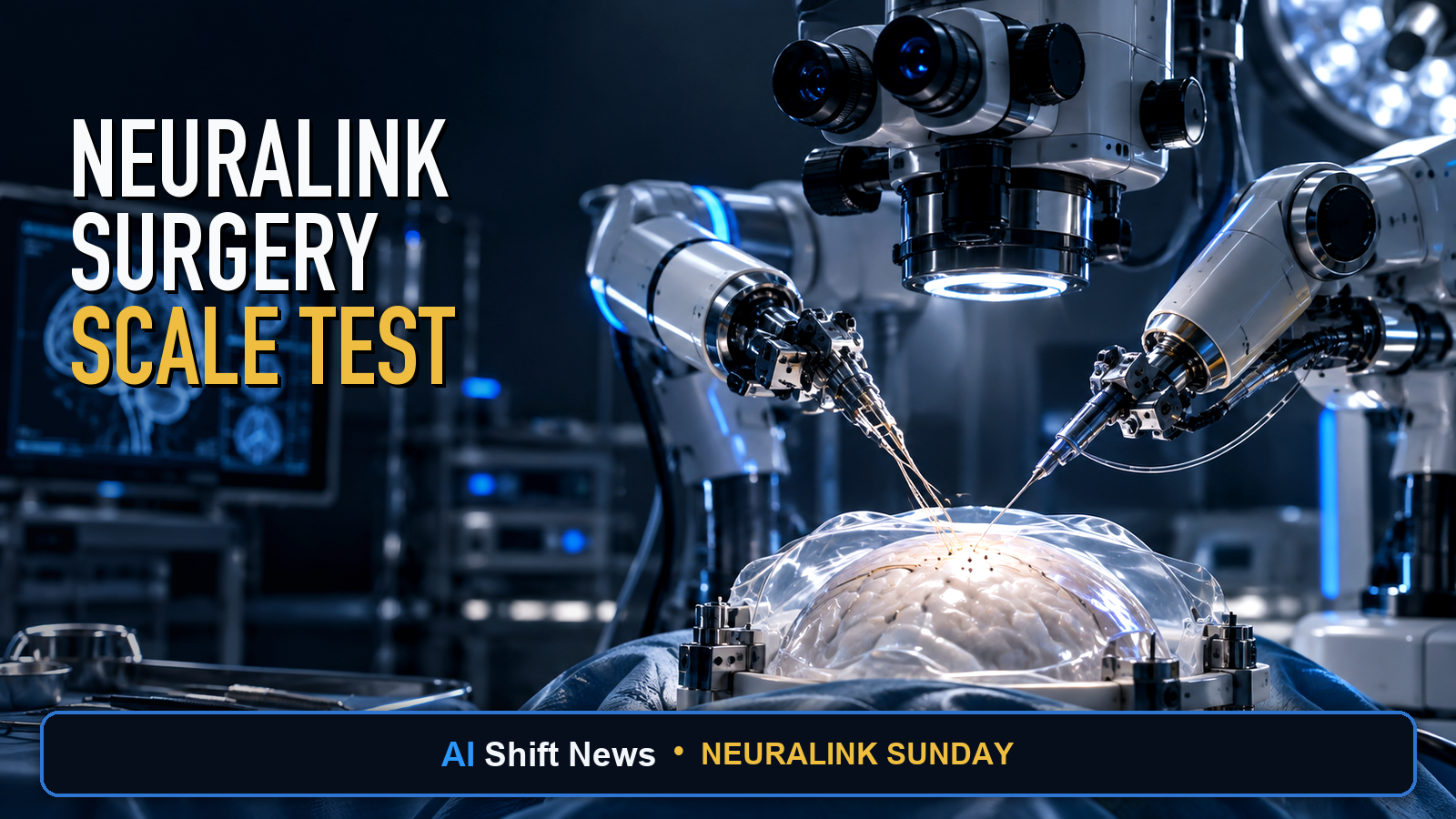
Neuralink says it completed its first human transdural N1 implant on May 20, 2026 at Toronto Western Hospital in the CAN-PRIME trial—threading electrodes through an intact dura instead of cutting it open. That is a real process change. It is not, by itself, proof that surgery is safer, that the craniotomy is gone, or that the company can scale clinical benefit.
Our First Transdural Procedure | Neuralink · Neuralink
Quick Take
- May 20, 2026 at Toronto Western Hospital: Neuralink reports the first human N1 implant with electrode threads inserted through an intact dura (CAN-PRIME pathway; Dr. Andres Lozano’s team).
- Company framing: removing the durotomy takes out a delicate manual step and supports a safer, more repeatable path to scale.
- Evidence fence: one procedure does not prove population-level safety improvement, FDA/Health Canada “safer” clearance, removal of the craniotomy, or scalable clinical benefit.
- Primary surfaces for this pack: Neuralink trials page, ClinicalTrials.gov PRIME listing NCT06429735, NeuroFounders process analysis, ALS News Today secondary clinical reporting, and Neuralink’s official procedure video.
What actually changed in the OR
For earlier Neuralink implants described in company materials, the surgical sequence included opening the dura—the tough membrane under the skull—so the R1 robot could visualize cortex and place electrode threads thinner than a human hair. On May 20, 2026, as part of ongoing clinical trials at University Health Network’s Toronto Western Hospital, Neuralink says that sequence changed: the robot inserted threads through the dura while leaving that membrane intact.
Neuralink’s June 30, 2026 public packaging (including the official YouTube video Our First Transdural Procedure) frames the dura as the brain’s armor and presents intact-dura insertion as a leap toward faster, less invasive surgery. Engineers describe thicker insertion needles that can penetrate without bending, plus optical systems meant to locate vessels and estimate depth when the membrane still hides the cortex. Secondary reporting from ALS News Today and NeuroFounders places the case with Dr. Andres Lozano’s neurosurgery team at Toronto Western and ties it to Neuralink’s Canadian trial pathway.
Readers should keep the anatomy ladder straight. Skipping a durotomy is not the same as skipping skull access. NeuroFounders’ July 2026 analysis is explicit that the transdural method does not eliminate the craniotomy: surgeons still remove a section of bone to reach the insertion site. Anesthesia risk, incision infection risk, and recovery from bone opening remain part of the patient pathway. The process win Neuralink is advertising is narrower—and more honest when stated narrowly: standardize or remove one delicate membrane-cutting step, not magically convert brain surgery into a bloodless outpatient procedure.
Company claims versus what one case can prove
Neuralink’s language connects the technique to scale. In company posts and video narration, preserving the dura instead of removing it is positioned as a massive step toward surgeries that are safer, more repeatable, and workable for more people who could benefit. That is a coherent engineering thesis. It is not the same object as a completed safety study.
A first-in-human process success can demonstrate feasibility under trial conditions. It cannot, alone, demonstrate:
- lower rates of infection, cerebrospinal fluid leak, hemorrhage, thread misplacement, or revision compared with prior technique;
- a regulator’s determination that the method is categorically safer;
- that functional outcomes—cursor control, communication, daily independence—improve because the dura stayed intact;
- that robot, needle, and optics performance generalizes across skull geometry, dural thickness, vascular patterns, and disease states.
Company and secondary coverage say the participant controlled a computer cursor within about an hour of surgery and that recovery progressed as expected. For AI Shift News, that remains a case narrative from Neuralink and clinical partners—not a peer-reviewed, controlled efficacy endpoint that settles the method’s clinical value. Early BCI demos can be real and still leave the hard questions—durability, infection, signal stability, caregiver burden—open.
Why the dura forced a robot redesign
NeuroFounders’ process reporting is useful because it separates motive from marketing. An intact dura creates three practical problems: it hides cortical vessels the threads must avoid; it can be thicker than the threads themselves; and the brain moves continuously beneath it, so the insertion target is not a fixed point in space. Neuralink’s public engineering story is that the old needle geometry could not reliably penetrate, so diameter increased; new optics were built to see through or around the membrane’s obscuring effect; and the surgical robot itself had to change.
That reads less like a miracle and more like a manufacturing problem. If Neuralink’s bottleneck is surgical throughput and consistency, transdural insertion is a scaling test: can the stack hit cortex safely enough, often enough, that operating-room time and surgeon craft stop being the limiter? If the bottleneck is long-term electrode performance, immune response, or software decoding, then skipping a membrane cut may be necessary theater for scale without being sufficient for outcomes patients care about.
Matthew MacDougall, Neuralink’s head of surgery, called the May case the most cutting-edge version of the surgery the company had performed. That quote is useful as internal ranking of technique maturity. It is not independent evidence that risk fell for patients as a class.
Trial paperwork without the blur
Neuralink’s trials page remains the company front door for patient registry interest and study overviews. ClinicalTrials.gov listing NCT06429735 (PRIME) is a primary U.S. study record in the same implant program family and belongs in any evidence-first source set. ALS News Today’s coverage also points to CAN-PRIME (NCT06700304) for the Toronto Western Canadian pathway. Those identifiers should stay labeled separately. Shared device branding does not make protocols interchangeable, and Sunday readers should not be trained to treat every Neuralink acronym as one trial.
As of the sources used for this pack, the honest regulatory posture is ongoing investigational implant experience under authorized trials—not a completed pivotal proof package and not a broad commercial claim that regulators have stamped a new “safer” standard of care. Health Canada’s earlier authorization of CAN-PRIME made Canada an important early non-U.S. site; that authorization history is not the same as a 2026 verdict that transdural technique is approved as categorically superior.
How to read participant stories without hype
Canadian and BCI-trade coverage has identified the May 20 participant in public reporting as an ALS patient in the CAN-PRIME pathway, with additional biographical detail appearing in mainstream Canadian outlets after Neuralink’s late-June announcement window. For this editorial package, the lead remains the surgical process, not a patient profile. Clinical dignity and house voice both point the same way: use named personal detail only when a cited source already published it and only when it clarifies trial context—not as emotional proof that the method works for everyone.
Early cursor control after implant is impressive when true. It is also the kind of moment companies put in launch videos. AI Shift News separates that moment from the longitudinal questions that decide whether a BCI is a research success or a durable assistive technology: months of signal quality, revision surgery rates, infection surveillance, caregiver load, and whether benefits survive outside a lab demo.
Evidence fences locked for Neuralink Sunday
- Do not claim proven safety improvement from one procedure.
- Do not claim FDA (or Health Canada) approval of transdural technique as a finished safety verdict.
- Do not claim the craniotomy is gone.
- Do not claim scalable clinical benefit is demonstrated.
- Do attribute “safer,” “more repeatable,” and “path to scaling” language to Neuralink (and attributed paraphrases in secondary press) as company claims.
- Do treat the official video as primary company packaging—valuable, on-theme, and still not independent adjudication.
What would move the story from process to proof
Useful next evidence is cumulative, not cinematic. More transdural cases with complication rates compared against prior technique. Peer-reviewed or registry-style outcome reporting with clear denominators. Explicit labeling of which protocol each patient sits under. Independent neurosurgery commentary on whether intact-dura insertion changes real risk tradeoffs in practice—especially vessel avoidance when optics must work through or around membrane. Transparency about failure modes: aborted insertions, converted durotomies, thread breakage, or unexpected CSF issues.
Until that stack exists in public, the accurate headline is the one on this page: a scaling test inside a trial, not a safety stamp.
How this fits the rest of Neuralink’s public story
Neuralink Sunday coverage this year has already touched careers-page “neural foundation models,” wheelchair demos, participant counts, and voice-study packaging. Those stories answer different questions—data scale, assistive demos, enrollment optics. The May 20 transdural case answers a narrower one: can the company change the OR sequence in a living human under trial rules? Keeping that distinction matters for novelty and for readers who would otherwise hear every Neuralink post as the same breakthrough loop.
Official video packaging is still the right embed for this angle because it shows the company’s own mechanism explanation—dura model, needle redesign, robot insertion—without pretending the film is a regulatory dossier. Pair it with ClinicalTrials.gov and secondary clinical reporting, and the house-voice job is done: process confirmed in company and press accounts; verdict withheld.
Bottom Line
Neuralink’s first human transdural implant is a legitimate Neuralink Sunday flagship because it changes how electrode threads reach cortex and because the company is openly betting that process change unlocks scale. The bet may eventually be right. On the public record used here, safety improvement, regulatory blessing of a new standard, and population-level clinical benefit remain unproven. Cover the OR advance. Fence the verdict.