
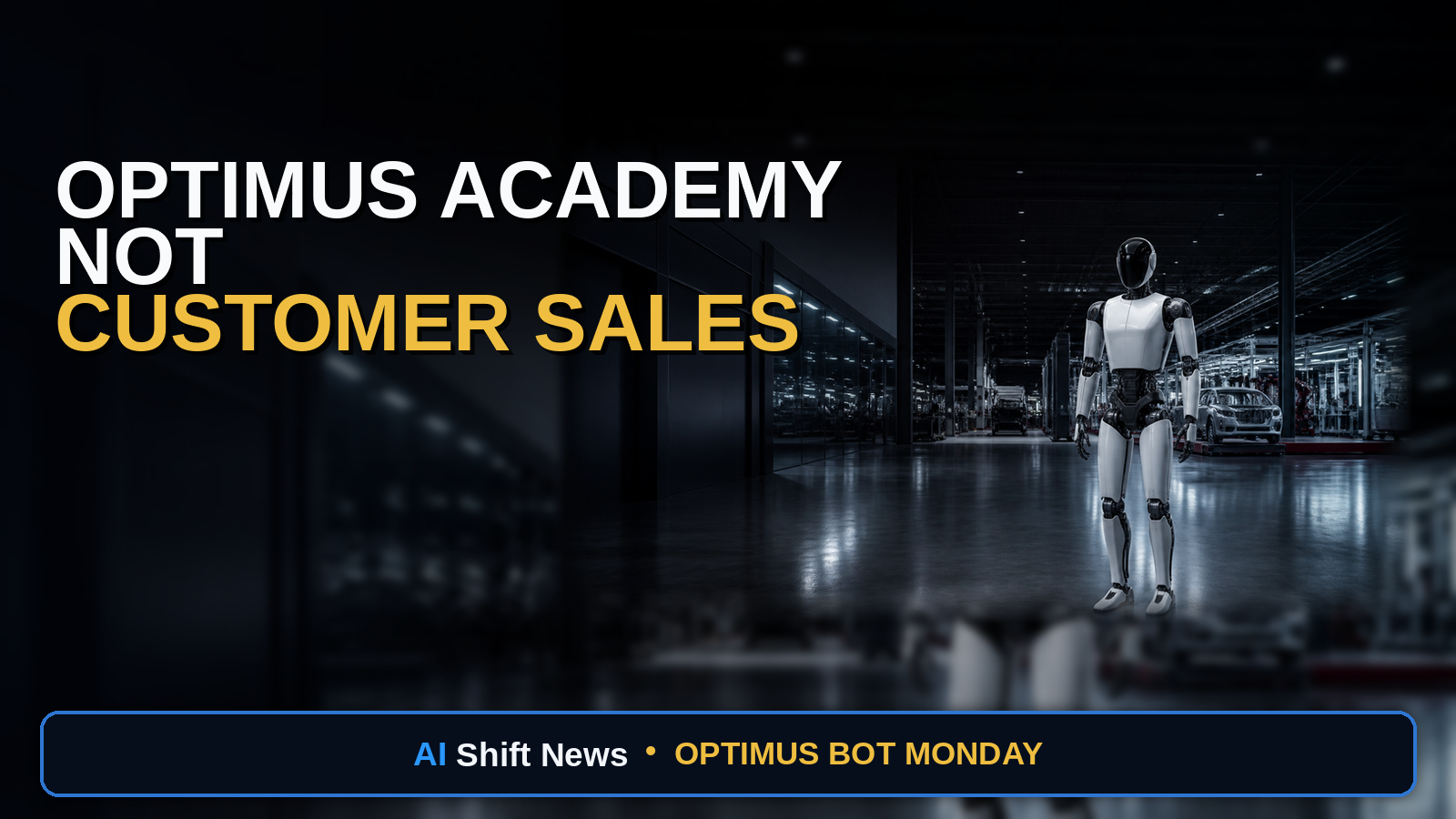
Secondary reporting (RobotsBeat, Sep 2) says Tesla has begun Optimus production at Fremont on the former Model S/X floor, with early units framed for internal “Optimus Academy” deployment — robots that generate training data inside Tesla’s own facilities — not for customers. Musk’s Dwarkesh conversation (OfficeChai write-up) describes Academy scale as tens of thousands of robots doing self-play in reality plus simulation to close the sim-to-real gap. Musk also warns of a long, flat S-curve and calls Optimus the hardest manufacturing product Tesla has ever scaled. Consumer $20–30k sales remain a 2027 company claim. Do not invent IR unit counts.
Elon Musk Drops Massive UPDATE On Tesla Bot Optimus! · TESLA CAR WORLD (creator channel, not Tesla official)
Quick Take
The near-term Optimus story is not a consumer showroom. Secondary reporting from RobotsBeat (September 2, 2026) says Tesla has begun producing Optimus at Fremont on floor space previously used for Model S and Model X, with early robots framed for an internal Optimus Academy — a closed-loop system where factory robots generate operational data that feeds software and hardware iteration — rather than external sales.
Musk’s conversation with Dwarkesh Patel (OfficeChai write-up) puts numbers on the training problem: cars will soon have on the order of 10 million vehicles generating demo data; robots cannot copy that flywheel, so Tesla needs an Academy with at least ~10,000 to 30,000 Optimus units doing self-play in reality, plus millions of simulated robots to close the sim-to-real gap. On the manufacturing side, RobotsBeat attributes Musk’s earnings-call warning that Optimus is the hardest product Tesla has ever scaled, with an S-curve whose early portion is “flat and long.”
- Confirmed (secondary): Fremont production start framing + Academy-first internal deployment narrative (RobotsBeat Sep 2).
- Confirmed (attributed Musk): Hardest manufacturing scale-up; long flat S-curve; Academy scale targets; sparse robot demo data vs cars (RobotsBeat + OfficeChai/Dwarkesh).
- Claim (do not adopt): $20–30k consumer sales in 2027; 80% of long-term Tesla value from Optimus; million-unit annual targets at Fremont / Texas.
- Fence: No invented IR unit counts. This package is Academy-as-product — distinct from Aug 31 AISN Motley Fool / JPMorgan tarp and $25B capex briefs.
What the video shows
Required embed for this package: TESLA CAR WORLD — “Elon Musk Drops Massive UPDATE On Tesla Bot Optimus!” (YouTube iUJTOQt5RMg). House note: this is creator/fan channel packaging (published Jul 24, 2026), not a Tesla official upload. Crystal’s scout list also included Electric Fortunes (w89niEdi9gs), TheMarkets (15uxyLVOiks), and Auto Helpers (vWdsa-qSRwI); none beat this clip for Academy + Fremont clarity, and no fresher title-matched Academy/production YouTube was verified in the last ~14 days. Prefer this embed with hedges over NONE.
Use the video as visual context for Academy / production language — not as primary evidence equal to RobotsBeat or the Dwarkesh write-up. Do not treat creator narration as Tesla IR.
What’s new
For Tesla Bot / Optimus Monday, what is newsworthy is the internal-first product definition. If Fremont’s early output feeds Optimus Academy, then the near-term deliverable is a training fleet and a manufacturing learning curve — not a consumer SKU. That framing matches Musk’s Dwarkesh explanation: humanoids have far more degrees of freedom than cars, lack millions of hours of road demo data, and therefore need a purpose-built Academy plus simulation.
RobotsBeat’s Sep 2 piece stitches the manufacturing and training stories together: production start at Fremont; Academy as the destination for early robots; S-curve expectation management; Giga Texas as later volume home; 2027 consumer price claims still sitting on the far side of the flat part of the curve. Readers should hear the difference between a line that exists to teach robots and a product you can buy.
This Monday flagship stays distinct from AI Shift News’s August 31 Optimus packages (Motley Fool “entered production” vs JPMorgan tarp visit; $25B capex). Those covered conversion optics and capital intensity. This package covers why early units matter if Academy is the real near-term loop.
Evidence
RobotsBeat (Sep 2, 2026) — secondary primary for this pack. Reports Optimus production beginning at Fremont using former Model S/X space after those vehicles ended production in May; states initial production is not targeting external customers and instead feeds Optimus Academy — robots performing routine factory tasks, generating data that improves software and hardware; attributes Musk quotes that Optimus is the hardest manufacturing scale-up Tesla has attempted, that “everything on the robot is new,” and that the early S-curve is flat and long; notes >$25B 2026 capex context with Giga Texas as a significant Optimus component; records Musk/company claims of $20–30k consumer pricing in 2027 and 80% long-term value from Optimus. Treat as secondary journalism summarizing company language — useful structure, not an IR unit table.
OfficeChai write-up of Musk × Dwarkesh Patel. Musk on shared AI stack with cars (same chips, same basic principles) and the hard difference: cars have millions of hours of human demo data; robots do not. Solution described: build many robots into an Optimus Academy for self-play in reality — “at least 10,000… maybe 20 or 30,000” — then run millions of simulated robots and use the real fleet to close the simulation-to-reality gap. Instant transfer of learnings across the robot fleet is part of the pitch. Attribute all headcount targets to Musk.
What is still missing (confirmed fence). No Tesla IR disclosure in this package invents how many Optimus units have actually rolled off Fremont, how many are installed in Academy cells, or what task-completion metrics look like. Absence of those numbers is itself the story: Academy is described; the scoreboard is not public.
What this does not prove
- It does not prove customer Optimus sales have started. Reporting and company language point internal-first; 2027 consumer timing is a claim.
- It does not prove Academy already has 10k–30k robots. That range is Musk’s stated need / build-out intent in the Dwarkesh conversation, not a confirmed census.
- It does not prove the S-curve will resolve on any particular calendar. “Flat and long” is Musk’s warning, not a dated ramp chart.
- It does not prove 80% of Tesla’s long-term value will come from Optimus. Attributed strategic claim — keep it labeled.
- It does not replace Aug 31 AISN coverage. Do not merge Motley Fool / JPMorgan tarp optics or the $25B capex brief into this Academy thesis.
- Creator YouTube is not Tesla IR. iUJTOQt5RMg is packaging for the embed, not primary confirmation.
Why it matters
For practical readers watching humanoids, the scarce resource is not another glossy walk demo — it is useful hours of real robot experience plus a factory that can build the bodies that generate those hours. Optimus Academy is Tesla’s proposed answer to the data gap relative to Full Self-Driving’s fleet flywheel. If Fremont’s early production really feeds that loop, then judging Optimus in 2026 by consumer waitlists misses the program Tesla is actually running.
It also matters as an honesty check against timeline hype. Musk’s own S-curve language and “hardest product to scale” line are expectation management. Pairing that with Academy-first deployment is more coherent than pretending a converted Fremont hall equals a shipping consumer robot. Buyers, suppliers, and investors tracking physical AI need that distinction: internal learning fleet now (claimed structure), home robot later (claimed calendar).
Competitive context stays narrow. Other humanoid programs also chase real-world data loops. Tesla’s public differentiator in this package is vertical integration language — same AI chips as the car, in-house actuators, Academy + sim — not a peer-reviewed dexterity leaderboard or a purchase page.
What to watch next
- Any Tesla IR or primary disclosure with Optimus unit counts, Academy installation figures, or task metrics (not only secondary summaries).
- Whether “production” language stays Academy-bound or quietly shifts toward external pilot customers before 2027.
- Giga Texas timing — whether the larger Optimus factory remains the volume handoff after Fremont standardizes processes.
- 2027 consumer claims — price band, capability bar, and whether “full-function home robot” marketing stays tethered to manufacturing reality.
- Keep Aug 31 AISN packages separate — tarp-visit optics and capex intensity remain background, not this flagship’s lead.
Bottom Line
Secondary reporting says Fremont Optimus production is real enough to start — and aimed at Optimus Academy, an internal closed-loop learning fleet, not customers. Musk’s Dwarkesh remarks explain why: robots lack the car fleet’s demo-data flywheel and need tens of thousands of Academy units plus simulation. His S-curve warning says the manufacturing ramp stays hard and initially flat. Customer sales at $20–30k in 2027 remain a claim. That is a Tesla Bot Monday story about what the near-term product actually is. It is not a purchase-date announcement and not an IR unit dump.
Bottom Line
Secondary reporting says Fremont Optimus production is real enough to start — and aimed at Optimus Academy , an internal closed-loop learning fleet, not customers. Musk’s Dwarkesh remarks explain why: robots lack the car fleet’s demo-data flywheel and need tens of thousands of Academy units plus simulation. His S-curve warning says the manufacturing ramp stays hard and initially flat. Customer sales at $20–30k in 2027 remain a claim. That is a Tesla Bot Monday story about what the near-term product actually is. It is not a purchase-date announcement and not an IR unit dump.