
 Shift News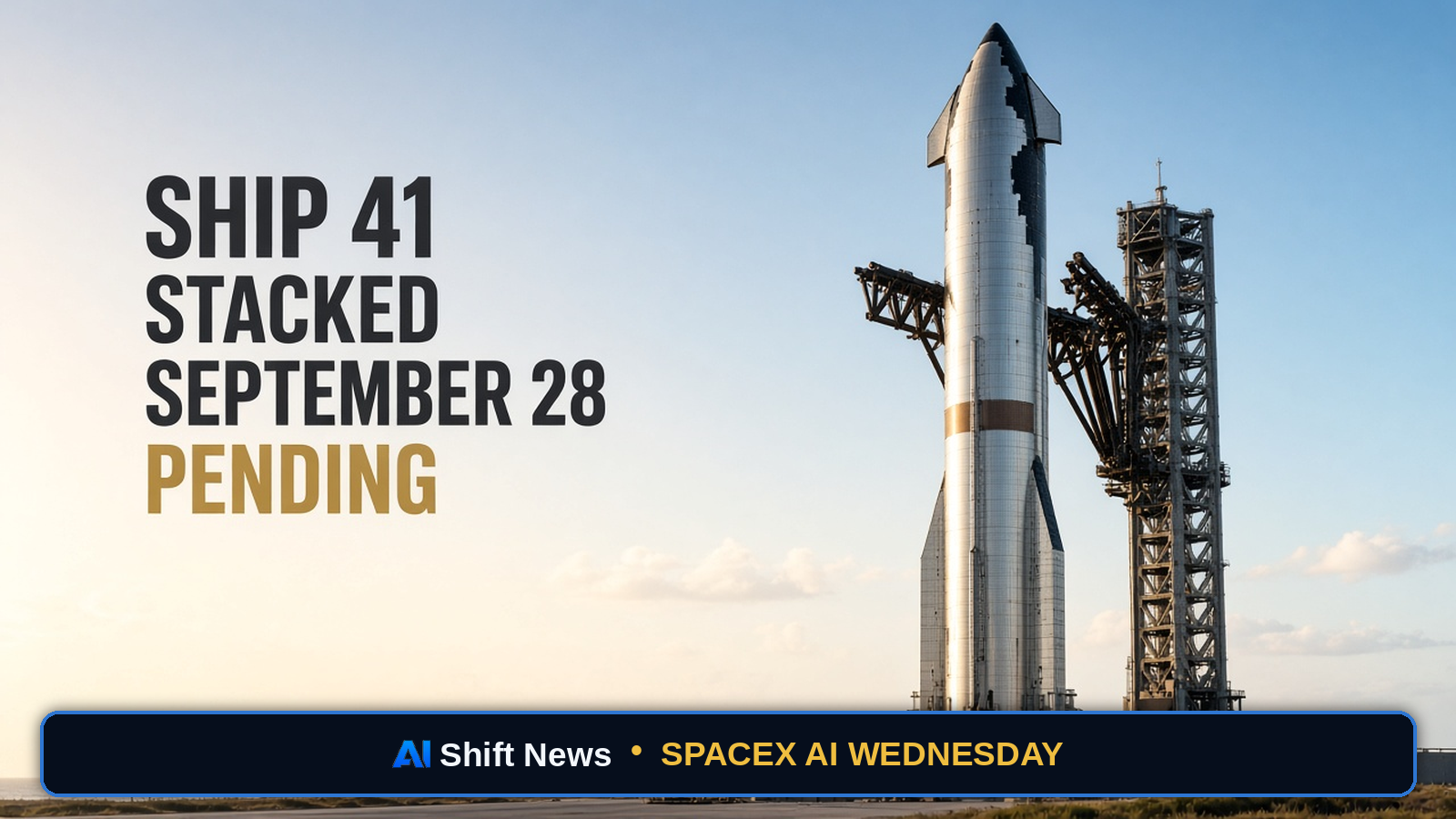
On the evening of September 22, 2026, NASASpaceflight covered SpaceX rolling and stacking Ship 41 on Super Heavy Booster 21 at Orbital Launch Pad 2 at Starbase — concrete pad integration ahead of Starship Flight 14. SpaceX has retargeted the attempt to no earlier than Monday, September 28, 2026, with a 75-minute window opening at 7:15 a.m. CT, still pending regulatory approval. The mission profile remains the first planned Starship orbital insertion and the first planned deployment of roughly 26 Starlink V3 satellites — neither flown yet. AISN’s September 16 “Targets Sep 22” package is soft-re-cover background only. Stacking is an integration receipt. It is not a countdown clock, not FAA/FCC clearance in hand, and not proof Flight 14 will orbit on September 28.
NASASpaceflight — SpaceX Rolls & Stacks Ship 41 For Flight 14
What the video shows
Required embed for this package: NASASpaceflight — “SpaceX Rolls & Stacks Ship 41 For Flight 14” (YouTube c11hl-VAtN8), streamed about September 22, 2026 evening. House note: this is pad-integration coverage — roll, lift, and stack of Ship 41 onto B21 at Pad 2 — not a SpaceX webcast of a successful orbital insertion and not an FAA license grant. Use it as the viewer’s look at the hardware state that moved this week. Prefer this embed with hedges over NONE because it matches the locked SpaceX AI Wednesday mix and lands on the new stack facts. Do not let the title or livestream chat upgrade “stacked” into “orbited,” and do not substitute the older static-fire / pad-roll video sfj4kdQD2MU as this pack’s lead.
What’s new
AI Shift News already published a September 16 Flight 14 package when the public target still pointed at September 22. That post is a soft-re-cover ban for the lead: you may mention the Sep-22 slip as background, but you do not redo static fires, Louisiana Starbase color, or “targets Sep 22” as if they are fresh. What is new is a dated integration receipt plus a dated retarget: Ship 41 stacked on B21 at Pad 2, and SpaceX language pointing at NET Monday September 28 with a 7:15 a.m. CT window open still tied to regulatory approval.
That combination matters for house voice. Starship coverage routinely confuses pad photos with flight outcomes. The scarce journalistic job is to keep the stack, the NET date, the regulatory clause, and the still-unflown orbit/V3 profile in the same paragraph — without pretending any of those lines is a splashdown video.
Evidence
Pad integration — Ship 41 on B21 (Sep 22). NASASpaceflight’s roll-and-stack coverage shows the Flight 14 upper stage moving to and stacking on Super Heavy Booster 21 at Orbital Launch Pad 2. Secondary reporting earlier in the week had already placed B21 on the Pad 2 mount after a late-night rollout (Spaceflight Now, Sep 21: B21 departed assembly shortly before midnight local Sep 20 and was on the mount roughly two hours later). Tesla Oracle’s Sep 22 writeup likewise ties the booster pad move to an expected Ship 41 rollout and integration window. House fence: a stacked stack is real. It is not a wet-dress complete stamp, not a go for launch, and not an orbit.
SpaceX targeting language — NET Sep 28, 7:15 a.m. CT, pending regulatory approval. Tesla Oracle (Sep 22) reproduces SpaceX’s update: “Now targeting to launch Starship Flight 14 as early as Monday, September 28, pending regulatory approval. The 75-minute launch window will open at 7:15 a.m. CT.” Spaceflight Now’s Sep 21 pad piece had already framed the attempt as no earlier than Sep 28 pending final FAA approval of the license modification needed for the orbital flight plan. AISN keeps those clauses glued together: every “Sep 28” in this package travels with “NET” and “pending regulatory approval.”
Mission profile — planned, not flown. Company and secondary desks describe Flight 14 as the first planned Starship orbital insertion and the first planned deployment of Starlink V3 satellites (commonly counted at about 26, with Starlink Group 31-1 / Starlink 31-1 framing in secondary coverage). Spaceflight Now attributes SpaceX prelaunch language that each V3 satellite is intended to add about 1 Tbps of constellation capacity (~26 Tbps for the mission; ~10× a Falcon 9 V2 Mini launch) — that is company mission writing, not an on-orbit checkout receipt from this flight. Next Spaceflight’s profile notes splashdowns rather than tower catches for ship and booster on this attempt, a ~275 km altitude class orbital coast measured in hours, and contingency options to shorten the coast if ship health does not support a full orbital plan. House fence: quote the plan; do not upgrade it into “V3 capacity is proven” or “orbit tonight.”
Regulatory gate — why the stack is not the clock. Spaceflight Now quotes the FAA’s general statement that license applications must meet safety, policy/payload, and financial responsibility requirements, and notes this would be the first time the FAA grants an orbital license for an object the size of a Starship upper stage. Uncontrolled reentry risk for a vehicle of Starship’s bulk is exactly why “pending regulatory approval” is not boilerplate. Tesla Oracle likewise stresses that the new date remains conditional if regulators are not satisfied. Stacking Ship 41 does not close that file.
What is still missing (confirmed fence). No AISN claim that the FAA modification is granted in this pack; no flown orbital insertion; no on-orbit V3 customer service from Flight 14; no treatment of NSF livestream chat as SpaceX IR; no soft-re-lead of Sep 19 Holy Grail / ASP / heat-shield Friday coverage as this slot’s news.
Schedule slips of one or several days for weather or hardware are normal even after a license lands. That is why house voice prefers “NET Monday Sep 28” over “launches Sep 28.” Readers comparing Starbase cams to creator thumbnails should treat pad stacking as necessary, not sufficient.
What this does not prove
- It does not prove Flight 14 will orbit on September 28. NET + pending regulatory approval is the company frame; weather and technical holds remain available even after clearance.
- It does not prove the FAA (or other required regulators) have signed the orbital modification. Stack ≠ license.
- It does not prove Starlink V3 capacity claims. ~26 sats and Tbps language are planned-mission figures until deploy and checkout happen.
- It does not prove tower catches return on this flight. Current profile language points to splashdowns.
- It does not authorize redoing the Sep 16 Sep-22-target post, static-fire packages, or Sep 19 SpaceX Friday heat-shield file as today’s lead.
What operators should do
- Track the company clause, not the thumbnail. If SpaceX still says “pending regulatory approval,” do not brief customers or internal launch desks as if Sep 28 is locked.
- Separate pad cams from license status. NSF/stack footage is useful for hardware state; it is not a substitute for FAA/SpaceX licensing updates.
- Keep V3 capacity language in the “planned” column. Do not rewrite constellation forecasts as if Flight 14’s 26 birds are already serving.
- Budget for slip. One- or two-day moves for weather or tech remain normal after a NET date; orbital firsts add paperwork risk on top.
- Ignore “orbit tonight” packaging. Creator maximal titles are not SpaceX targeting language.
Why it matters
For practical readers following Starship as infrastructure — not as scoreboard culture — the scarce signal is often what hardware state changed plus what the company will still not promise. This week clears that bar: Ship 41 is on B21 at Pad 2, and the public NET moved to September 28 with the regulatory hedge intact. That is useful planning context for anyone watching the first orbital Starship attempt and the first planned Starlink V3 ride — if you refuse to confuse a stack photo with an orbit receipt.
It also matters for the SpaceX AI Wednesday franchise specifically. Starlink V3 is the AI-era bandwidth story people want to skip ahead to. Cover the integration and the gate; do not pretend the satellites have already delivered the Tbps slide.
What to watch next
- Regulatory daylight — whether SpaceX or the FAA publicly confirms the orbital license modification before the NET window.
- Integrated testing — whether a fully stacked wet dress / tanking rehearsal is confirmed (Spaceflight Now noted SpaceX had not said as of Sep 21).
- Window holds — weather and technical slips inside or after the Sep 28 NET.
- Flight profile execution — orbital insertion decision gates, payload deploy, deorbit burn, splashdowns — only after liftoff.
- Amplifier hygiene — outlets that upgrade “stacked” or “NET Sep 28” into “orbits Monday” without the pending-approval clause.
Bottom Line
Ship 41 is stacked on B21 at Pad 2 — that is integration progress. SpaceX now targets Flight 14 NET Monday Sep 28, 2026, 75-minute window opening 7:15 a.m. CT, still pending regulatory approval. The mission remains the first planned Starship orbit and first planned ~26 Starlink V3 deploy — not flown. Soft-re-cover the Sep 16 Sep-22-target post; do not rehash static fires as the lead. Treat NSF’s stack video as pad coverage, not an orbit receipt. Prefer SpaceX targeting language + regulatory fence over “orbit tonight” packaging.
Sources
- https://www.spacex.com/launches/starship-flight-14
- https://www.teslaoracle.com/2026/09/22/starship-flight-14-gets-delayed-spacex-moves-booster-21-to-starbase-launch-pad/
- https://spaceflightnow.com/2026/09/21/spacexs-super-heavy-booster-arrives-at-pad-ahead-of-first-orbital-starship-launch/
- https://nextspaceflight.com/launches/details/8346/
- https://www.youtube.com/watch?v=c11hl-VAtN8