
 Shift News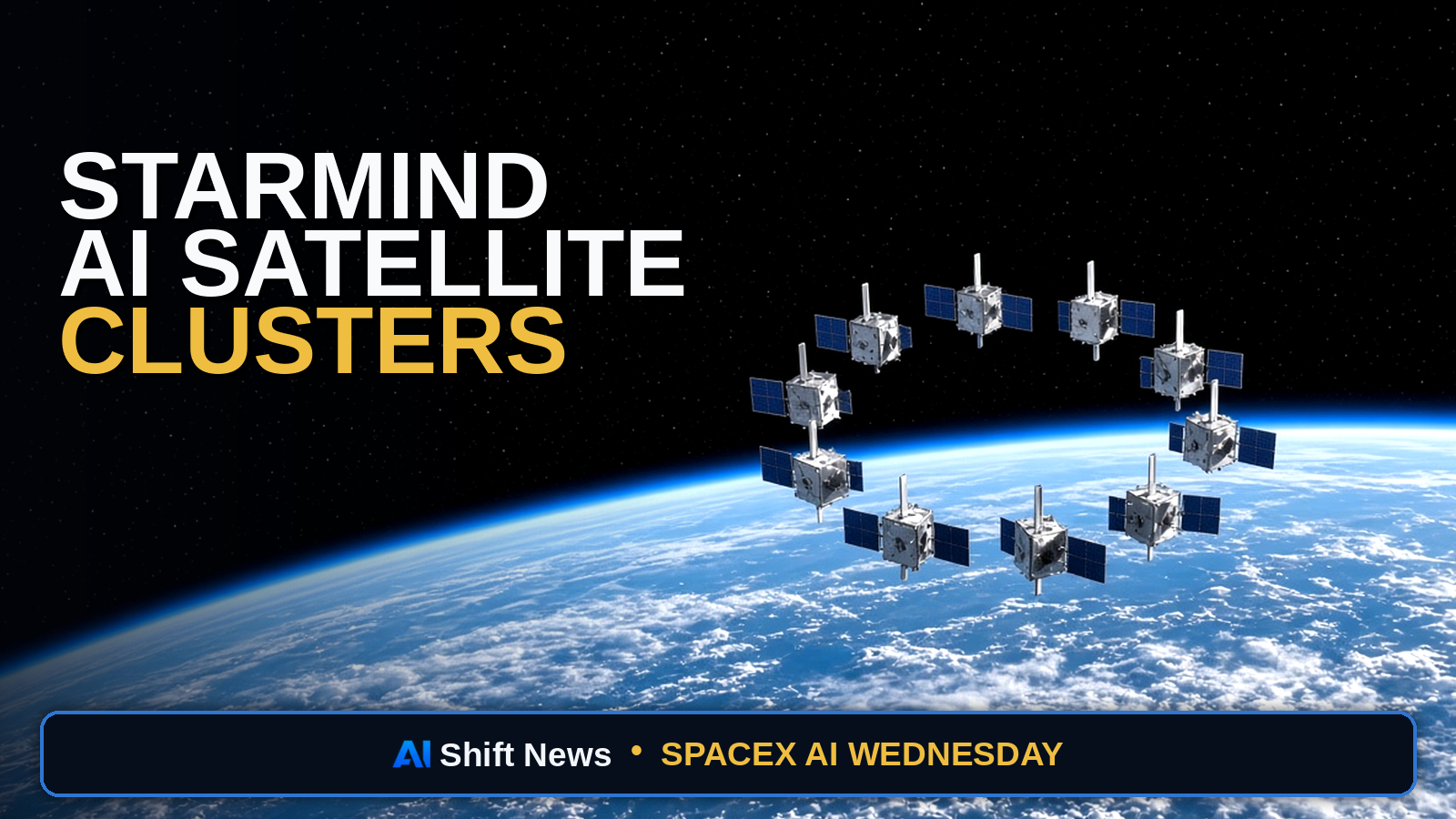
Honest fence (read first): This SpaceX AI Wednesday flagship is built on one primary: Michael Nicolls’s IAC 2026 Highlight Lecture in Antalya, Türkiye, on Tuesday, October 6, 2026 (17:45 local, 10:45 AM ET). Nicolls is SpaceX’s senior vice president of Starlink engineering and, per the IAF programme, president of SpaceXAI. The official International Astronautical Federation upload is the embed (Qeqdaujbybs, posted Oct 7). Quotes below come from the talk’s captions and are lightly cleaned for filler words. Supporting primaries: Starlink’s Oct 6 post on X, the SpaceX Starmind page, the Starlink Space Safety platform, and the FCC notice accepting SpaceX’s orbital data center application. Starmind has not launched. There is no FCC grant, no hardware photo and no customer. Nicolls called SpaceX’s own constellation render “a very notional concept … probably wrong.” Every Starmind number below is a planning number, and most came with “something like” or “-ish” attached.
International Astronautical Federation — IAC 2026 Highlight Lecture by Michael Nicolls, SpaceX (delivered October 6, 2026; uploaded October 7). Quotes come from the talk’s captions; supporting facts cite the Starmind page, Starlink’s Space Safety platform and the FCC notice.
Editorial Thesis
For months, Starmind has been a one-line ambition: put AI compute in orbit, powered by the sun and cooled by radiating heat into space. On Tuesday SpaceX gave it an architecture. Starmind satellites won’t work as a million separate servers. They’ll fly in tight formations of about ten, each satellite roughly one rack of compute, linked to each other at around 10 terabits per second, and linked to Starlink to get data home. That makes Starmind a formation-flying problem first and a compute problem second. Nicolls spent most of the talk on Starlink’s collision-avoidance record. That makes sense: the Starlink playbook is the only part of this plan that already works in orbit.
Honest Verdict
Believe the talk happened and what Nicolls said. The organizer posted the full lecture, and Starlink promoted the livestream. Treat cluster size, link bandwidth and per-satellite power as design targets in a public talk, not specs. Note the drift: in June, SpaceX described its AI1 satellite as a roughly 150 kW compute payload (Tom’s Hardware account of the June 8 interview). On Tuesday Nicolls said “something like a 250 kilowatt satellite.” Treat “launching and scaling next year” as a target. The Starmind page says deployment starts “as soon as late 2027.” Starlink’s safety numbers (about 1,000 avoidance maneuvers a day, about 650 operators’ satellites dodged, Stargaze tracking over 17,000 objects) are SpaceX’s own counts. No independent audit has been published.
What the primary actually says
Starmind: what it is, according to Nicolls (IAC 2026, Oct 6)
- Starmind is “our AI satellite constellation that we plan to begin launching and scaling next year.” The goal is “to take AI compute off of Earth and put it into space.”
- Why: SpaceX is building “over 2 gigawatts of compute in Memphis, Tennessee” on the ground. Nicolls said demand for AI compute will keep outgrowing what Earth can supply in power, land and water. In orbit, “we can scale by using the power of the sun” and “radiative cooling from large structures.”
- The satellites are “quite a bit simpler than a Starlink satellite.” They carry compute payloads “very similar to the compute payloads we develop on the ground in our own data centers,” with large solar arrays and large radiators. In his words: “fundamentally it’s a computer in space.”
- Scale is the hard part. SpaceX may need to build “potentially thousands of satellites per week.” Starmind “will be the largest consumer of orbital capacity for Starship … much like Starlink drove the capacity of Falcon.”
- The filing covers “up to 1 million satellites.” The render shown is “a very notional concept and thus it’s probably wrong and will change a lot.” The constellation would mix low-inclination and sun-synchronous orbits.
The cluster detail (the new fact)
- “We need to operate clusters of satellites in tight formation to get enough coherent compute together such that we can run these AI models efficiently.”
- Each satellite “might be something like a 250 kilowatt satellite or roughly a rack of compute in space. Something like an NVL72.” That is Nvidia’s rack-scale system. SpaceX said in August it was working with Nvidia on the payload (per Teslarati).
- A cluster is “10-ish satellites … interconnected with 10 terabits or so of bandwidth between them,” then “interconnected into the broader constellation and into Starlink.”
- New problems he listed: much higher reliability and redundancy than Starlink, close-formation “proximity ops,” micrometeoroid debris, and end of life. Starmind satellites “may not” reenter Earth’s atmosphere. SpaceX might instead send them to heliocentric or graveyard orbits, which he called “new conops that we have not had to design for.”
The Starlink safety record the plan leans on
- Over 11,000 broadband satellites in low Earth orbit (“something like 60% of active satellites” in LEO, by his estimate). Over 13 million customers in about 170 markets, a figure Nicolls said is from the end of Q2 and “a bit stale.”
- Each satellite makes about one collision-avoidance maneuver every 10 days, “roughly 1,000 per day” across the fleet. SpaceX says its threshold is “almost two orders of magnitude more conservative than industry standards.”
- Stargaze: star trackers on “over 30,000” Starlink sensors also spot passing objects. SpaceX says that lets it track “over 17,000 objects” and about 90% of maneuvering satellites that cross Starlink’s shells.
- His example: a predicted 9 km miss shrank to about 60 meters after another operator maneuvered without warning. Stargaze caught it and the Starlink satellite moved.
- Over “the past several months,” Starlink maneuvered against satellites from about 650 other operators. It actively shares ephemeris (precise position and trajectory data) with only “about half” of them. Nicolls said the gap includes US, European and Japanese operators, not just Chinese or Russian ones. More than 100 operators have joined SpaceX’s free sharing platform.
- V3 Starlink satellites will fly at about 350–360 km, so a dead one falls out of orbit in months rather than years.
What the other primaries add
- Starlink on X (Oct 6, 10:45 AM ET): “space safety will continue to be a top priority,” with a link to Nicolls’s livestream.
- SpaceX Starmind page: “Capturing solar energy in space to power low-cost, high-performance AI compute for Earth.” The Gigasat Factory in Bastrop, Texas, is planned for “thousands of AI satellites starting as soon as late 2027.”
- FCC (DA-26-113, Feb 4, 2026): the Space Bureau accepted the application for filing and asked for comment. That starts a review. It is not an approval.
Why this is today’s SpaceX AI Wednesday flagship
Starmind is where SpaceX, Starship and SpaceXAI’s compute plans meet. Tuesday was the first time a SpaceX executive described how the system would be built, on an international stage, next to the operating record it depends on. The cluster design also explains Nicolls’s main ask. Ten 250 kW satellites flying in tight formation will only work if the operators around them share where their satellites are going. Readers should track three things, in this order: an FCC decision, a first prototype launch, and Starship cadence high enough to make “thousands per week” matter.
Claim vs proof scoreboard
| Claim | Proof today |
|---|---|
| Starmind launches start next year | Target in a talk; the Starmind page says “as soon as late 2027” |
| ~10-satellite clusters, ~10 Tbps links | Design intent, stated with “-ish” and “or so” |
| ~250 kW per satellite | Spoken estimate; June AI1 description said ~150 kW |
| Up to 1 million satellites | FCC application accepted for filing Feb 4, still under review |
| ~1,000 Starlink avoidance maneuvers a day | SpaceX’s own operational figure |
| Half of ~650 operators don’t share ephemeris | SpaceX’s own count; operators not named |
What to watch next
- An FCC Space Bureau order on the Starmind application, plus any conditions on formation flying or end of life.
- A first Starmind prototype manifest (vehicle, date, orbit).
- Whether SpaceX publishes Starmind specs on paper instead of in a talk, including which number is right: 150 kW or 250 kW.
- Q3 Starlink subscriber numbers, which Nicolls said are coming “soon.”
Human review risks
- Writing “SpaceX is launching a million AI satellites” as fact. It is an application, and the render is self-described as probably wrong.
- Treating 250 kW, 10-ish and 10 Tbps as specs.
- Implying Stargaze or the collision numbers were independently verified.
- Calling the 650-operator figure a China/Russia story. Nicolls said the gap includes US, European and Japanese operators.
- Mixing in Google’s Suncatcher prototype as if it were Starmind. Different company, different program.
Bottom Line
Believe the talk happened and what Nicolls said. The organizer posted the full lecture, and Starlink promoted the livestream. Treat cluster size, link bandwidth and per-satellite power as design targets in a public talk, not specs. Note the drift: in June, SpaceX described its AI1 satellite as a roughly 150 kW compute payload (Tom’s Hardware account of the June 8 interview). On Tuesday Nicolls said “something like a 250 kilowatt satellite.” Treat “launching and scaling next year” as a target. The Starmind page says deployment starts “as soon as late 2027.” Starlink’s safety numbers (about 1,000 avoidance maneuvers a day, about 650 operators’ satellites dodged, Stargaze tracking over 17,000 objects) are SpaceX’s own counts. No independent audit has been published.
Sources
- International Astronautical Federation — IAC 2026 Highlight Lecture 1, Michael Nicolls (Oct 6, 2026; uploaded Oct 7)
- Starlink on X — 'space safety will continue to be a top priority' (Oct 6, 2026, 10:45 AM ET)
- SpaceX — Starmind AI satellite page
- Starlink Space Safety platform (ephemeris sharing, Stargaze)
- FCC Space Bureau — accepts SpaceX orbital data center application for filing (DA-26-113, Feb 4, 2026)
- IAF — IAC 2026 plenary programme (Highlight Lecture, Tue Oct 6)
- Teslarati — SpaceX reveals how its 1 million AI satellite network will work (Oct 6, 2026)
- PCMag — SpaceX provides new look at orbital data center plans (Oct 6, 2026)