
 Shift News
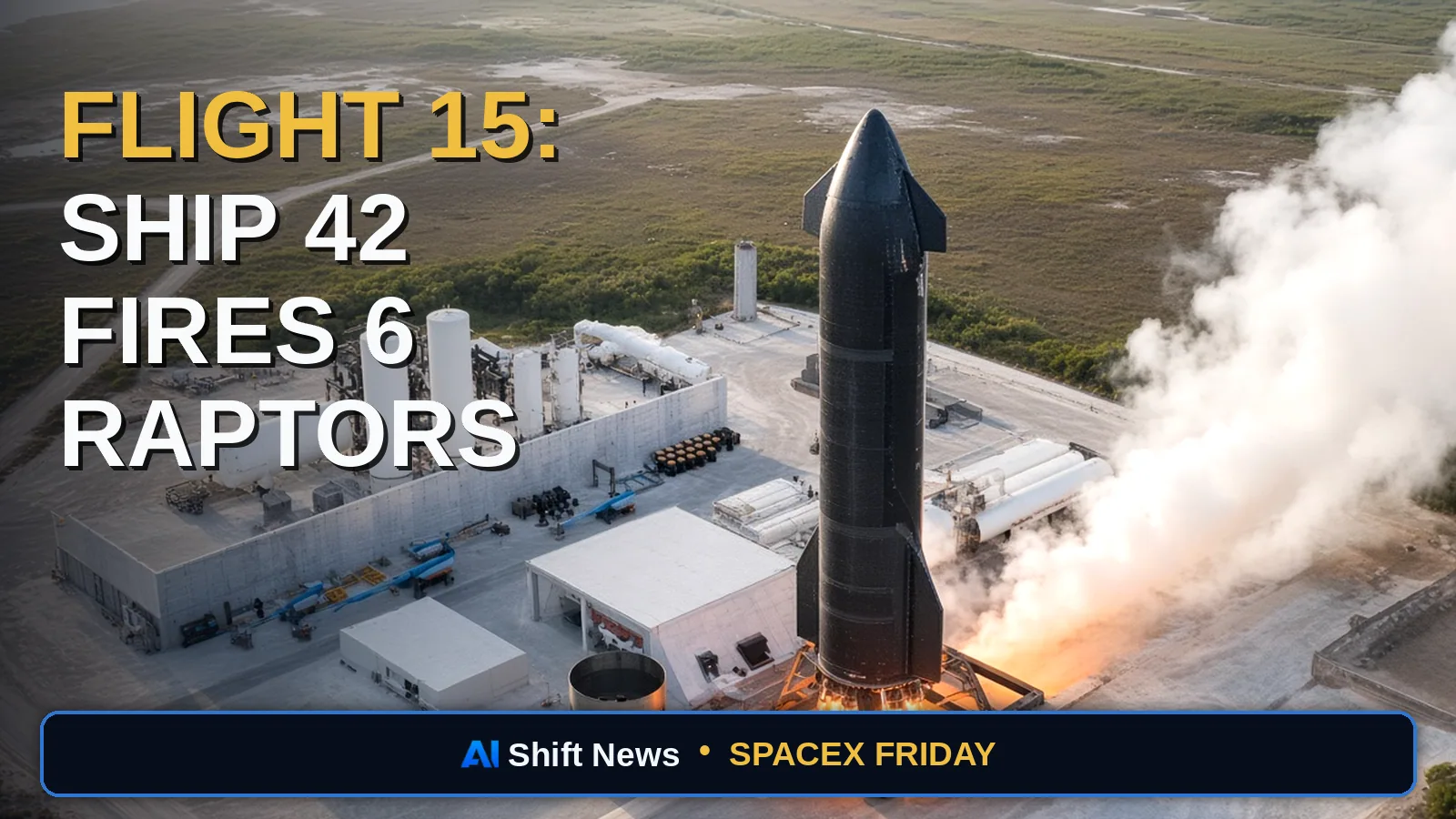
VideoFromSpace: "SpaceX Fires Up Starship for Flight 15! Plus Super Heavy Test & Flight 14 Highlights". Facts on this page cite the primary sources below, not the video.
Honest fence (read first): Everything "done" in this post is ground testing. SpaceX confirmed both static-fire campaigns itself, on X. A static fire isn't a launch date, and it isn't an FAA license. Our Oct 21 post covered SpaceX's plan to catch both stages on Flight 15, and an earlier post covered the Nov 8 airspace-planning marker, written when Ship 42's engines were still out. This post covers what changed since: both vehicles have now fired their engines.
Editorial Thesis
On Sunday, Oct 25 at 3:49 PM ET, SpaceX posted: "Full duration 33-engine static fire for the Super Heavy booster preparing for Flight 15." That's Booster 22.
On Wednesday, Oct 28 at 12:10 PM ET, it followed with the upper stage: "Ship 42 static fires complete. The Starship preparing for Flight 15 performed a full duration, six-engine static fire, and fired a single Raptor engine to simulate a deorbit burn."
Put together, SpaceX has now run all 39 Raptor engines for Flight 15 on the ground: 33 on the booster and 6 on the ship. Both stages have passed the last big engine test before a vehicle usually heads to the pad for stacking.
That evening, at 10:37 PM ET, Elon Musk quoted SpaceX's post and wrote: "As the prophecy foretold, Starship 42 will be the first tower catch."
That last line is the bold part. No Starship upper stage has ever been caught by the launch tower. SpaceX has caught Super Heavy boosters on three flights, according to Space.com, but never a ship. Musk's sentence is a plan stated with confidence. It isn't a result, and it isn't an approval.
Honest Verdict
Proven (SpaceX's own posts): Booster 22 completed a full-duration 33-engine static fire on Oct 25. Ship 42 completed a full-duration six-engine static fire and a single-engine relight simulating a deorbit burn, which SpaceX announced on Oct 28. Claimed (Musk): Ship 42 "will be the first tower catch." Not public yet: an FAA license for Flight 15, a launch date, and whether that license covers bringing both stages back to the tower. Launch Library 2 still lists Flight 15 as "NET November," with month precision.
What the two tests actually show
A static fire is the closest a rocket gets to flying without leaving the ground. The vehicle is bolted down, loaded with propellant, and its engines run while sensors record pressures, temperatures and vibration. "Full duration" means the engines ran for as long as the test plan called for, not just a quick ignition check.
Booster 22. All 33 Raptors lit at once on Oct 25. Super Heavy is the stage SpaceX has already caught, so this was the expected box to check. It still matters: every booster is new hardware, and one bad engine can push a launch by weeks.
Ship 42. The ship's campaign ran across Monday, Oct 26 and Tuesday, Oct 27, according to Space.com. Next Spaceflight, which logs Starbase testing, lists both tests on Oct 27: the single-engine fire, and then a roughly 60-second six-engine fire. Ship 42 had already passed three cryogenic proof tests, on Sep 3, Sep 4 and Oct 9, per the same log.
The single-engine relight is the more interesting test. To come home from orbit, a ship has to fire an engine briefly against its direction of travel. That lowers its path into the atmosphere, where the heat shield does the rest of the braking. If the engine doesn't relight, the ship can't leave orbit on command. If it fires off-target, the ship reenters in the wrong place.
Flight 15 needs that burn to work before anything else does. A ship that's going to be caught at Starbase has to come down on the right ground track, toward the same South Texas coast it launched from. The relight on the test stand is the ground rehearsal of that first step.
Why the ship catch is the hard part
SpaceX says double tower catches will be the normal way Starship flies once it's operational. Space.com reports SpaceX's view that catching both stages cuts the time needed to get them ready to fly again, which is the whole point of a fully reusable rocket.
The booster half is proven. A Super Heavy separates at a fraction of orbital speed, flips, relights, and steers back to the tower. SpaceX has done that three times.
The ship's return is much harder. It comes back from orbit at about 7.8 kilometers per second. It has to survive full reentry heating, flip from a belly-first fall to upright, relight its engines and hover into the tower's arms. All of that only works if the deorbit burn put it on the right path in the first place.
That's why Flight 15 is a big deal, and also why it's fair to keep the claim and the proof apart. Musk said it will happen. SpaceX's hardware has now passed the ground tests that come before trying.
What's still not public
The FAA license. The FAA's Starship page, last updated Thursday, Oct 22, lists finished environmental reviews that cover Starship return-to-launch-site profiles and an added reentry path back to Boca Chica. Those reviews clear the environmental side for the license changes. They aren't the license itself, and no Flight 15 license has been posted. Space.com says Musk's double-catch plan is "provided the company can get regulatory approval."
The date. Musk has said Flight 15 is targeted for November. An FAA airspace planning slide showed a no-earlier-than marker of Nov 8, which we covered. Launch Library 2 lists Flight 15 at Starbase's Orbital Launch Pad 2 as NET November 2026, status "To Be Determined," last updated Wednesday afternoon. Nothing official is narrower than that.
The flight plan. SpaceX hasn't published a Flight 15 mission page with a timeline, a payload, or where the ship is supposed to come down if the catch is called off.
What happens next
Here's the usual sequence after static fires, based on how earlier flights went. It's a pattern, not a schedule:
- Ship 42 goes back to the high bay for final work. A community Starbase tracker logged it rolling back on Oct 29.
- Booster 22 and Ship 42 roll to Pad 2 and get stacked.
- A full fueling rehearsal may come before launch.
- The FAA posts a license or a license change, usually days before launch.
- SpaceX posts a mission page with a target date and a webcast.
Steps 2 through 5 are the ones that turn "ready on the hardware side" into an actual countdown.
Context: why SpaceX cares this much about cadence
This week also put a much bigger number in the air. In a comment to the FAA, SpaceX said it expects to launch about 10,000 times a year, according to reports on the docket. Musk added on X that "10k Starship launches/year is just from Starbase Louisiana." We haven't read that docket ourselves, and it's a long-range projection, not a plan anyone has approved.
What's clear is that the projection depends on exactly what Flight 15 is trying. A rocket that throws away its upper stage has to build a new one every flight. Catching both stages is the step SpaceX needs to make anything close to airline-style cadence possible. On the paperwork side, the FAA is only now scoping a Starbase plan for up to 456 launches a year, with public meetings Nov 17 to 19.
The video
We embed Space.com's VideoFromSpace cut from Wednesday, Oct 28 (8:29). It shows Ship 42's six-engine and single-engine fires and Booster 22's 33-engine fire, with SpaceX footage, plus Flight 14 highlights. NASASpaceflight's Starbase Summary from Tuesday night (12:38) is the alternate and covers both Ship 42 tests. We couldn't play either video on our research machine, so every fact here comes from SpaceX's posts and the written sources listed.
How this connects to Flight 14
Flight 14, on Sep 28, was the first time Starship reached orbit, and the ship deployed 26 Starlink V3 satellites. Reaching orbit is what makes a deorbit burn necessary in the first place. Flight 15's ship is the first one SpaceX says it'll try to bring home to the tower from orbit.
That's the real chain: Flight 14 proved orbit, Flight 15 is meant to prove the way back, and the static fires this week are the ground check that comes before trying.
What would change our read
- The FAA posts a Flight 15 license that names tower catches for both stages. That's the biggest missing receipt.
- SpaceX posts a mission page and date.
- Stacking at Pad 2. Photos of Ship 42 on Booster 22 at the pad would mean the countdown is real.
- A slip. If either vehicle goes back for engine swaps, the November target moves. That happened to Ship 42 earlier this month.
Bottom line
SpaceX has now fired all 39 Raptors for Starship Flight 15 on the ground, including a single-engine relight that rehearses the burn a ship needs to come home. That's real progress on the hardware. The first ship catch is still Musk's stated plan, not a result, and the FAA license and the launch date still aren't public.
Bottom Line
Proven (SpaceX's own posts): Booster 22 completed a full-duration 33-engine static fire on Oct 25. Ship 42 completed a full-duration six-engine static fire and a single-engine relight simulating a deorbit burn, which SpaceX announced on Oct 28. Claimed (Musk): Ship 42 "will be the first tower catch." Not public yet: an FAA license for Flight 15, a launch date, and whether that license covers bringing both stages back to the tower. Launch Library 2 still lists Flight 15 as "NET November," with month precision.Sources
- SpaceX on X, Wed Oct 28 2026 12:10 PM ET: 'Ship 42 static fires complete. The Starship preparing for Flight 15 performed a full duration, six-engine static fire, and fired a single Raptor engine to simulate a deorbit burn'
- SpaceX on X, Sun Oct 25 2026 3:49 PM ET: 'Full duration 33-engine static fire for the Super Heavy booster preparing for Flight 15'
- Elon Musk on X, Wed Oct 28 2026 10:37 PM ET: 'As the prophecy foretold, Starship 42 will be the first tower catch'
- FAA SpaceX Starship page (last updated Thu Oct 22 2026): completed tiered EAs for Starship return-to-launch-site profiles and an added reentry trajectory to Boca Chica; Starbase PEIS scoping meetings Nov 17-19; no Flight 15 license posted
- Next Spaceflight, Ship 42: single-engine static fire (deorbit-burn demo) and roughly 60-second six-engine static fire, Tue Oct 27 2026; cryo proof tests Sep 3, Sep 4, Oct 9
- Space.com (Mike Wall), Oct 29 2026: Ship 42 tests Mon Oct 26 and Tue Oct 27; double catch 'provided the company can get regulatory approval'; Super Heavy caught on three flights; no ship capture yet
- Launch Library 2: Starship Flight 15, Orbital Launch Pad 2, NET November 2026 (month precision), status TBD, updated Oct 28 3:46 PM ET
- VideoFromSpace (Space.com), Wed Oct 28 2026: Ship 42 six-engine and single-engine static fires plus Booster 22 33-engine fire (embed)