
 Shift News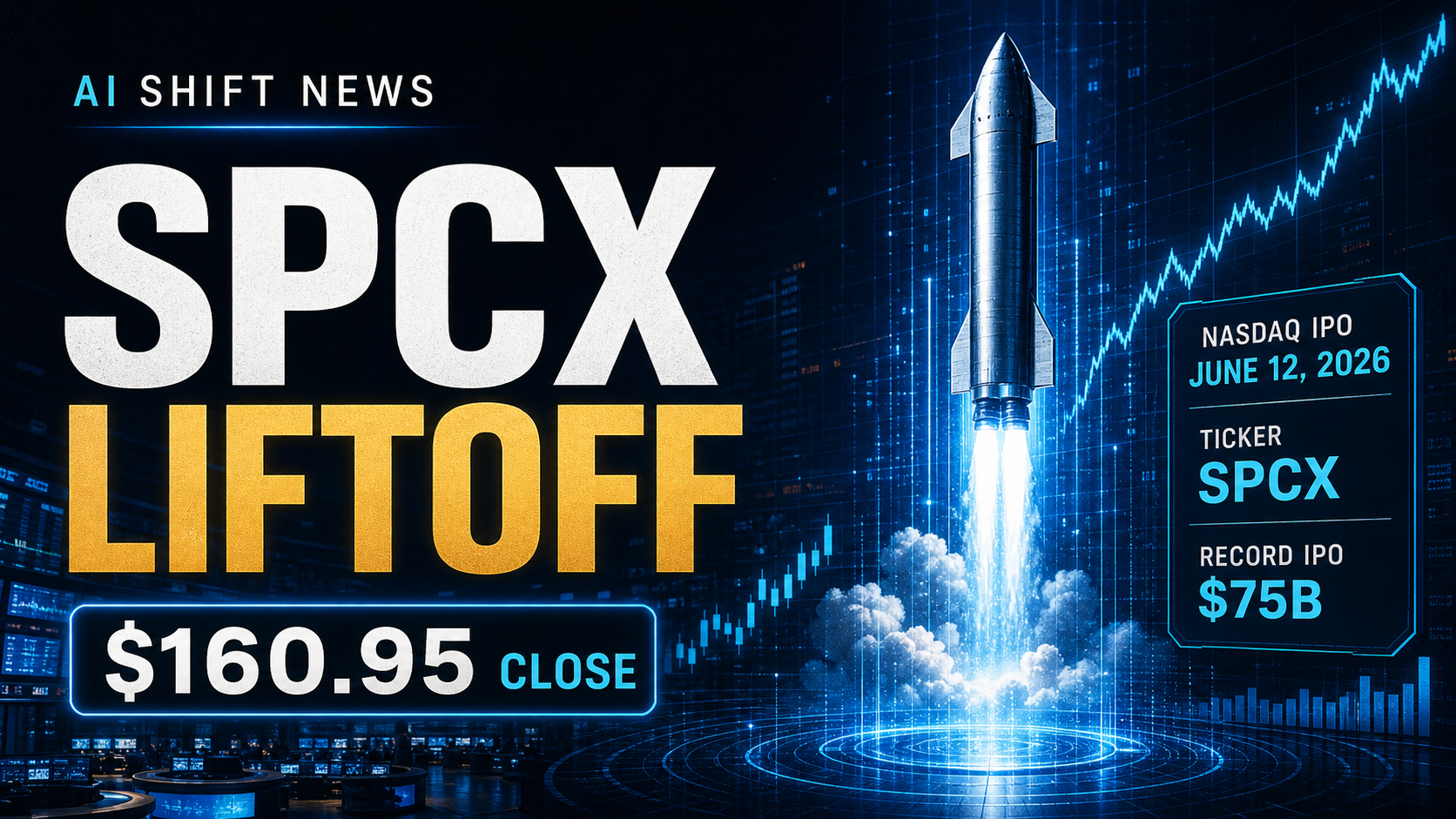
SpaceX finally hit the public markets on Friday, June 12, 2026, and the debut was as loud as the rocket metaphor everyone was waiting to use.
The company began trading on Nasdaq under the ticker SPCX in what multiple outlets described as the largest IPO ever. Business Insider reported that SpaceX raised $75 billion, priced at $135 per share, and closed its first day at $160.95, up about 19%. MarketWatch and the Wall Street Journal also reported a $160.95 close.
The Numbers
- Ticker: SPCX
- Exchange: Nasdaq
- IPO date: June 12, 2026
- Reported raise: $75 billion
- Reported IPO price: $135 per share
- First-day close: $160.95
- Reported first-day move: roughly 19%
- Reported closing valuation: about $2.1 trillion
Why AI Shift Readers Should Care
SpaceX is now a public proxy for several big AI-era themes at once.
First, Starlink is not just internet access. It is a global data distribution layer. If AI systems keep moving into real-time devices, logistics, defense, drones, vehicles, remote work, and edge computing, low-latency satellite connectivity becomes a strategic asset.
Second, SpaceX sits at the intersection of government demand and commercial scale. Launch contracts, defense communications, satellite services, and private infrastructure all feed into the same investor narrative: whoever controls the rails may capture more value than whoever builds a single app on top.
Third, the IPO gives public investors direct exposure to a company that has been private for more than two decades. Until now, most people could only touch the SpaceX story indirectly through funds, suppliers, or companies connected to Elon Musk's wider orbit.
Risks Before Anyone Gets Swept Up
The hype is real, but so are the risks.
Valuation is the first one. A company worth roughly $2.1 trillion has to execute almost perfectly for a long time. If revenue growth, margins, launches, Starlink adoption, or AI infrastructure plans disappoint, the stock could reprice quickly.
Control is the second. Reports emphasized Elon Musk's large ownership and influence. That may comfort investors who believe in founder control, but it also concentrates strategic and governance risk.
Profitability is the third. Business Insider cited analyst concerns about current fundamentals, including losses and a valuation built on future growth. SpaceX may have extraordinary assets, but the public market is paying for a long-term machine that still has to prove how much durable cash it can produce.
Volatility is the fourth. This was a huge, emotional, high-demand IPO. First-day trading does not tell us what the stock is worth once the initial rush fades.
What To Watch Next
- Index inclusion: if SpaceX moves quickly into major indexes, forced buying from funds could add another wave of demand.
- First earnings: the first public report will matter more than first-day enthusiasm.
- Governance: concentrated control can feel different if results wobble.
- Competitors and suppliers: Rocket Lab, satellite companies, defense contractors, AI infrastructure firms, and telecom names may all react.
The Bottom Line
The SpaceX IPO was not just a market debut. It was the public-market arrival of a company trying to bundle rockets, satellites, communications, defense infrastructure, and AI-era compute ambition into one mega-cap story.
That makes SPCX exciting. It also makes it dangerous to treat like a normal first-day winner.
The smart read is not "buy because rockets are cool." The smart read is: SpaceX just became one of the most important public companies to watch in the AI infrastructure era, and the first real test starts after the IPO glow wears off.
Analysis, not financial advice.