
 Shift News
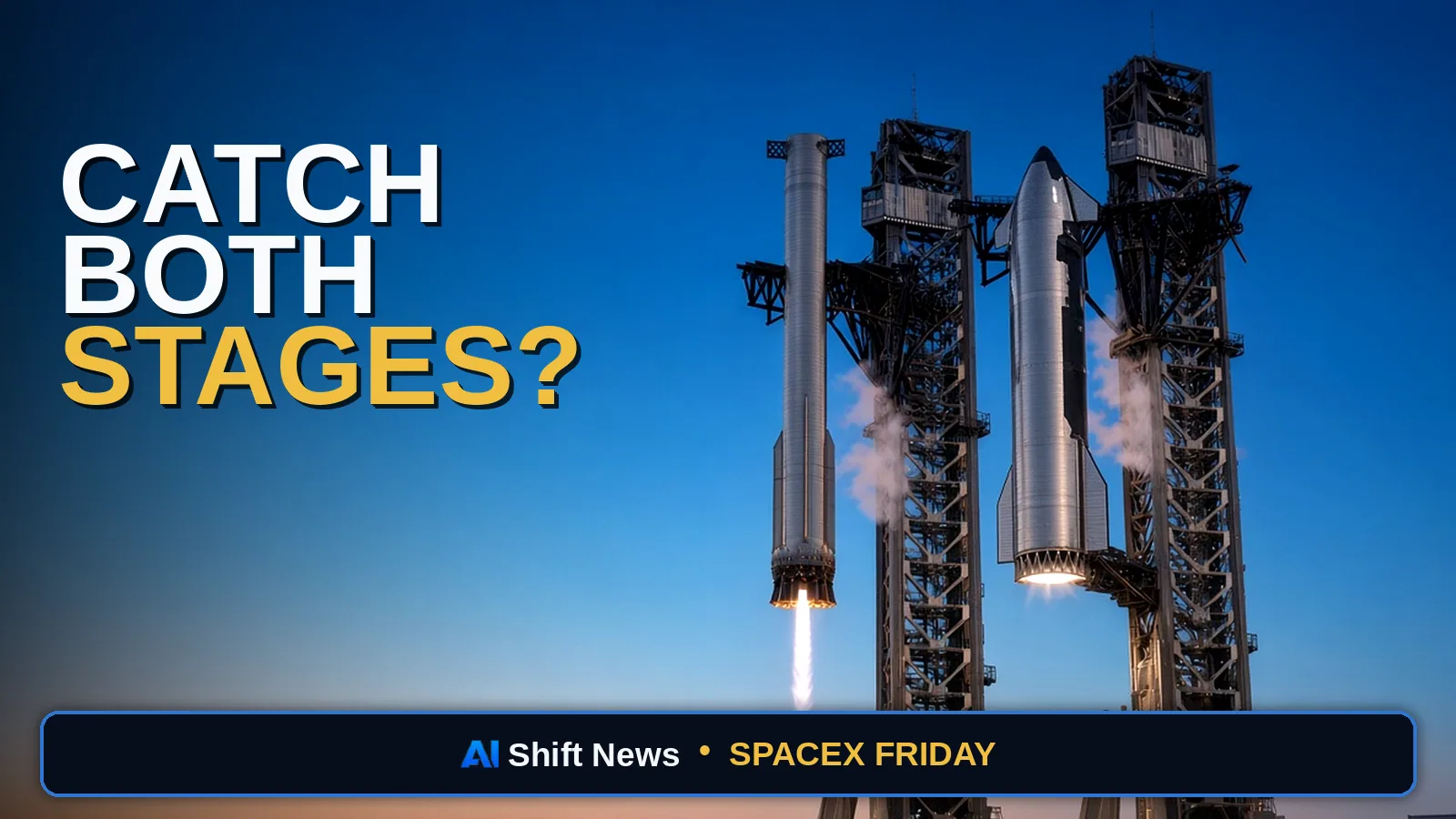
VideoFromSpace (Space.com): "Elon Musk: SpaceX Will Attempt to Catch BOTH Starship & Booster on Flight 15!". Facts on this page cite the primary sources below, not the video.
Honest fence (read first): On Tuesday, Oct 20, during SpaceX's first earnings call as a public company, Elon Musk said Starship Flight 15, expected "next month," will try to catch both the Super Heavy booster and the Ship with the launch tower at Starbase. President Gwynne Shotwell said SpaceX expects the FAA license for Flight 15 to cover a return to the launch site and tower catch for both stages. That license has not been published, SpaceX gave no launch date, and the only specific date in public, no earlier than Nov 8, is an FAA airspace planning marker, not a countdown. This is a plan stated by the company, not a result.
Editorial Thesis
SpaceX has caught a Super Heavy booster before. It has never caught a Ship. The Ship comes back from orbit, much faster and hotter than a booster coming back from a few minutes of flight, and to land at the tower it has to fly back over land instead of splashing into the ocean. So the real news from Tuesday isn't "SpaceX wants to catch Starship." Everyone knew that was the goal. The news is that SpaceX has now put this specific flight on the record for a double catch, put odds on it, and said it expects regulators to sign off. Those are three different kinds of claims, and they deserve to be checked separately.
Honest Verdict
Confirmed (company statements on the call): Flight 15 will attempt to catch both stages; SpaceX expects it next month; Musk rates success "more likely than not"; Shotwell expects the FAA license to include return to launch site and tower catch for both stages. Confirmed (public record): the FAA has finished an environmental assessment that covers Starship "Return to Launch Site mission profiles" at Boca Chica. Not confirmed: a Flight 15 license, a launch date, completed static fires for Booster 22 and Ship 42, and of course whether either catch works.
What SpaceX actually said
All quotes below are from the Oct 20 call. We checked them against a published transcript and against Space.com, Ars Technica and Teslarati, which quote the same lines.
Musk, on the plan: "For Flight 15, which we expect to happen next month, we're going to attempt to catch both the booster and the ship." He added that if it works, "it will be the first time that an orbital launch vehicle has been fully recovered."
Musk, on the odds: "Success is not guaranteed on these first flights, but I'd say it's more likely than not that this succeeds next flight. And if not, we have a steady stream of Starship flight attempts through the end of this year and then accelerating next year."
Shotwell, on the regulator: "We have had significant constructive engagement with the FAA, and we expect the license for our Flight 15 to include return to launch site and tower catch for both stages."
Shotwell, on what comes after: SpaceX remains "on track with our goals to bring back both the first and second stages to the tower this year, refly the second stage by early next year," and it will "attempt an on-orbit refueling early next year."
Musk, on cadence: Starship should fly "weekly at some point in the first half next year and then second half next year, twice weekly or maybe even more frequently."
During the call SpaceX also played an animation of the Ship catch. Teslarati describes it as about 80 seconds long, running under an "Up Next: Ship Catch" banner: the Ship falls belly-first with its flaps steering, flips vertical near the shoreline, and drops into the tower's arms. That's a simulation of the plan. It's useful for understanding the maneuver. It is not flight footage.
Why catching the Ship is harder than catching the booster
Super Heavy has been caught by the tower's "chopstick" arms three times, on Flights 5, 7 and 8, according to Teslarati's count. The booster does its job in the first few minutes of flight, turns around, and comes straight back to Starbase.
The Ship is a different problem:
- It comes back from orbit. Flight 14 on Sept 28 was the first Starship to reach orbit. A Ship returning from orbit carries far more energy than a booster, so the heat shield takes the brunt of reentry before any catch.
- It has to come home over land. To reach the tower in South Texas, the Ship's return path crosses land, including northern Mexico, according to Ars Technica. Every Ship so far has ended in the ocean, by design.
- It has to hit a small target. The tower arms have to grab the Ship at the right points, at the right moment, after a flip from horizontal to vertical in the last seconds.
Musk said back in February that SpaceX would bring a Ship over land only once the chance of it breaking up over land was very low, according to Teslarati. Tuesday's call is SpaceX saying it believes it's at that point. The FAA's license decision is where that belief gets tested by someone outside the company.
Where the hardware actually stands
The company's plan and the hardware on the ground don't always move together. Here's the latest public picture, all from outside observers, because SpaceX doesn't publish a hardware status board:
- Ship 42 is the Flight 15 Ship. In September, Teslarati reports, Ship 42 was lifted by the Pad 2 chopsticks into a simulated catch position, where crews cycled the arms while it hung from the tower. That was a fit check on real hardware, not a catch.
- Its engines came out, then started going back in. NASASpaceflight reported on Oct 18 that SpaceX removed Ship 42's engines before its static fire and sent it back to the Massey's test site for another cryogenic test. NSF's Oct 21 update says Ship 42 "is also receiving Raptors again" after that test. The removal may be linked to the early shutdown of one vacuum Raptor on Flight 14. Musk has called that a software glitch on a single engine's computer.
- Booster 22 had all its engines installed and was waiting to move to Pad 2 for its static fire, per NSF on Oct 18.
- The engines are Raptor 3. This is the V3 generation: Booster 22 is a V3 booster, and NSF's latest update notes long-duration Raptor 3 firings at SpaceX's McGregor test site.
Both vehicles still need a static fire before launch. Those tests are public events, usually visible on Starbase livestreams and in road-closure notices. Neither had happened as of NSF's latest update.
The date question
The most specific date in public is NET Nov 8, from the FAA's air traffic planning (CADENA) slides that NASASpaceflight reported on Oct 18. We covered that date earlier this month. It's a planning marker for airspace, and those markers move. NSF also reported that Musk had talked about a launch "within the next four to six weeks, before Thanksgiving," which lines up with early to mid November.
On Tuesday's call, Musk only said "next month." He didn't give a day. Space.com noted the same thing. So the honest answer to "when is Flight 15?" is still: November is the company's aim, Nov 8 is the earliest planning marker, and no date is set.
The FAA piece, in plain English
Two different FAA documents matter, and they're easy to mix up.
- The environmental review. The FAA's Starship project page (updated Oct 22) lists a completed environmental assessment, with a finding of no significant impact, for "updated operations for Starship Return to Launch Site mission profiles" at Boca Chica. This tells you the FAA studied the environmental effects of bringing Ships back to Starbase and signed off on them.
- The launch license. This is the permission for a specific flight profile, covering public safety, airspace and more. Shotwell said SpaceX expects the Flight 15 license to include return to launch site and tower catch for both stages. We did not find that license or a modification for it on the FAA's Starship page as of Friday morning.
An environmental finding is not a license. Until the license appears, the double catch is a plan that still needs a signature. If the FAA approves a different profile, for example a booster catch with an ocean landing for the Ship, the mission changes.
That same FAA page also shows the much bigger, slower process for SpaceX's request to fly up to 456 Starship launches a year from Starbase. Public scoping meetings are set for Nov 17 to 19, and comments close Nov 30. That's years-scale paperwork, and it isn't what gates Flight 15.
Claim vs proof
| Claim | Who said it | Proof today | What would prove it |
|---|---|---|---|
| Flight 15 will try to catch both stages | Musk, Oct 20 call | Company statement + animation | The flight |
| Flight 15 is "next month" | Musk | NET Nov 8 planning slide (NSF) | A license and a SpaceX launch announcement |
| Success is "more likely than not" | Musk | His own estimate | The result |
| FAA license will include RTLS + tower catch for both stages | Shotwell | Completed environmental assessment for RTLS profiles | The license itself |
| Ship refly "early next year" | Shotwell | None yet | A caught Ship flying again |
| Weekly Starship flights in H1 2027 | Musk | Starbase is capped at 25 launches a year today (FAA) | Launch cadence data |
Why it matters
If the Ship catch works, it's the piece that turns Starship from a rocket that throws away its upper stage into one that brings everything home. That's the whole basis for SpaceX's cost and cadence claims, for the Starlink V3 rollout, and for NASA's Moon plans, which depend on many Starship launches. If it doesn't work on Flight 15, Musk has already said SpaceX has more vehicles lined up. Both outcomes are worth watching. Neither has happened yet.
There's also a reason to keep expectations calibrated: this is the first Ship catch attempt ever, on a new generation of vehicle and engine, after a flight where one engine shut down early. "More likely than not" is a confident thing to say. It still leaves a lot of room for "not."
What to watch next
- Booster 22 and Ship 42 static fires. Watch Starbase livestreams and Cameron County road-closure notices.
- The FAA license for Flight 15, and whether it includes the Ship's return to the launch site.
- A SpaceX mission page and a launch date. SpaceX usually posts one a few days ahead.
- Flight 16. NSF says it's aimed for December and could be the first Starship launch from Kennedy's LC-39A.
Video note
Space.com's video (di6_DcLjeWE, 14:28, uploaded Oct 20 at 5:47 PM ET) uses SpaceX's own call audio and footage, including the catch animation. NASASpaceflight's Oct 21 Starship Update (jpmXdGzy4gk) is the better source for hardware status, including Ship 42's engines going back in. Watch the source, not a reaction video.
Bottom Line
Confirmed (company statements on the call): Flight 15 will attempt to catch both stages; SpaceX expects it next month; Musk rates success "more likely than not"; Shotwell expects the FAA license to include return to launch site and tower catch for both stages. Confirmed (public record): the FAA has finished an environmental assessment that covers Starship "Return to Launch Site mission profiles" at Boca Chica. Not confirmed: a Flight 15 license, a launch date, completed static fires for Booster 22 and Ship 42, and of course whether either catch works.Sources
- SpaceX Investor Relations: Q3 2026 results and audio webcast (Tue Oct 20, 4:30 PM ET). Quotes checked against the TradingKey transcript and Space.com/Ars/Teslarati
- FAA: SpaceX Starship project page (last updated Oct 22, 2026): completed environmental assessment covering Starship Return to Launch Site profiles; 456-launch PEIS scoping. Not a launch license
- Space.com (Mike Wall), Oct 20: Musk confirms double-catch attempt on Flight 15, no date given
- Ars Technica (Eric Berger), Oct 21: Shotwell's FAA quote, return over land incl. northern Mexico, refly and refuel early 2027
- SpaceNews (Jeff Foust), Oct 20: both stages, pending regulatory approval
- Teslarati, Oct 21: the ~80-second catch animation; three booster catches so far (Flights 5, 7, 8); Ship 42 chopstick lift test in September
- NASASpaceflight (Bergin/Reid), Oct 18: NET Nov 8 on CADENA slides, Ship 42 engines pulled for extra cryo test, Booster 22 waiting on Pad 2 static fire
- NASASpaceflight Starship Update, Oct 21: Ship 42 receiving Raptors again after cryo testing (alt video)
- AI Shift News, earlier: Flight 15 NET Nov 8 on FAA planning slides (the date this post updates)
- VideoFromSpace (Space.com): Elon Musk: SpaceX Will Attempt to Catch BOTH Starship & Booster on Flight 15! (uploaded Oct 20; embed)