
 Shift News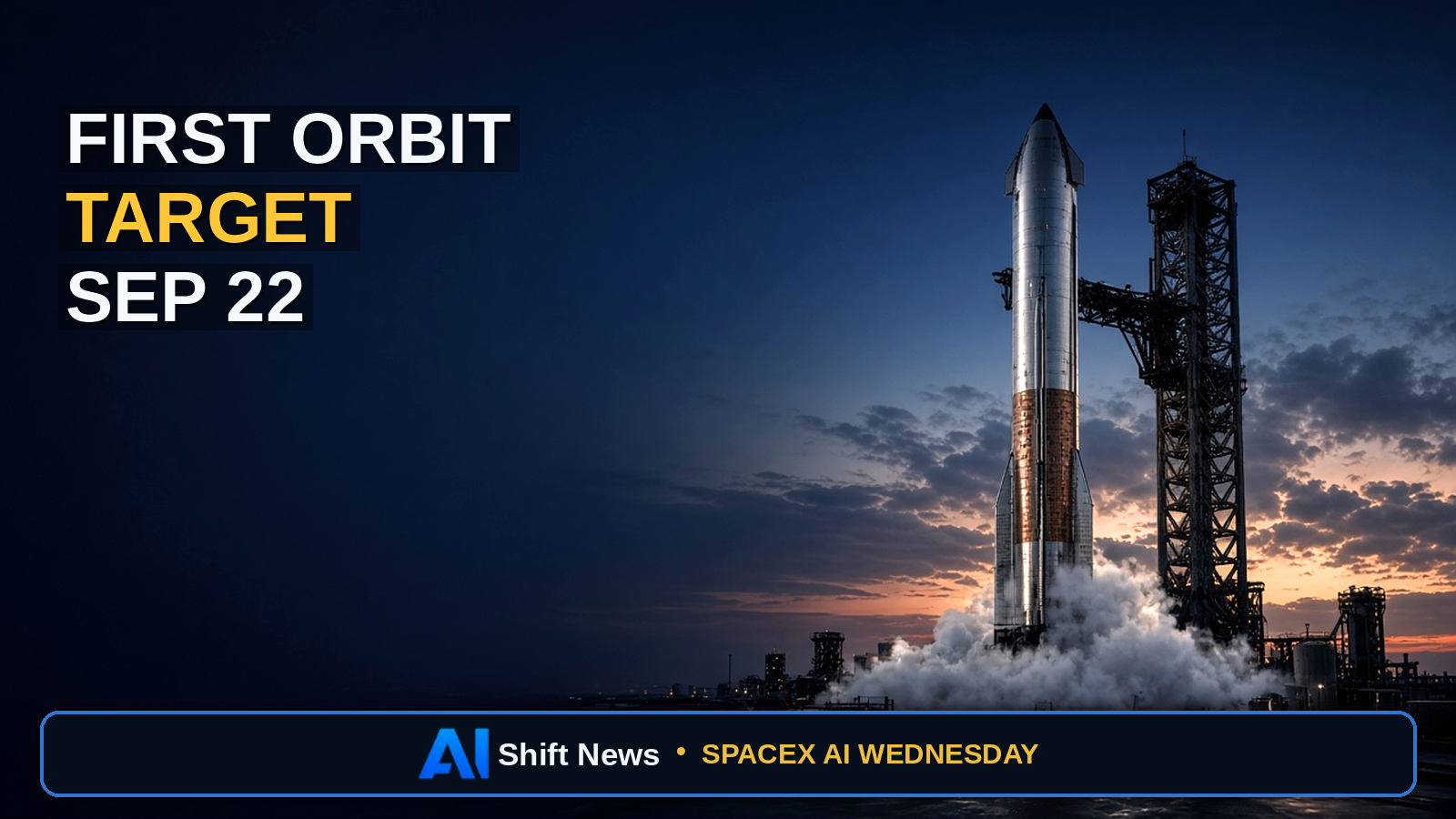
SpaceX’s official Flight 14 mission page now targets liftoff as early as Tuesday, September 22, 2026, during a 75-minute window opening 7:15 a.m. CT (8:15 a.m. EDT), pending regulatory approval. The company frames the flight as Starship’s first planned orbital attempt (~275 km, roughly six orbits, ~10-hour mission ending with a Pacific splashdown west of Chile) and the first planned deploy of 26 Starlink V3 satellites (SpaceX cites ~1 Tbps each → ~26 Tbps total, ~10× one Falcon 9 V2 mini launch — company comparison). Super Heavy is planned for an offshore Gulf landing — not a tower catch. Ship orbital insertion is gated on a deorbit-burn redundancy check. Secondary: Mike Wall / Space.com (Sep 15) restates the package; TeslaNorth notes FAA COPA airspace for Sep 22/23 — not a locked countdown. This flagship is a dated target + mission architecture receipt — not a flown success and not proof every license condition is closed.
Will Starship Finally Go Orbital? - Starship Flight 14 - Countdown to Launch · NASASpaceflight
Quick Take
SpaceX’s official Flight 14 mission page now targets liftoff as early as Tuesday, September 22, 2026, in a 75-minute window opening 7:15 a.m. CT (8:15 a.m. EDT), pending regulatory approval. The company frames the flight as Starship’s first planned orbital attempt and the first planned deploy of 26 Starlink V3 satellites.
- Confirmed (primary / Space.com restatement): Sep 22-as-early-as target; 75-minute window; pending approval; ~275 km, ~six orbits, ~10-hour Ship flight; Pacific splashdown west of Chile.
- Confirmed (payload framing): 26 Starlink V3; SpaceX cites ~1 Tbps each → ~26 Tbps, ~10× one Falcon 9 V2 mini launch (company comparison).
- Confirmed (recovery): Super Heavy offshore Gulf landing — not a tower catch; Ship not caught this flight.
- Confirmed (ops notes): Orbital insertion gated on deorbit-burn redundancy check; heatshield experiments; two Ship 40 tiles reflown on Ship 41.
- Confirmed (secondary FAA via TeslaNorth): COPA airspace Sep 22 primary / Sep 23 backup — airspace plan, not a locked countdown.
- Reject as fact: Flown orbital success; countdown lock; tower catch on Flight 14; redo of static-fire / Pad 2 / Louisiana packages.
What the video shows
Recommended embed for this package: NASASpaceflight — “Will Starship Finally Go Orbital? - Starship Flight 14 - Countdown to Launch” (YouTube q-7zyYItMZc). House note: this is Sep 22 orbital-target/hardware footage for Flight 14 hardware — it is not a rewrite of the Sep 22 orbital/V3 mission page and not a flown-success clip. Prefer this embed with that hedge over NONE so readers see current Starbase hardware context while the article lead stays on the official date + orbit + V3 package. Do not let pad-roll narration stand in for a countdown clock or an orbital receipt.
What’s new
AI Shift News has already covered Flight 14’s static fires, Booster 21 on Pad 2, T-minus-week / stack-off-pad status, the FAA paperwork NET Sep 15 marker, and Louisiana Starbase infrastructure beats. What is new is an official dated target plus a full first-orbit / first-V3 mission architecture: SpaceX now points to September 22 as early as possible (still pending approval), publishes the 75-minute CT window, and spells out an orbital Ship profile with a named Starlink V3 deploy count.
That package matters because it separates three things readers often mash together: (1) hardware is at the pad, (2) regulators and range have an airspace plan, and (3) SpaceX has published a specific attempt date and orbital objectives. Items (1) and (2) were already in prior AISN packs; item (3) is this flagship’s lead.
Space.com’s Mike Wall (Sep 15) mainly restates the official page for a general audience — useful secondary packaging, including the camera-equipped Starlinks for post-deploy heatshield imagery and the explicit “no catch” recovery note. TeslaNorth’s FAA COPA writeup adds the Sep 22/23 airspace hold without upgrading it into a webcast lock. Use both as amplification; keep the SpaceX mission page as the primary spine.
Evidence
SpaceX Flight 14 page (primary). Targets launch as early as Tuesday Sep 22, 2026, pending regulatory approval; 75-minute window opening 7:15 a.m. CT. Frames first planned orbital Starship flight (~275 km, ~six orbits, ~10-hour duration, Pacific splashdown west of Chile). First planned deploy of 26 Starlink V3; company cites ~1 Tbps per satellite (~26 Tbps aggregate) and ~10× one Falcon 9 V2 mini launch. Super Heavy: offshore Gulf landing (not tower catch). Ship: orbital insertion only after deorbit-burn redundancy check; heatshield experiments; two Ship 40 tiles reflown on Ship 41.
Space.com (Mike Wall, Sep 15) — secondary. Restates Sep 22 target; window opens 8:15 a.m. EDT / 7:15 a.m. local Texas time; quotes SpaceX on orbit enabling the next reusable-development phase and on first Starlink V3 deploy; notes three camera-outfitted Starlinks for heatshield imagery; contrasts prior ~65-minute Indian Ocean suborbital Ship profiles; confirms Super Heavy Gulf splashdown ~seven minutes after liftoff and no chopstick catch of either stage this flight.
TeslaNorth (Sep 15) — secondary FAA airspace. FAA Current Operations Plan Advisory lists “SPACEX STARSHIP FLT-14, STARBASE, TX” with primary window Sep 22, 12:15–14:14 UTC (7:15–9:14 a.m. CT) and Sep 23 backup same hours. Explicit hedge: airspace notices plan the national system around a flight; they are not a SpaceX webcast time and do not by themselves prove every launch-license condition is closed.
What is still missing (confirmed fence). No flown orbital insertion; no closed public statement that every regulatory condition is already green; no post-flight confirmation of V3 health or throughput; no tower-catch attempt on this profile.
What this does not prove
- It does not prove Flight 14 will lift off on September 22. SpaceX says “as early as” and pending regulatory approval; Starship dates have slipped before.
- It does not prove Starship has already reached orbit. This is a planned first orbital attempt, not a flown receipt.
- It does not prove 26 Starlink V3 satellites are already delivering ~26 Tbps. That is the planned deploy package and company throughput framing.
- It does not prove a tower catch. Super Heavy is planned offshore Gulf; Ship is planned Pacific splashdown.
- FAA COPA airspace is not a countdown clock. It is an airspace plan for Sep 22/23, not proof the license package is fully closed.
- The NASASpaceflight pad-roll video is not a mission-page rewrite. Related hardware context only.
- It does not replace prior AISN Flight 14 packages. Static fires, Pad 2, paperwork NET, and Louisiana Starbase stays separate.
Why it matters
For practical readers, Starship coverage often collapses “hardware moved” into “orbit next Tuesday.” Separating the official Sep 22 target from pad choreography and from FAA airspace holds keeps the newsroom honest: the new public fact is a dated orbital attempt with a named first V3 payload — still gated on approval and still unflown.
It also matters as an AI/connectivity beat under SpaceX AI Wednesday. Starlink V3 on Starship is how SpaceX says it will jump constellation throughput; Flight 14 is the first planned public test of that packaging. Company Tbps claims stay in the Claim fence until on-orbit performance is measured.
Finally, the no-catch recovery choice clarifies what “first orbit” buys versus what it defers. Orbit and V3 deploy are the big boxes this flight aims to check; chopstick reuse of Ship (and another Super Heavy catch) remain future milestones.
What to watch next
- Regulatory / range greenlights — whether SpaceX and the FAA convert the Sep 22 airspace hold into an actual attempt window.
- Stack and weather — final stacking, propellant, and range weather on the attempt day.
- Deorbit-burn redundancy gate — whether Ship clears the insertion criteria SpaceX described.
- V3 deploy and heatshield imagery — how many satellites separate cleanly and what the camera Starlinks show of the heatshield.
- Slip / backup day — Sep 23 COPA backup and any official retarget if Tuesday does not go.
Bottom Line
SpaceX now targets Starship Flight 14 as early as Tuesday, September 22, 2026 (75-minute window from 7:15 a.m. CT), pending regulatory approval, for the vehicle’s first planned orbit (~275 km, ~six orbits, ~10 hours, Pacific splashdown west of Chile) and the first planned deploy of 26 Starlink V3 satellites. Super Heavy is planned for an offshore Gulf landing — not a tower catch. Treat this as an official target + mission architecture receipt, not a flown success and not a locked countdown. FAA COPA airspace for Sep 22/23 reinforces the calendar without closing every license condition. Embed NASASpaceflight’s B21 pad-roll only with the hedge that it is related hardware footage, not a Sep 22 orbital/V3 rewrite.
Sources
- https://www.spacex.com/launches/starship-flight-14
- https://www.space.com/space-exploration/launches-spacecraft/spacexs-next-starship-launch-will-lift-off-on-sept-22-and-aim-to-reach-orbit-for-1st-time
- https://teslanorth.com/2026/09/15/faa-starship-flight-14-september-22/
- https://www.youtube.com/watch?v=q-7zyYItMZc