
 Shift News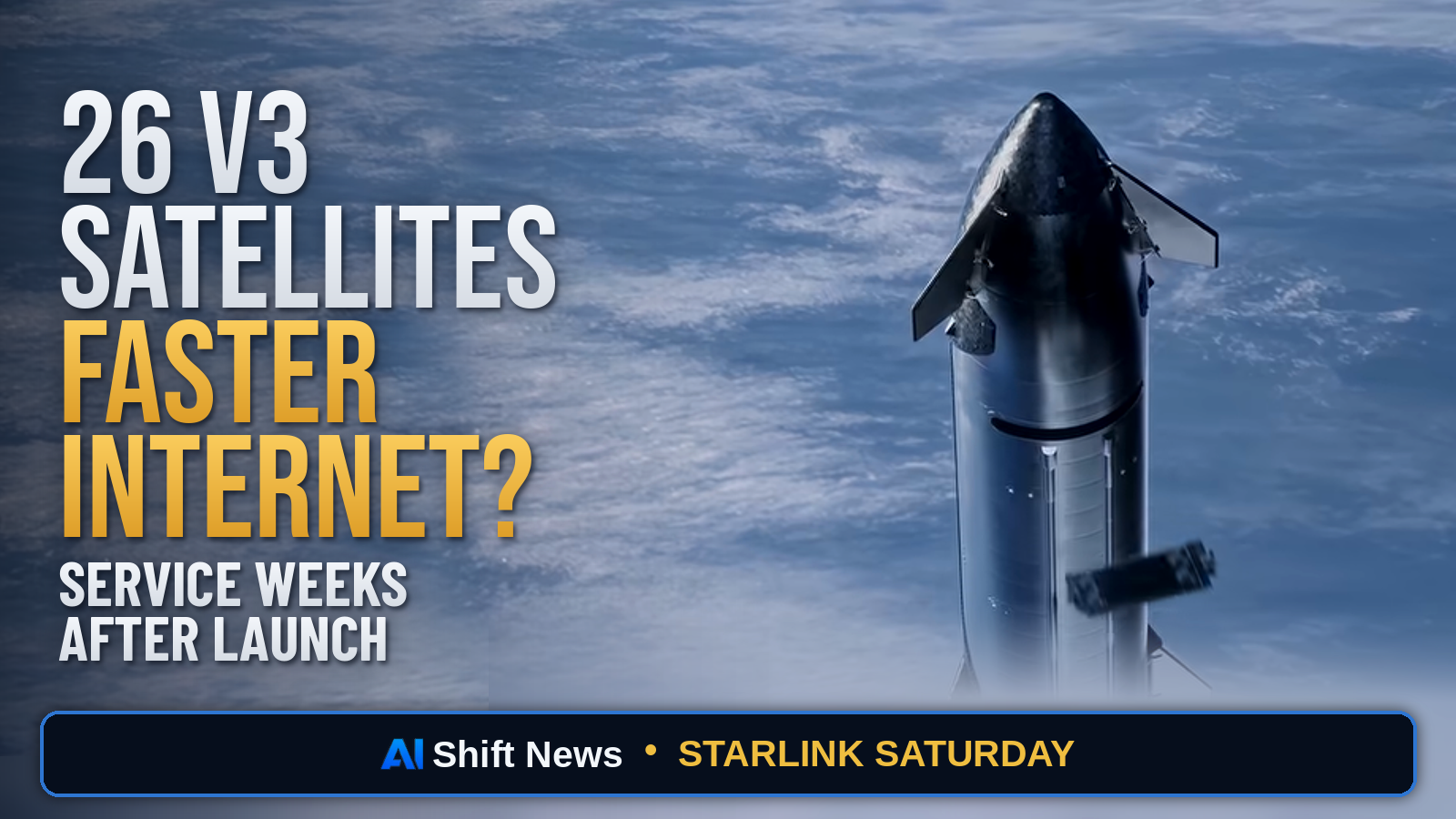
Starship Flight 14 is set to carry 26 Starlink V3 satellites, the first V3s meant to stay in orbit and join the network. SpaceX says each V3 adds 1 Tbps of capacity, or 26 Tbps on this flight, about 10x a Falcon 9 launch of V2 Minis. Those are design and capacity figures from SpaceX. They are not measured customer speeds, and service would start weeks after launch at the earliest.
Spaceflight Now — Starship Flight 14: SpaceX’s next giant leap with Starlink — Spaceflight Now (published Sept. 26, 2026): reporter Will Robinson-Smith asks Starlink experts what changes between V2 Mini and V3 and how it may affect consumers. The numbers in this brief come from SpaceX’s own documents.
At a glance
Capacity ≠ your speed test. V3 is SpaceX’s biggest per-satellite jump so far on paper. Flight 14 is the first time V3s are meant to reach orbit and stay there.
- Confirmed (SpaceX): 26 V3 satellites on Flight 14, 1 Tbps each, 26 Tbps total, about 10x a V2 Mini Falcon 9 launch.
- Confirmed (SpaceX): V3 is designed for more than 1 Tbps down and more than 200 Gbps up per satellite and will fly lower to cut latency.
- Not yet shown: On-orbit checkout, service start (SpaceX says as soon as a few weeks after launch), and real customer speeds.
What changes from V2 Mini to V3, per SpaceX
V2 Mini satellites have been Starlink’s workhorse on Falcon 9. SpaceX’s 2025 Progress Report says the company flew more than 120 dedicated Falcon 9 Starlink missions last year and launched more than 3,000 “V2 Mini Optimized” satellites, adding more than 270 Tbps of capacity. The same report describes V3 as an order-of-magnitude step: each satellite is designed for more than a terabit per second of downlink and more than 200 Gbps of uplink, which SpaceX calls more than 10 times the downlink and 24 times the uplink of the second generation. V3s are meant to be launched by Starship, not Falcon 9, and to operate at lower altitudes for better latency.
What Flight 14 actually carries
SpaceX’s Flight 14 page is specific: 26 V3 satellites, each adding 1 Tbps, for 26 Tbps on this mission. SpaceX says that is about 10 times the capacity of one Falcon 9 V2 Mini launch. After deployment, the satellites are supposed to unfold their antennas and solar arrays, make contact through radio and laser links, and raise their orbits with onboard thrusters. SpaceX says they should begin serving customers “as soon as a few weeks after launch.” The Progress Report’s larger projection, about 60 Tbps per V3 Starship launch, applies to later full-load flights, not this first one.
What isn’t proven yet
All of these figures are SpaceX design and capacity numbers. Capacity is how much bandwidth the network gains. What one household or one airline cabin sees is a different measurement, and none exists yet for V3. Flight 14 also has to reach orbit first. It is Starship’s first orbital attempt, and it still needed FAA license approval as of Saturday morning ET.
Bottom Line
If Flight 14 works, this is the first real test of SpaceX’s V3 capacity claims. The receipt to watch for isn’t the launch alone. It’s the 26 satellites passing checkout, entering service, and then showing up in real speed data. Until then, “10x” describes capacity per satellite, not a promise of 10x faster internet.
Sources
- https://www.spacex.com/launches/starship-flight-14
- https://starlink.com/public-files/starlinkProgressReport_2025.pdf
- https://www.space.com/space-exploration/launches-spacecraft/spacexs-starship-megarocket-aces-launch-rehearsal-ahead-of-1st-orbital-test-flight-video
- https://www.youtube.com/watch?v=8M6TGSn5-7s