
 Shift News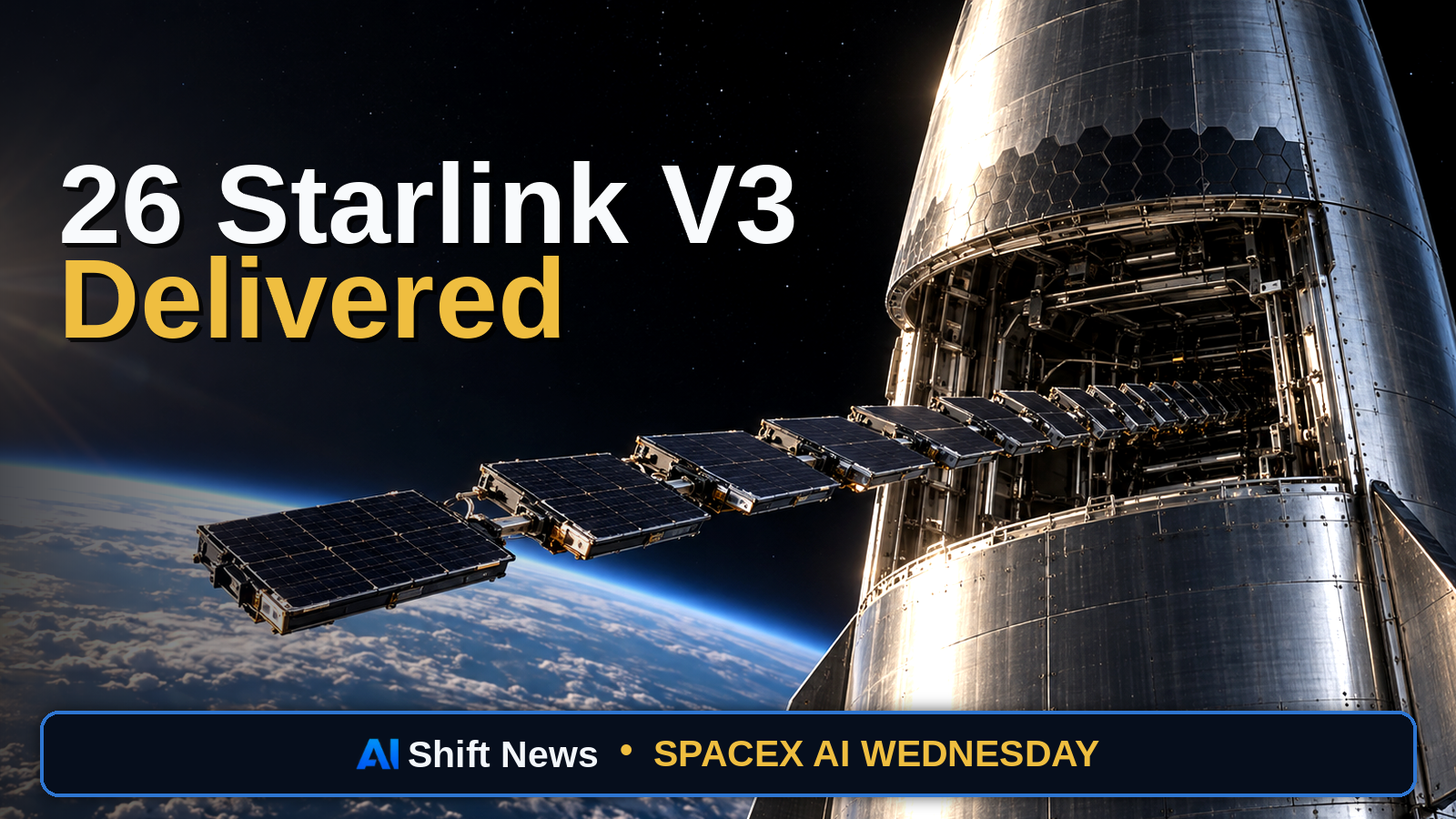
On Flight 14, Starship deployed 26 Starlink V3 satellites with Pez-deploy views from Ship and lookback views from the satellites themselves. SpaceX says contact with all 26 is established; the sats still face on-orbit checkout and orbit raise before customers. Fence 1 Tbps / ~10× / user-speed lines as company capacity claims.
VideoFromSpace — “Whoa! SpaceX Starship’s Starlink deployment seen by ship and satellite cameras” (published September 28, 2026). Visual match for Pez deploy and satellite lookback. Flight facts cite Ars Technica, Space.com, Spaceflight Now, and Launch Library 2 — not the YouTube title.
Honest fence (read first): This SpaceX AI Wednesday flagship is about Starlink V3 constellation ops after Flight 14 — Pez deploy imagery, satellite lookback cameras, and SpaceX’s contact / checkout path — not a redo of the live orbit-and-short-coast brief (#303). The embed is VideoFromSpace, “Whoa! SpaceX Starship’s Starlink deployment seen by ship and satellite cameras” (wWfJ3cXacws), published September 28, 2026. Treat the YouTube “Whoa!” packaging as a title, not a SpaceX fact sheet. SpaceX’s Flight 14 page (https://www.spacex.com/launches/starship-flight-14/, also tried with trailing /n) is a JavaScript shell in this desk’s fetch tools; deploy, contact, and capacity language below is taken from Ars Technica’s September 28 report quoting SpaceX, Space.com, Spaceflight Now, and Launch Library 2.
Editorial Thesis
Flight 14’s scarce new ops file is that commercial-grade Starlink V3 satellites left a Starship in orbit on camera, and SpaceX says the constellation team has contact with all 26. That is a constellation-build event. It is not proof that household Starlink speeds already feel “V3.” Capacity numbers SpaceX publishes for V3 are company design claims. Quilty Space’s Caleb Henry, quoted by Ars, said it will take many more V3s before those satellites define the user experience. Keep those sentences apart.
Honest Verdict
Twenty-six Starlink V3 satellites rode Flight 14 and were released through Starship’s Pez-style deployer. Cameras on Ship and on the satellites themselves recorded the sequence; three of the V3s carried cameras aimed at inspecting Starship’s heat shield after deploy (The Conversation, citing the mission design). SpaceX told reporters it established contact with all 26. Serving customers still sits behind on-orbit checkout and orbit-raising work. Prefer that ops ladder over any thumbnail that implies users already feel V3.
What left the ship
Ars Technica’s Stephen Clark (September 28, 2026) reports that SpaceX packed 26 next-generation Starlink broadband satellites into the cargo bay and released them one by one with a pulley-and-cable Pez dispenser. Each V3 weighs about 2 metric tons (4,400 pounds) at launch — too large for Falcon 9’s fairing — with larger solar arrays and improved antennas. Spaceflight Now’s William Harwood places the Pez sequence roughly eight-and-a-half minutes after the orbit-insertion go. Space.com’s Mike Wall published the ship-camera and satellite-lookback stills that make this slot visual: a flat-packed V3 sliding out over Earth’s limb, and a bird’s-eye view of Ship from a just-deployed satellite.
Flight 13 had already lofted V3 hardware on a suborbital path; those satellites burned up on the way down. Do not equate Flight 13’s short ride with Flight 14’s orbital deploy. Launch Library 2 names the mission Starship | Starlink Group 31-1 (Starship Flight 14) and marks status Launch Successful for payload insertion. An LL2 update on the day of flight records that all Starlink satellites were deployed and in contact with ground stations.
Cameras are receipts for deploy — not for reuse
VideoFromSpace’s cut stitches SpaceX-released views: Ship looking out through the Pez slot, and satellites looking back at Starship. That is the right visual match for a deploy-ops flagship. The Conversation’s Sven Bilén (September 29, 2026) notes that three of the released Starlinks carried cameras to inspect the heat shield after deployment — a post-ascent inspection trick for engineers comparing tile state before and after reentry. Useful for the heat-shield desk. It does not convert deploy B-roll into a completed thermal-protection reuse certificate. Camera footage of satellites leaving Ship is not a teardown of Ship 41 after splashdown.
Contact, checkout, and when customers might notice
Ars quotes SpaceX: the satellite team established contact with all 26 after separation. SpaceX also said this group should be integrated into the broader constellation and begin serving customers as soon as a few weeks after launch. That is company timeline language, not a measured speed test in a subscriber app. Henry’s Quilty line, also in Ars, is the house hedge: capacity onboard is great; until a meaningful number of V3s are up, they will not yet define the user experience.
House ladder for readers:
- Deployed — Pez sequence completed; imagery exists.
- In contact — SpaceX / LL2 update language.
- Checkout and raise — still ahead of routine customer service.
- User speeds — not proven by this flight’s press kit.
Capacity claims stay fenced
SpaceX’s published V3 design numbers, as carried by Ars and Space.com:
- About 1 Tbps of downlink capacity per satellite (SpaceX; Space.com also cites 160 Gbps uplink in SpaceX’s technology description).
- Roughly ~10× downlink capacity improvement versus the V2 / Falcon-era generation SpaceX compares against.
- Beam counts SpaceX cites for V3: 2,048 downlink and uplink beams, versus 192 / 144 on V2 phased arrays (Space.com quoting SpaceX).
- SpaceX line that V3s will “greatly expand the network’s capacity and user speeds.”
Treat 1 Tbps, ~10×, and user speeds as company capacity packaging. Do not invent measured household Mbps from those figures. Future Starships could carry up to about 60 V3s per flight, per Ars — a vehicle capacity claim, not a flown Flight 14 count. Musk’s longer horizon lines — on the order of 100,000 V3 satellites, Starmind orbital compute nodes, and extreme annual Starship cadence — stay ambition, not Flight 14 receipts (Space.com summarizing Musk).
How this differs from AISN post #303
The September 29 brief “Starship Flight 14 Made Orbit, Then Cut the Coast Short” already owns the first-orbit + short-coast + CNET supercut lane (mSQnhKKmC1s). It mentioned deploy and contact in passing under the Launch Library record. This Wednesday flagship does not reopen that thesis. Lead stays on V3 ops imagery and the contact → checkout → customers path. Pre-flight AISN V3-vs-V2 Mini specs posts stay background only; they did not have orbital deploy cameras or post-separation contact language.
What the video is (and is not)
- Title: Whoa! SpaceX Starship’s Starlink deployment seen by ship and satellite cameras
- Channel: VideoFromSpace
- Published: September 28, 2026
- Role: Visual match for Pez deploy and satellite lookback; facts still cite SpaceX-via-Ars / Space.com / LL2
- Reject from the title alone: Any implication that “Whoa!” equals measured user-speed gains
Do not swap in CNET mSQnhKKmC1s or NSF / Spaceflight Now full livestream twins already barred as #303 orbit-recap duplicates.
What this does not prove
- Contact ≠ customers already served on V3 capacity.
- Design 1 Tbps / ~10× ≠ a Ookla chart from a dish in Toronto.
- Ship and satellite cameras ≠ a full heat-shield reuse verdict (see Flagship 2).
- Twenty-six V3s ≠ the constellation experience redefined (Quilty via Ars).
- Musk constellation / Starmind / cadence lines ≠ flown Flight 14 results.
- Flight 13 suborbital V3s ≠ this orbital deploy.
Why it matters
For readers who want AI Shift News as the Musk-stack desk with claim-versus-proof voice, Flight 14’s V3 chapter is the first time Starship has put next-gen Starlinks into a stable low-Earth orbit path with public deploy imagery. The operational story is real. The user-speed story is still ahead. That split is the retention edge: cameras and contact on one side of the fence; marketing capacity language on the other.
What to watch next
- SpaceX confirmation that this group completed checkout and orbit raise into the serving constellation.
- Whether later Starship flights stack toward the ~60-per-flight V3 load Ars cites as future capability.
- Independent measurements — not press-kit Tbps — of whether dense V3 coverage changes subscriber experience.
- Any primary update that revises the “few weeks” serving timeline SpaceX floated after Flight 14.
Bottom Line
Starlink V3 deploy ops on Flight 14 are a constellation milestone with pictures: 26 satellites left Starship, lookback cameras worked, and SpaceX says all are in contact. Checkout and orbit raise still sit between that contact and customers. Fence 1 Tbps, ~10×, and user speeds as company claims. VideoFromSpace is the embed. Ars, Space.com, Spaceflight Now, and LL2 carry the receipts. This is not #303’s short-coast twin.
Sources
- SpaceX — Starship Flight 14 (JS-rendered page; alternate without trailing /n used after /n returned same shell)
- Ars Technica (Stephen Clark, Sep 28, 2026) — orbital deploy, contact, V3 capacity quotes
- Space.com (Mike Wall, Sep 28, 2026) — ship and satellite camera deploy views
- Spaceflight Now (William Harwood, Sep 28, 2026) — deploy and early return recap
- Launch Library 2 — Starlink Group 31-1 / Flight 14 status and contact update
- VideoFromSpace — Starlink deployment seen by ship and satellite cameras (Sep 28, 2026)