
 Shift News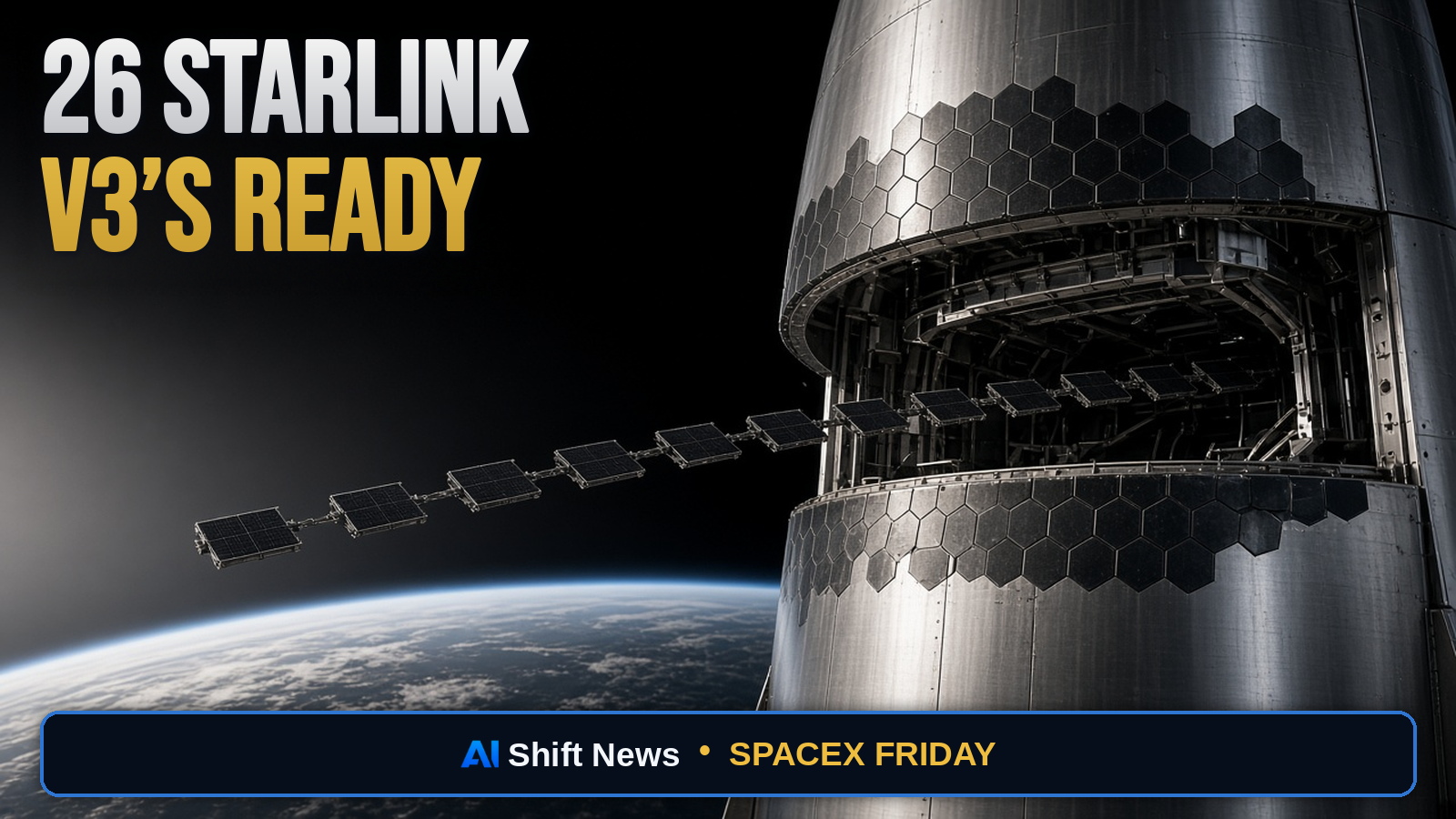
SpaceX’s Starship Flight 14 page and major desks describe the first planned Starship orbital attempt: roughly 275 km altitude, about six Earth orbits, roughly 10 hours end-to-end, Super Heavy soft splashdown in the Gulf, Ship splashdown in the Pacific west of Chile, and no tower catch on this flight. The same primary plan calls for the first planned operational deploy of 26 Starlink V3 satellites — not 20, not 23 — with SpaceX’s own capacity language of 1 Tbps per V3, 26 Tbps for the mission, and roughly 10× versus a single Falcon 9 V2 Mini Starlink launch. Three of the 26 carry cameras to image the heatshield. None of that is flown yet. NET remains Monday, September 28, 2026, pending FAA approval.
Spaceflight Now — SpaceX shoots for first orbital flight of Starship
What the video shows
Required embed for this package: Spaceflight Now — “SpaceX shoots for first orbital flight of Starship” (YouTube Gce_Qr6Ox68), published September 23, 2026. House note: this is a preferred primary desk walking the mission architecture — first planned orbital insertion, the long on-orbit timeline versus prior suborbital hops, Starlink V3 deploy intent, and splashdown geometry — not a flown success montage and not a Wall Street revenue model. Prefer this embed with hedges over NONE because it matches the locked SpaceX Friday Flagship 2 mix and lands on SpaceX’s own page numbers. Do not let the title upgrade “shoots for” into “achieved,” and do not substitute WDR livestream footage or the Sep 23 stack video as this slot’s architecture lead.
Spaceflight Now’s value here is translation: it packages the same objectives SpaceX lists — insertion only after a deorbit-redundancy health check, operational V3 deploy, extended mission duration — in plain broadcast English. AISN still treats the desk as secondary to the SpaceX Flight 14 page when counts conflict. In this pack they do not: the count is 26.
What’s new
AI Shift News already published a mid-September package when Flight 14 was framed against an earlier “as early as” window. That post is a soft-re-cover ban for the lead except as one sentence of “plan held; NET moved.” What is new for Friday’s architecture flagship is not a reinvented trajectory fantasy — it is the disciplined restatement of SpaceX’s current public plan against the September 28 NET and the wet-dress readiness context owned by Flagship 1. The scarce journalistic job is to keep “26 V3 / six orbits / splashdowns” labeled as planned while creators race to declare orbit locked or capacity proven.
Also new relative to casual social packaging: SpaceX’s explicit insertion gate. The company says Starship will execute a burn to enter orbit only after the flight control team has ensured sufficient redundancy on hardware critical to the later deorbit burn. That is a safety architecture detail, not a promise the gate will be passed. Quote it; do not flatten it into “they’re going to orbit Monday for sure.”
What evidence supports
The orbital profile — altitude, orbits, duration, splashdowns. SpaceX’s Flight 14 page and concordant desks (Spaceflight Now, Space.com, Next Spaceflight) describe a first planned Starship orbital insertion near roughly 275 km, about six Earth orbits, on the order of ten hours from liftoff to Ship splashdown. Super Heavy is planned for a soft splashdown in the Gulf of Mexico. Ship is planned for a Pacific splashdown west of Chile — a different downrange story than earlier Indian Ocean suborbital targets. House fence: all of the above is mission design language. None of it is a post-flight reconstruction.
Twenty-six Starlink V3 — count lock and capacity language. The authoritative deploy count in this pack is 26. Reject 20 and 23. SpaceX’s own comparison language — each V3 adds 1 Tbps, the mission adds 26 Tbps, roughly 10× a single Falcon 9 V2 Mini Starlink launch — may be quoted as company framing. It may not be rewritten as proven on-orbit constellation performance before the birds fly and check out. Three of the 26 carry cameras intended to image Starship’s heatshield — a useful bridge to Flagship 3’s reentry-production story, still not a thermal success receipt.
“Customers in a few weeks” and revenue fences. SpaceX prelaunch language describes post-deploy antenna/solar deploy, RF and laser contact, orbit raising, checkout, and an aspirational line that satellites should begin serving customers as soon as a few weeks after launch. That is company aspiration. It is not a service-level agreement and not a receipt. Separately, any “$1B per launch,” ARPU, or constellation-revenue scoreboard circulating in creator packaging is Claim in this pack — AISN has no primary SpaceX / SEC / audited receipt authorizing those figures as fact. Stick to Tbps / ~10× if capacity is discussed at all.
Catch history is not this flight’s recovery plan. SpaceX has caught Super Heavy on prior flights and still aims for eventual tower catches of both stages. Flight 14’s published plan nevertheless uses splashdowns for both booster and ship. Do not let catch nostalgia imply Monday’s attempt is an operational catch demonstration. Splashdown is the recovery mode on the page.
What is still missing (confirmed fence). No AISN claim Flight 14 has inserted to orbit; no claim 26 V3s are on station; no claim V3 capacity is proven in customer service; no claim FAA license modification is already granted; no treatment of Musk 100k-satellite or AI-constellation scale talk as Flight 14 receipt.
What it does not prove
- It does not prove Starship has reached orbit. The profile is planned.
- It does not prove 26 Starlink V3s are deployed or serving customers. Deploy and checkout are objectives, not outcomes.
- It does not prove SpaceX’s Tbps / ~10× comparison as measured constellation performance on this flight. Quote the company language; do not upgrade it into an independent audit.
- It does not prove any $/launch or $1B revenue figure. Those remain Claim / Reject-as-fact without primary receipts.
- It does not prove a tower catch on Flight 14 or authorize 20/23 satellite counts.
Why this matters
For practical readers, Flight 14’s importance is easy to oversell and easy to undersell. Oversell looks like “orbit locked, V3 changes everything Monday.” Undersell looks like ignoring that SpaceX has published a concrete first-orbit, first-operational-V3 plan with specific counts and splashdown geometry. The honest middle is AISN’s job: report the plan precisely, keep the NET behind the FAA hedge, and refuse revenue fan fiction.
It also matters for how Starlink capacity claims travel. SpaceX’s 1 Tbps / 26 Tbps / ~10× wording is specific enough to quote. Vague creator multipliers and dollar-per-launch memes are not. Keeping those lanes separate is how a Musk-companies desk stays useful after the thumbnail scroll.
How to read insertion and abort contingencies. SpaceX describes possible Mission Control calls that could shorten the mission (including fewer-orbit paths) if hardware health fails the insertion gate. Those contingencies are part of the architecture conversation — they are not the nominal six-orbit plan, and they are not proof the nominal plan will fail. Attribute contingency language carefully; do not demote the published nominal profile into doomcasting, and do not pretend contingencies do not exist.
Soft-re-cover discipline on the Sep 16 file. Readers who saw AISN’s earlier Flight 14 orbit/V3 package need one honest update sentence: the architecture largely held; the early window did not. Leading again on “targets September 22” energy would be a soft-re-cover failure. Leading on 26 / six orbits / splashdowns / Sep 28 pending FAA is the correct Friday architecture beat.
Operator checklist for the architecture file. Track (1) whether public desks still cite 26 V3 from SpaceX primary — reject count drift; (2) whether insertion and deorbit-redundancy language remains on the company page; (3) whether recovery mode stays splashdown-not-catch for this flight; (4) whether any license-modification reporting actually authorizes the orbital profile. Architecture literacy is useless if the count and recovery mode get rewritten by thumbnails.
What happens next
- License + NET — whether September 28 remains the public NET with the regulatory clause attached.
- Insertion gate in flight — if/when Flight 14 flies, whether Mission Control clears the orbital insertion burn after the deorbit-redundancy check.
- V3 deploy and checkout — 26 birds, antenna/solar deploy, RF/laser contact, orbit raising — all post-liftoff evidence, not pre-launch proof.
- Heatshield camera return — imagery from the three camera-equipped V3s (bridge to Flagship 3), still not a thermal success claim in this pack.
- Capacity claims after checkout — only then does Tbps language start to leave the “company plan” column.
Bottom Line
Flight 14’s public architecture is a first-orbit, ~six-orbit, 26× Starlink V3 plan with Gulf and Pacific splashdowns and no tower catch on this attempt. SpaceX’s Tbps / ~10× capacity wording may be quoted; $/launch and “$1B” packaging may not be asserted as fact. Until it flies, this remains SpaceX’s page — not a flown receipt.
Sources
- https://www.spacex.com/launches/starship-flight-14/
- https://spaceflightnow.com/2026/09/21/spacexs-super-heavy-booster-arrives-at-pad-ahead-of-first-orbital-starship-launch/
- https://spaceflightnow.com/2026/09/23/spacex-stack-starship-and-super-heavy-for-first-orbital-flight/
- https://www.space.com/news/live/spacex-starship-flight-14-live-updates-sept-24-2026-starship-first-orbital-launch-attempt
- https://nextspaceflight.com/launches/details/8346/
- https://www.youtube.com/watch?v=Gce_Qr6Ox68