
 Shift News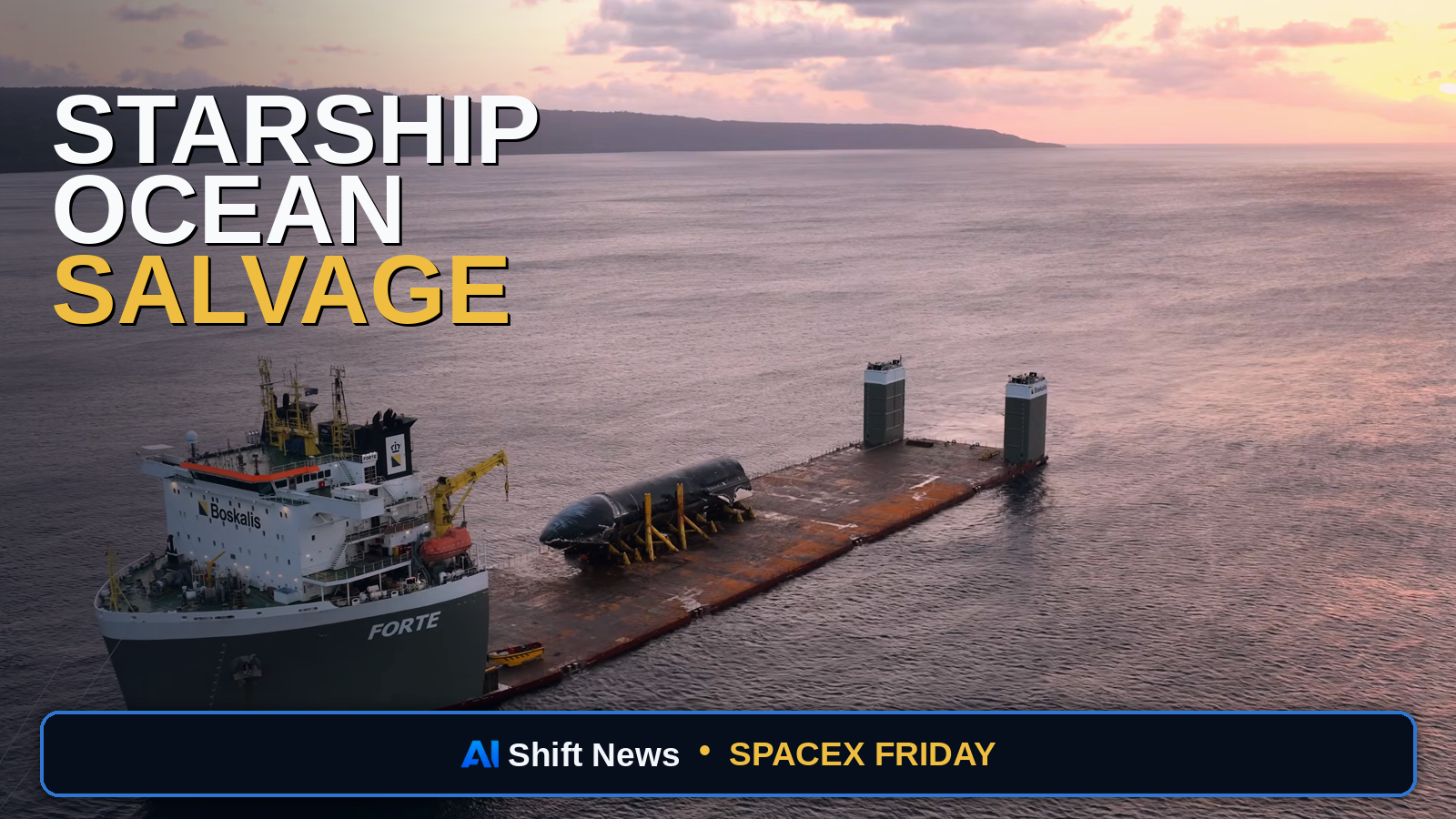
SpaceX’s Sep 18 “Holy Grail of Rocketry” documentary packages Ship 40’s ocean recovery as a reuse milestone. The fresh story is the film — Christmas Island inspections and a Forte load-out — not a new launch, and not a tower catch.
SpaceX — Starship - The Holy Grail of Rocketry · SpaceX
What the video shows
The selected film is SpaceX’s own next chapter in a Starship documentary series. Official description language says a fully and rapidly reusable rocket will change how humanity reaches space, then promises a look back at scrappy engineers proving reuse was possible and a “high-seas race to recover a floating Starship.” Opening reels revisit Grasshopper hops and Falcon 9’s path to landing — company storytelling about how partial Falcon reuse pointed toward Starship.
The present-tense payload is Ship 40 after Flight 13. Captions and sequences show an upper stage floating after soft splashdown, recovery crews fighting wind and sea state on a slow tow, damage risk if they pull too hard, and a pivot away from a distant mainland port toward inspection access off Christmas Island. Crews talk about rolling the vehicle, pulling tiles, and floating Ship 40 onto the deck of the heavy-lift ship Forte for a trip eventually back toward Starbase. Engineering voices stress heat-shield work: plasma as a flowing load, roughly twenty thousand tiles as twenty thousand chances to get attach wrong, and the claim that Ship 40 discoveries roll into Ship 41 because returning a ship to the launch site will lean on the heat shield more than ever.
The closing beat is the line most likely to be clipped out of context: the film says Flight 13’s ocean endgame ran landing-guidance maneuvers as if for a tower catch, and that had a tower been there, the rocket would have been caught. That is SpaceX narration inside SpaceX’s film. It is not a range report of a catch attempt, and it is not FAA confirmation that a catch profile was independently verified by outsiders. House voice can report the sentence; house voice cannot upgrade it into a catch that happened.
Taken together, the episode is a coherent company arc: Falcon history, Ship 40 afloat, hard salvage, inspection gold, next-ship heat-shield feed-forward, implied catch readiness. AI Shift News inventories that arc, then demotes every leap from salvage footage to rapid reuse unlocked.
What is new
AI Shift News already covered Flight 13 in late July — including the point that a real step forward is not the same as a routine system. What is new for this Friday pack is the Sep 18 official documentary drop: SpaceX packaging the recovery saga, Forte load-out, and reuse thesis for a wide audience days after TeslaNorth and others noted the content-hub push. Soft-re-cover rule: do not pretend July 24 is breaking news. The news object is the film’s framing of salvage as holy-grail evidence.
Next-flight orbital language belongs on a different page. SpaceX’s Flight 14 materials describe a pending first-orbital attempt (public reporting has cited a September window and roughly six orbits over many hours). Cite that only as separate company targeting. This video does not prove Flight 14’s outcome, timing, or orbital success.
What evidence supports
Official artifact and series placement — SpaceX YouTube + content hub + vehicle page. The upload is SpaceX primary media. The Starship vehicle page linked from the description remains the company’s overview of the architecture the film is selling. Prefer those URLs over creator recaps when stating what SpaceX published. The content-hub player at spacex.com mirrors the same episode for viewers who never open YouTube.
Flight 13 as prior primary — SpaceX Flight 13 mission page. The July 24, 2026 flight is documented on SpaceX’s own launch page. The documentary is retrospective packaging of that campaign’s aftermath, not a substitute for the mission page. Soft-re-cover against AISN’s July posts means: cite the mission page when you need flight facts; cite the Sep 18 film when you need packaging facts.
Recovery logistics shown in the film — Christmas Island / Forte. The selected video’s load-bearing “new” footage for many viewers is the salvage: tow failure modes, Christmas Island inspections, and Forte cradle operations. On-camera voices describe shallow draft, huge sail area, and a slow tow that risked damaging the vehicle — the opposite of a quick turnaround narrative, even inside a reuse-branded film. Secondary write-ups (TeslaNorth, Starlust) track the same arc for readers who want dates and place names beside the film. Intact enough to inspect and load is still not “rapid reuse,” and recovered for inspection is not the same as refurbished at Starbase.
Heat-shield feed-forward as company statement. The film’s roughly 20,000-tile discussion and Ship 40→Ship 41 upgrade language are SpaceX’s own engineering narrative inside the documentary. Treat them as attributed company claims about iteration. The deeper “is the heat shield solved?” fight belongs to the separate heat-shield brief; this flagship only needs the film’s own admission that discoveries still roll forward into the next ship.
What it does not prove
- It does not prove rapid reuse is unlocked or that “holy grail” status is achieved.
- It does not prove a tower catch. The closing line is in-film narration about guidance precision over empty ocean.
- It does not make Sep 18 a new flight day. No new integrated launch is shown as today’s result.
- It does not prove Ship 40 is refurbished and ready to fly again, or already operating as a returned asset at Starbase — Forte/return language is logistics intent in the film.
- It does not prove Flight 14’s orbital plan has flown. Six-orbit / Starlink-deploy targets live on separate launch materials and remain pending until flown.
Why this matters
Official documentaries travel faster than mission pages. A polished recovery film can convince casual viewers that salvage equals reusable airline operations. The useful distinction for readers: Flight 13’s soft splashdown and Ship 40’s inspection value are real engineering receipts AISN has already treated carefully; wrapping them in “holy grail” branding is communication strategy.
Cross-pack hygiene matters this Friday. The Stage Zero brief is about propellant logistics, not this salvage. The heat-shield brief is about Musk’s “solved” language versus continued iteration. This flagship should own the Sep 18 documentary packaging angle — Forte, Christmas Island, in-film tower-catch narration — and leave those other fights alone. Catch-and-reflight with short turnaround remains a future demonstration, not a sentence at the end of a recovery episode.
What happens next
- Keep Flight 13 soft-re-cover hygiene: link prior AISN posts; do not duplicate their leads.
- Watch Forte / Ship 40 logistics updates from primary or strong secondary sources — ashore vs still at sea is a factual question, not a film implication.
- Flight 14: track SpaceX’s launch page for pending-approval windows; do not backfill success from this documentary.
- Catch claims: require a documented tower catch before retiring the “would have been caught” hedge.
Bottom Line
SpaceX’s Sep 18 Starship film is company storytelling about Ship 40’s ocean salvage and the reuse thesis; it is not a new flight, not rapid-reuse proof, and not a tower catch — even when the narration says a tower would have caught the ship.
Sources
- https://www.youtube.com/watch?v=EthkNLasUa8
- https://www.spacex.com/content/starship/holy-grail-of-rocketry
- https://www.spacex.com/launches/starship-flight-13
- https://www.spacex.com/vehicles/starship
- https://www.spacex.com/launches/starship-flight-14
- https://teslanorth.com/2026/09/17/spacex-holy-grail-ship-40/
- https://starlust.org/the-holy-grail-of-rocketry-how-space-x-recovered-stranded-starship-upper-stage-from-sea/
- https://aishiftnews.ca/news/starship-flight-13-was-a-real-step-forward-but-it-did-not-make-starship-routine-yet/