
 Shift News
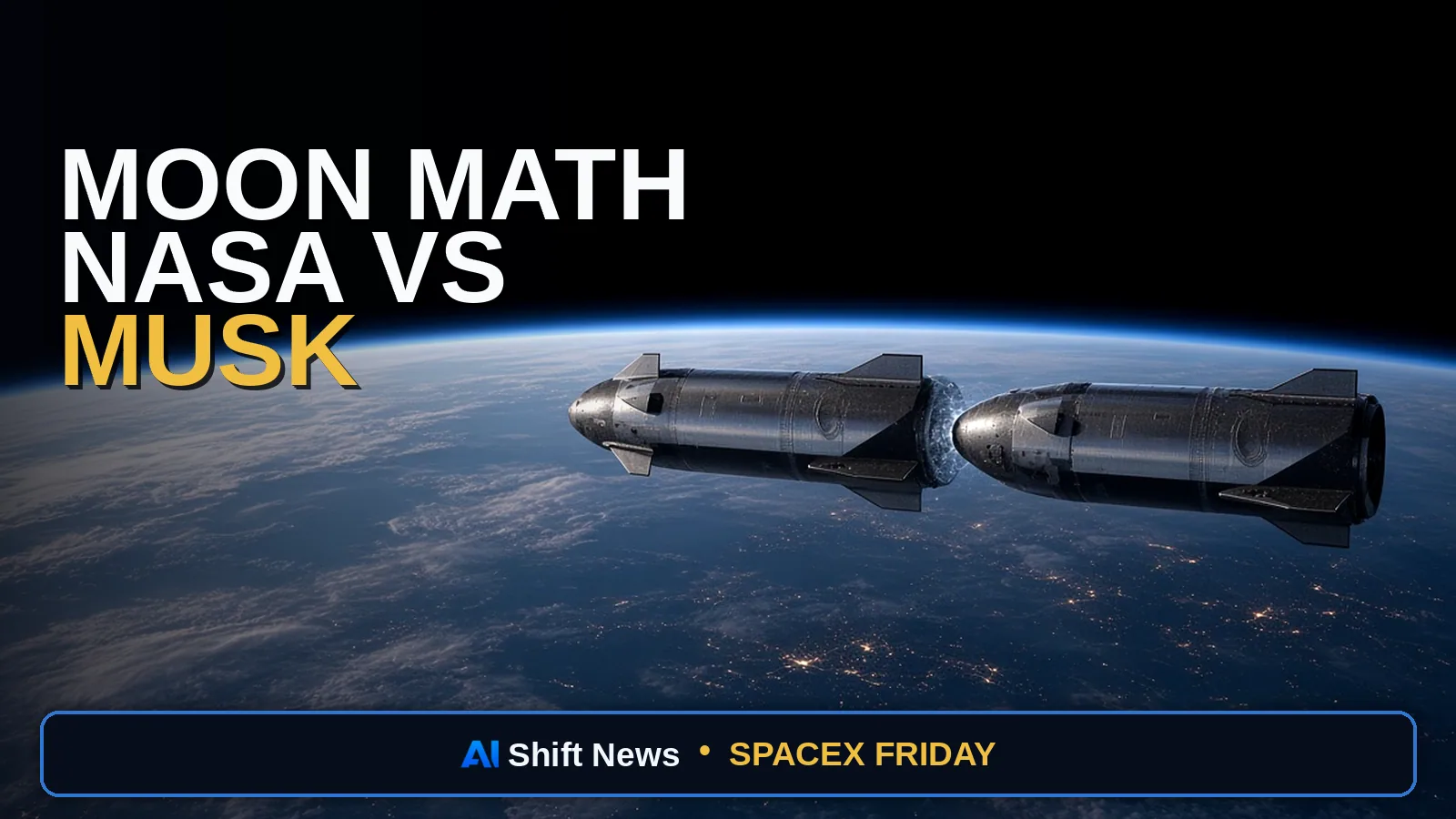
Philip Sloss: "Is this the NASA Artemis lunar landing schedule that Blue Origin and SpaceX finally meet?". Facts on this page cite the primary sources below, not the video.
Honest fence (read first): On Thursday, Oct 22, at the quarterly public meeting of NASA's Aerospace Safety Advisory Panel (ASAP), panel member Charlie Precourt, a former astronaut, said the latest estimate for fueling the lunar lander for Artemis IV is "around 22 flights." He didn't name Starship, but it's the only crewed lander in NASA's plan that refuels in orbit. At 5:12 PM ET the same day, Elon Musk replied on X: "That's way too high. Actual number will be more like 6 to 8." Neither NASA, the panel nor SpaceX has published how its number was worked out. This post compares two unexplained estimates. It is not a ruling on which is right. Embed: Philip Sloss jfeVornFhxg (oEmbed 200), which walks NASA's lander milestone charts; it was posted two days before the 22 remark.
Editorial Thesis
For years the most important number in NASA's Moon plan has been one NASA won't say out loud: how many Starship launches it takes to fill a lunar lander with propellant in Earth orbit. On Thursday a NASA safety adviser said one out loud, and it was big. Musk answered with a number less than half as big. The gap between 22 and 6 to 8 is the gap between a lunar mission that needs months of back-to-back launches and one that needs a couple of weeks at the cadence SpaceX says it's aiming for. The honest takeaway isn't "NASA says" or "Musk says." It's that the deciding test, a large-scale ship-to-ship propellant transfer, hasn't flown, and NASA's own chart puts it in early 2027.
Honest Verdict
On the record: Precourt said "around 22 flights" at a public NASA advisory meeting; Musk said "more like 6 to 8" on X; NASA's HLS program manager presented a milestone chart in October showing a propellant transfer demo, a first tanker flight and an uncrewed lander demo still ahead. Not on the record: the math behind either number, how many of the 22 are tankers versus other launches, what payload per tanker each side assumes, and how much propellant is expected to boil off. Not proven by anyone: that ship-to-ship refueling at this scale works at all. It's never been done.
Why Starship has to refuel
The Starship lunar lander is huge: NASA's slides list it at 171 feet (52 meters), powered by six Raptor engines, launched on a Super Heavy booster from Starbase or Kennedy's LC-39A. The lander is the rocket's second stage. Getting itself to Earth orbit uses up nearly all of its propellant.
So SpaceX's plan, as NASA and SpaceX have described it for years, works like a gas station in orbit:
- Launch a Starship that acts as a storage tank, called a depot.
- Launch a string of tanker Starships. Each one docks with the depot and pumps its leftover liquid oxygen and methane across.
- Launch the lander, fill it from the depot, and send it to the Moon, where it waits for astronauts arriving on Orion.
Every tanker is a full Starship launch. That's why the count matters so much. More launches mean more time, more cost and more chances for something to go wrong before a crew ever leaves Earth.
The two numbers, side by side
"Around 22." Here's Precourt's full quote, as reported by Ars Technica's Eric Berger, who was listening to the call: "With respect to Artemis IV, however, we've got a large number of firsts that reduce the likelihood of mission success. We need to keep our eyes on numerous required fuelings for the lander. I think the last estimate is around 22 flights." Berger posted the remark on X at 2:43 PM ET. Precourt called it "the last estimate," which suggests it came from NASA's own briefings to the panel, but the panel hasn't said where it came from, and its minutes aren't posted yet.
"6 to 8." Musk's reply to Berger at 5:12 PM ET was two sentences: "That's way too high. Actual number will be more like 6 to 8." No breakdown, no assumptions.
What each number probably assumes. This part is analysis, not a quote. The count depends mainly on two things: how much propellant each tanker delivers to orbit, and how much is lost along the way to boil-off and to the transfers themselves. Ars and Teslarati both read NASA's figure as based on what Starship can lift today, and Musk's as assuming a more capable vehicle. That's a reasonable reading, but neither side has confirmed it.
The number has always moved
This isn't the first time the count has jumped around:
- 2021: a government document suggested 16 launches. Musk called that "extremely unlikely" and said eight tankers would be the most needed (Teslarati's summary).
- 2023: then-HLS director Lisa Watson-Morgan told Ars that NASA had "a general idea" but was "reluctant to say exactly." She later said "high single digits to the low double digits," roughly a depot plus about 11 tankers (Ars).
- Nov 2023: NASA officials said "high teens," per SpaceNews (as cited by TeslaNorth).
- Oct 22, 2026: "around 22" (Precourt) versus "6 to 8" (Musk).
The trend in NASA's public hints has gone up, not down. The hope, Berger writes, was always that Starship's lift capacity would grow fast enough to bring the tanker count down. Thursday's remark suggests that, by NASA's math, it hasn't yet.
What NASA's own lander chart says
The most concrete public document is NASA's HLS presentation from the International Astronautical Congress, posted on NASA's technical reports server (NTRS 20260009199) with an Oct 9 distribution date. Program manager Steve Creech is the author. Philip Sloss walks through it in today's video.
Read from the chart, SpaceX's milestones run roughly like this:
- Q4 2026: first orbital flight (done on Flight 14), first V3 booster catch, first Ship catch, first Cape flight, first V3 booster reuse.
- Around Q1 2027: a propellant transfer demo, and a second Cape pad (LC-37) complete.
- Late 2027: tank pressurization upgrades, a first tanker flight, and the uncrewed demo lander launch.
- Q1 2028: an uncrewed demo mission to the Moon.
NASA's architecture slide adds context: Artemis III (2027) now tests Orion with both landers in Earth orbit, Artemis IV (early 2028) is the first crewed landing since 1972, and the slide says it's "TBD which lander will be used." The chart shows dates. It doesn't give a tanker count.
That lines up with what SpaceX said on its Oct 20 earnings call. Gwynne Shotwell: "We'll attempt an on-orbit refueling early next year." So the first real data on transfer efficiency is, on both NASA's and SpaceX's timelines, a few months away.
Why the gap matters
Here's a simple way to see the stakes. It's our own illustration, using SpaceX's stated cadence goal, not a forecast.
- At 6 to 8 launches and a "twice weekly" cadence, which Musk says Starship could reach in the second half of 2027, filling a depot would take about 3 to 4 weeks.
- At 22 launches and the same cadence, it would take about 11 weeks. Berger puts it at "about three months."
Cadence is a big assumption on its own. Starbase is licensed for 25 Starship launches a year today, per the FAA, and NASASpaceflight expects only five Starship launches in all of 2026. Musk's weekly and twice-weekly targets depend on full, rapid reuse that hasn't been shown yet. Starship's first Ship catch attempt is still ahead (see our Flight 15 story today).
Time isn't the only cost. Propellant sitting in orbit slowly boils off, so a longer fill campaign loses more of what it collects. And every extra launch adds risk to the mission before astronauts are involved.
Credit where it's due
Both sides deserve a fair reading. Precourt didn't attack SpaceX. He praised NASA Administrator Jared Isaacman's team for "bringing in resources" and looking "for places where there are barriers" to help both SpaceX and Blue Origin, according to Ars. Blue Origin's Blue Moon lander doesn't use orbital refueling for its first mission, Teslarati notes, so it doesn't face this exact problem. And Musk has a track record of beating some skeptics' numbers on reuse and cadence, along with a track record of missing his own timelines. Neither history tells us who's right about tankers.
Claim vs proof
| Claim | Source | Evidence shown | What would settle it |
|---|---|---|---|
| "Around 22 flights" to fuel the Artemis IV lander | Precourt, ASAP meeting | None published | NASA or ASAP releasing the assumptions |
| "More like 6 to 8" | Musk on X | None published | SpaceX publishing tanker payload and boil-off figures |
| Prop transfer demo ~early 2027 | NASA HLS chart; Shotwell | Plans only | The demo flying |
| First tanker flight late 2027 | NASA HLS chart | Plan only | The flight |
| Artemis IV lander choice | NASA slide: "TBD" | , | A NASA decision |
What to watch next
- ASAP meeting minutes on NASA's site, which may show the context for the 22 figure.
- Flight 15's Ship catch attempt, which NASA's chart lists for Q4 2026.
- SpaceX's propellant transfer demo, aimed for early 2027.
- Any NASA briefing that puts a tanker number on paper, with assumptions.
Video note
Philip Sloss (jfeVornFhxg, 13:32, uploaded Oct 20 at 5:00 PM ET) goes through NASA's HLS milestone charts and flags what's still missing, mainly status metrics and critical paths. It was posted before Precourt's remark, so it doesn't discuss the 22 figure. That's why we use it for the chart, not for the debate.
Bottom Line
On the record: Precourt said "around 22 flights" at a public NASA advisory meeting; Musk said "more like 6 to 8" on X; NASA's HLS program manager presented a milestone chart in October showing a propellant transfer demo, a first tanker flight and an uncrewed lander demo still ahead. Not on the record: the math behind either number, how many of the 22 are tankers versus other launches, what payload per tanker each side assumes, and how much propellant is expected to boil off. Not proven by anyone: that ship-to-ship refueling at this scale works at all. It's never been done.Sources
- NASA NTRS 20260009199: 'NASA's Human Landing System: Demonstrating the Capability to Land Artemis Astronauts on the Moon by 2028' (Steve Creech, HLS Program Manager; IAC 2026 slides; distributed Oct 9, 2026)
- Eric Berger on X, Oct 22, 2:43 PM ET: Precourt's 'around 22' remark during the ASAP call
- Elon Musk on X, Oct 22, 5:12 PM ET: 'That's way too high. Actual number will be more like 6 to 8.'
- NASA Aerospace Safety Advisory Panel (quarterly public meeting held Oct 22, 2026; minutes not yet posted)
- Ars Technica (Eric Berger), Oct 22: full Precourt quote, history of NASA's estimates, the three-month depot math
- TeslaNorth, Oct 22: no breakdown published; 'high teens' in Nov 2023 per SpaceNews
- Teslarati, Oct 22: 2021 '16 launches' document and Musk's 'eight tankers' reply; Blue Moon's first mission skips refueling
- SpaceX Q3 2026 call (Oct 20): Shotwell 'We'll attempt an on-orbit refueling early next year'
- Philip Sloss: Is this the NASA Artemis lunar landing schedule that Blue Origin and SpaceX finally meet? (uploaded Oct 20; walks the NTRS milestone charts; embed)