
 Shift News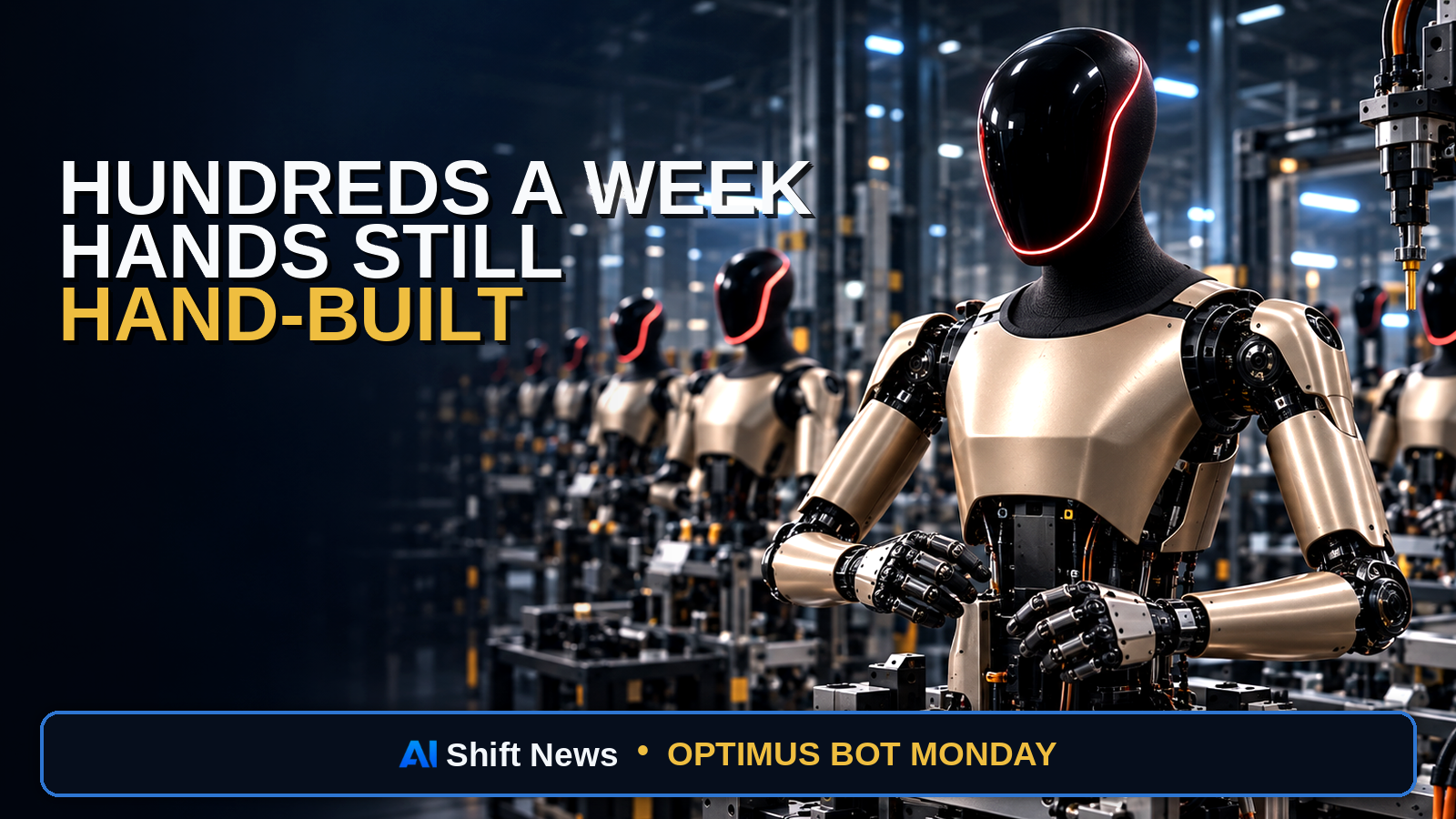
Secondary reports say Tesla built several hundred Optimus robots a week at Fremont in August—roughly 10× Q2—while hands stay hand-assembled and AI still needs days for basic tasks. Most units are for internal testing; the commercial V3 version is not the one on the line, and there is still no public reveal.
Dr. Know-it-all — Optimus production ramp and problems — creator commentary (published Sept. 26, 2026). The channel A/B tests its video titles, so it is labelled descriptively here. The written secondaries (Electrek, The Verge, Humanoids Daily, Ars Technica) carry the facts.
Honest fence (read first): This brief rests on secondary reporting of The Information’s September 25, 2026 account, as relayed by Electrek, The Verge, Humanoids Daily, and Ars Technica. It is not a Tesla IR table of unit deliveries, not proof of generalized factory labor, and not a public Optimus V3 commercial reveal.
What was reported
Electrek’s Fred Lambert summary of The Information says Tesla went from a few dozen Optimus units a week in small-batch Q2 testing to several hundred a week in August at Fremont—roughly a 10× step-up. The line sits where Model S and Model X used to be built after Tesla ended those vehicles’ production in early May and reassigned workers from S/X and Model Y onto the robot program.
Managers are reportedly aiming for a continuous automated line capable of more than 1,000 robots a week by year-end, with a much larger long-horizon capacity figure (~20,000/week) circulating in the same report. Humanoids Daily’s careful restatement is the house preference for how to read those numbers: they are capacity goals, not achieved weekly output and not customer deliveries.
Where do the robots go? Mostly internal testing, training, and data collection. Units working inside Tesla factories are described as confined to tightly controlled, supervised areas and programmed for specific tasks—not running as general-purpose machines.
Hands, fixtures, and suppliers
The same secondary chain puts the bottleneck where Optimus watchers already expected friction: the hand and forearm. Sources describe more than 100 screws and other small components that workers still assemble by hand. Fixtures at stations for hands, joints, and electronics testing reportedly struggle to hold alignment on parts that are smaller and tighter-tolerance than car parts, so more units need rework after leaving the line.
Touch-sensor durability is another reported snag. Tesla’s reported fix path is a replaceable “sensing glove” planned for later (2027 in Humanoids Daily’s summary) so the sensor layer can be swapped without replacing the whole hand. That is a design response in reporting—not proof the durability problem is already solved.
Supplier quality is the same story at volume: motors and precision gears that work as prototypes but slip when the line speeds up—prep context, not a Tesla IR BOM.
AI generalization is still the product question
Three people familiar with the system told The Information, per Electrek and Humanoids Daily, that Optimus’ AI cannot yet reliably handle a wide range of tasks and can behave unpredictably outside trained situations. Tesla is reportedly building a library of basic movements to recombine for new jobs, but learning even basic tasks can still take several days.
Data collection is the parallel bet: more than 500,000 hours of training data, aim to double by year-end, with collectors and hubs outside the active lines. Ars Technica’s related coverage of worker pushback against training robots as replacements belongs in the same evidence column.
The reported commercial plan is lease, not sell, to sites that resemble Tesla’s own—then use fleet data to improve software. No signed leases or external delivery schedule are announced in these secondaries.
What this does not prove
- Not Tesla-published unit deliveries. “Several hundred a week” is secondary sourcing from people familiar with the project; Tesla did not respond to The Information’s request for comment in the Humanoids Daily summary.
- Not useful general-purpose robots. Supervised, task-specific internal use is the described state. Days-to-learn-basic-tasks is the opposite of plug-and-play factory labor.
- Not a commercial V3 reveal. Machines on the line are described as Optimus V3 in some secondary language, but sources say this is not the exact version Tesla intends to commercialize; that version still needs stricter durability and reliability thresholds. No public unveil accompanies this pack.
- Not a >1,000/week receipt. Year-end continuous-line targets are capacity goals, not August output.
Electrek also contrasts today’s reported factory reality with older Musk timelines (10,000 units in 2025; mid-2026 V3 reveal). Keep founder forecasts out of the confirmed column.
What practical readers should take away
For operators, investors, and plant-floor readers, the scarce Monday fact is a manufacturing-scale signal with hard hedges: Fremont is reportedly producing Optimus at hundreds per week, while hands remain hand-assembled, AI generalization remains weak, and most units stay inside Tesla for testing. That combination is exactly the Optimus Bot Monday house beat—claim versus proof.
Watch for primary Tesla confirmation of weekly rates, a public commercial-V3 reveal with durability thresholds, independently reported task completion / intervention rates, and any named lease customers. Until those appear, treat “hundreds a week” as a reported production ramp—not a finished product story.
Bottom Line
Fremont’s reported Optimus ramp is the right Monday lead: a manufacturing-scale number with hard hedges attached. Hands are still hand-assembled, basic tasks can take days to learn, and most units stay inside Tesla. That is the fence: hundreds a week is a production signal — not a commercial V3 reveal.
Sources
- https://electrek.co/2026/09/25/tesla-optimus-production-ramp-hands-ai-generalization-problems/
- https://www.theverge.com/tech/1000794/tesla-optimus-production-issues-hands
- https://www.humanoidsdaily.com/news/tesla-optimus-production-hundreds-per-week-report
- https://arstechnica.com/ai/2026/09/tesla-workers-balk-at-training-optimus-humanoid-robots-as-replacements/
- https://www.youtube.com/watch?v=1Wjhw1vHmAA