
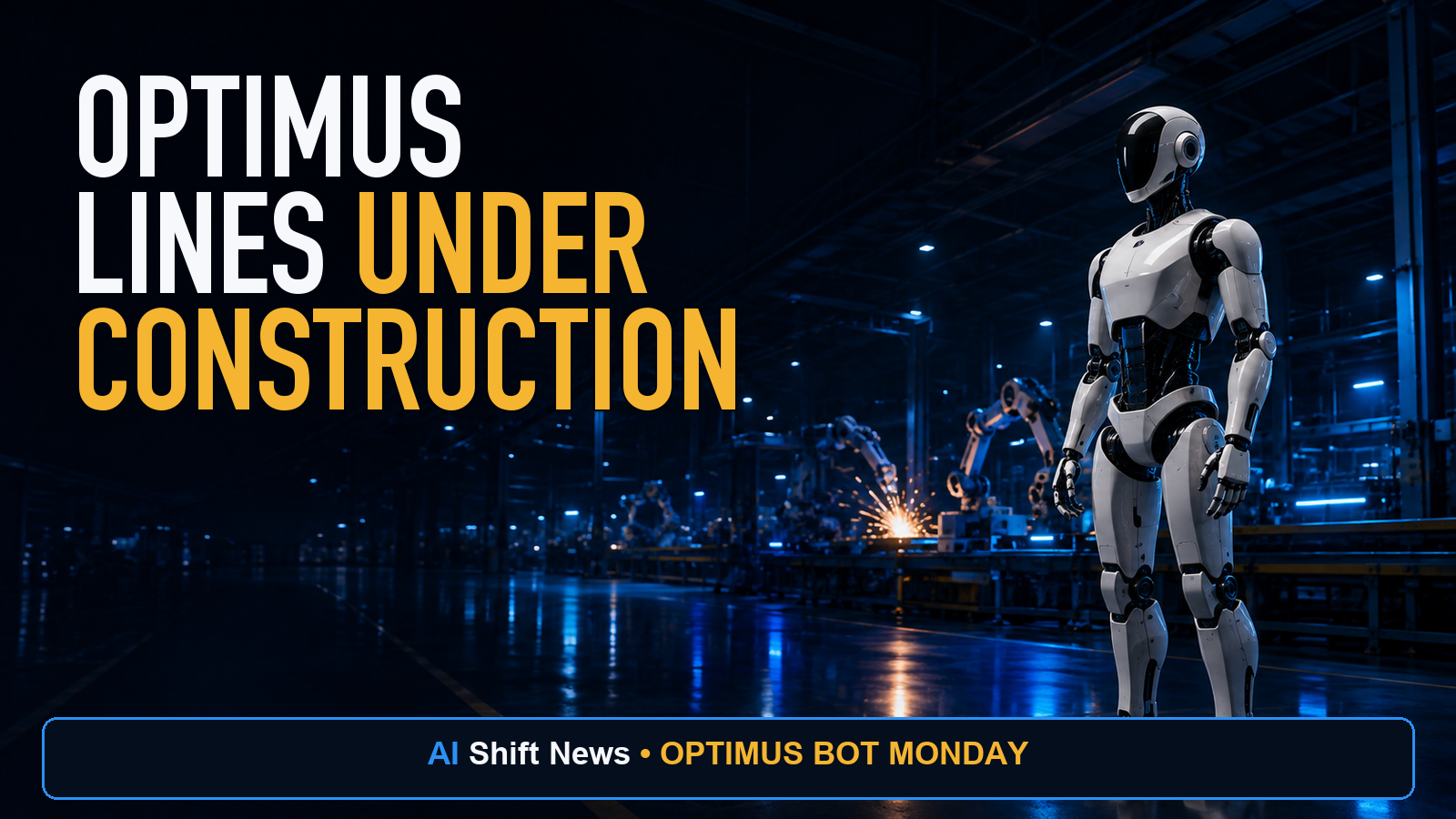
Tesla’s July 22 update puts both Fremont and Texas Optimus facilities in the construction column. That is meaningful manufacturing progress, but it is not evidence of a commercial production ramp.
Optimus Navigating Around | Tesla · Tesla
Tesla has provided a concrete, but carefully bounded, update on the manufacturing status of Optimus. In its Q2 2026 shareholder update, released July 22, the company said it had decommissioned Model S and Model X manufacturing lines at Fremont and was installing first-generation Optimus lines there. The same update said site development at Gigafactory Texas had continued, with building construction “now in full swing.”
Those are real markers of a factory program moving forward. They are not the same thing as a robot production ramp.
The distinction matters because Optimus is often discussed through a mixture of official updates, demonstrations, long-range capacity targets and online claims about future generations. The July filing is useful precisely because it is specific about Tesla’s present tense. At Fremont, equipment is being installed. In Texas, the building is being constructed. In Tesla’s installed annual manufacturing-capacity table, both California Optimus and Texas Optimus are listed with the status “Construction,” not “Production,” “Early Ramp,” or another label suggesting ongoing output.
That is the baseline for assessing the program as of the Q2 update: two Optimus sites under construction, with Fremont further along in the tooling process and Texas in active building construction.
## What Tesla actually said
Tesla’s Q2 2026 update ties the Fremont conversion directly to the retirement of its S and X lines. In the summary, Tesla said construction at Fremont for Optimus began after those lines were decommissioned and that production was anticipated later in the year. In the dedicated Robotics section, the language is more operational: first-generation Optimus lines are being installed at Fremont, where Tesla says it expects to start production soon.
There are two important qualifiers in that wording. First, “installing” describes the state of the lines, not a completed, qualified line running at volume. Second, “expect to start production soon” is a company expectation. It is not a report that production has started, that a rate has been achieved, or that units are shipping outside Tesla.
Tesla also explained what the first builds are for. The initial Optimus builds will be used in the company’s Optimus Academy for training-data collection and further functionality development. That description points to an internal learning and development phase. It does not describe a finished commercial product, customer deliveries, or a mature external supply chain.
This is not a semantic technicality. A manufacturing line can be physically installed while tooling, material flow, quality processes, software integration and operator procedures are still being proven. A first batch can be valuable because it creates data and exposes problems. But it is not interchangeable with a sustained ramp in which output, yield, reliability and downstream service all hold up over time.
Tesla’s own capacity-table footnote reinforces the caution. It says installed capacity is not current production rate and that production rates can be limited by equipment uptime, component supply, downtime associated with factory upgrades, regulatory considerations and other factors. The company defines “Construction” to include both factory and infrastructure buildout and tool installation. That definition fits the stated Fremont and Texas status exactly.
The Texas program should likewise be read as construction progress rather than an operating second line. Tesla said building construction there is in full swing and placed Texas Optimus in the construction category. The update did not provide an installed annual capacity figure for either Optimus location. It did not say the Texas site had begun assembling robots. And it did not attach a production-rate forecast to the site.
The independently published Robot Report account supplies useful context, but it does not change the official status. Its reporting describes Tesla’s longer-term Texas ambitions and the Fremont conversion. Those ambitions may explain why the buildout has attracted attention; they do not turn a construction designation into evidence that a high-volume facility is already operating.
## Why the first builds matter anyway
Calling this stage “not yet a production ramp” should not be mistaken for saying it is insignificant. Moving from a lab-like prototype program toward purpose-built lines is one of the hard transitions for a humanoid robot effort. It forces a company to make choices that can be deferred in a small-batch environment: how parts are made and supplied, how assemblies are tested, which steps are automated, what data is collected, and what failures are acceptable before the next iteration.
Tesla has named the intended early output’s job: collect training data and advance functionality through Optimus Academy. That makes the early fleet potentially valuable even if its output is modest. Humanoid robots interact with physical spaces, objects and people; their performance depends on more than a single model demonstration. Internal deployment can create feedback on navigation, manipulation, recovery from error, charging, task setup and the practical conditions that software must handle.
It also sets an appropriately narrow expectation for readers. The July update does not say that the first robots will be sold, leased or broadly deployed for customer work. It says the initial builds will serve Tesla’s own training-data and functionality-development effort. Those are different milestones with different evidence standards.
The same discipline applies to Fremont’s anticipated production date. Tesla’s July language is forward-looking, and the Q2 update includes the standard caution that forward-looking statements involve risks and uncertainties and are not guarantees. The appropriate conclusion is that Tesla had a stated plan to begin production later in 2026, not that the plan had already been achieved on July 22.
## A navigation demonstration, dated correctly
There is also direct evidence that Tesla had publicly demonstrated a relevant autonomy capability before this manufacturing update. Tesla’s official YouTube video, **“Optimus Navigating Around,”** was uploaded on October 18, 2024. The 84-second public video’s description says Optimus can explore unseen spaces autonomously, avoid people and obstacles using neural networks, and that multiple bots build a shared understanding of their surroundings. It also mentions charging-station docking, non-flat terrain and carrying heavier payloads.
That video is useful context because it shows what Tesla was presenting as a navigation capability: movement through an environment that the company characterizes as unseen, with people and obstacles present. It is more relevant to an autonomy discussion than a generic product reel because the accompanying description identifies the claimed behavior.
But it has a firm evidentiary limit. It was published in 2024, not 2026. It is a visual demonstration, not a factory report. It does not establish the condition of Fremont tooling in July 2026, prove that a production line was running, quantify a production rate, or show that the demonstrated configuration is the same one that will be built on the first-generation lines. It should therefore be treated as evidence of a demonstrated navigation claim at the time of publication—not evidence that 2026 production has begun.
Separating these facts makes the story clearer. The 2024 video speaks to a demonstrated capability in a controlled public presentation. The July 2026 shareholder update speaks to factory status and intended early use. Neither source, by itself or together, demonstrates a commercial manufacturing ramp.
## What not to infer from “first-generation”
The phrase “first-generation lines” describes Tesla’s manufacturing-line language in the Q2 update. It should not be used as a shortcut to assert unverified claims about a particular Optimus robot generation, a specific “Gen 3” configuration, its parts count, performance, cost, timing or readiness.
Discovery material around Optimus includes a range of claims about “Gen 3” and other future versions. Those claims are not evidence for this article unless Tesla has publicly documented them in a source that supports the specific assertion. They are not needed to understand the July update, and they should not be smuggled in as confirmation through repetition.
The practical reporting test is simple: distinguish a company’s physical manufacturing status from commentary about possible future hardware. On the record available here, Tesla has reported a Fremont conversion after S/X decommissioning, installation of first-generation lines, initial builds aimed at Optimus Academy data and functionality work, and Texas construction in full swing. It has also marked both Optimus sites as “Construction” in its capacity table.
That is substantial progress in a capital-intensive robotics program. It is still a construction and commissioning story.
## The milestones worth watching next
The next useful official update would answer questions the July document leaves open. Has Fremont begun producing Optimus units? If so, are the units still being used solely for Optimus Academy, and what kind of work are they doing? Has Tesla reported a production rate, a yield measure, an installed capacity number, or evidence that the line is moving from setup into stable operation? Has Texas progressed from building construction to line installation?
Those are the markers that would change the description from construction to ramp. A new video alone would not answer them. Nor would a target capacity without a status update. Capacity targets describe an aspiration or design intent; production evidence needs a stated operating condition and, eventually, sustained output.
For now, the most defensible headline is also the least dramatic one: Tesla’s Optimus manufacturing effort has advanced into visible factory conversion and construction. Fremont’s first-generation lines are being installed, and Texas is being built. Tesla says it expects to start production soon and plans to use initial builds to generate training data and develop functionality. As of the July 22 Q2 update, however, both sites remain listed as construction—not a confirmed production ramp at that time.
Bottom Line
Tesla’s July 22 update puts both Fremont and Texas Optimus facilities in the construction column. That is meaningful manufacturing progress, but it is not evidence of a commercial production ramp.
Sources
- https://assets-ir.tesla.com/tesla-contents/IR/TSLA-Q2-2026-Update.pdf
- https://www.sec.gov/Archives/edgar/data/1318605/000162828026049213/exhibit991.htm
- https://www.therobotreport.com/from-evs-to-robotics-tesla-targets-10m-optimus-units-with-new-texas-plant/
- https://www.youtube.com/watch?v=DrNcXgoFv20