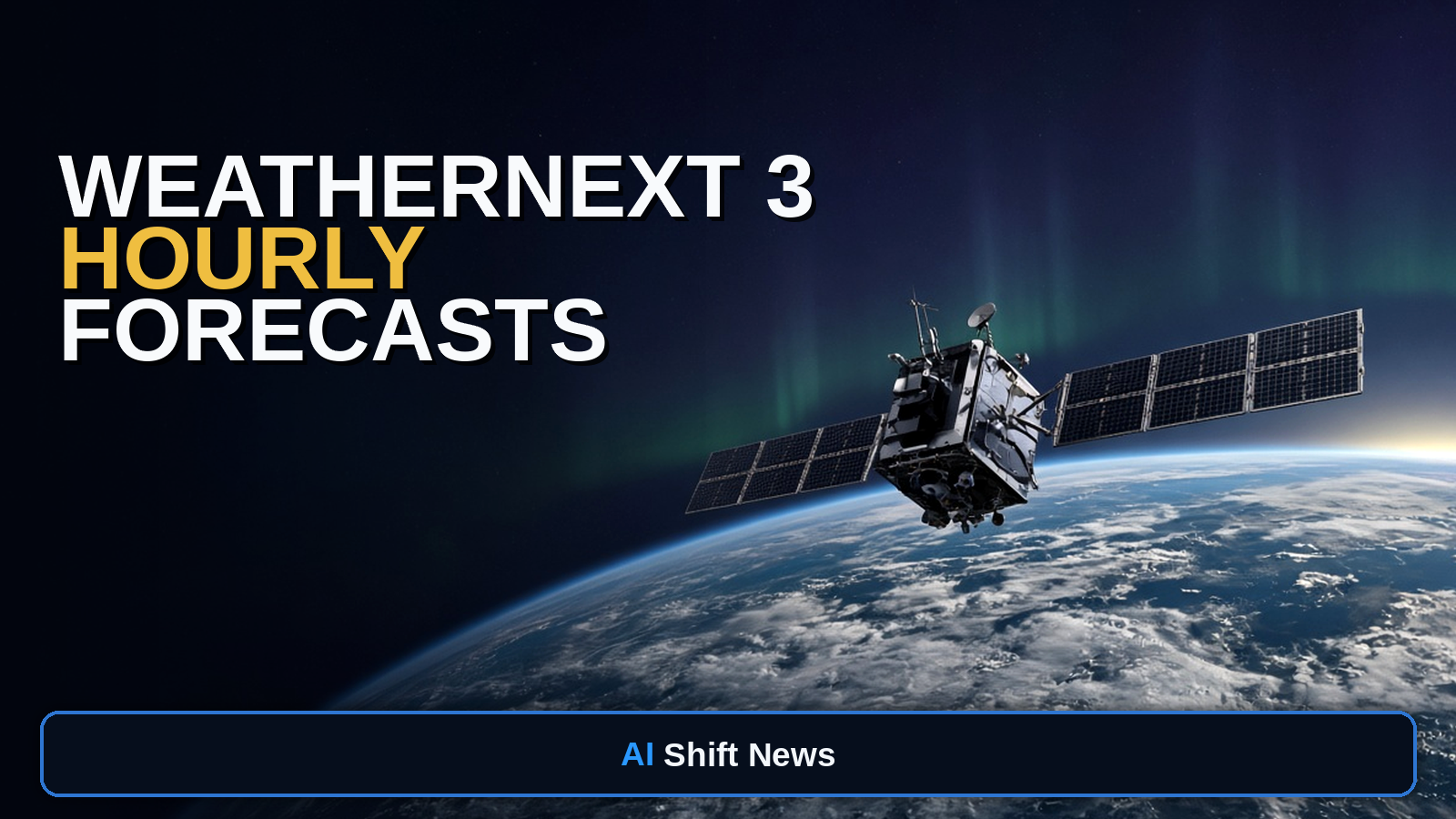
Google DeepMind and Google Research introduced WeatherNext 3 on September 3, 2026: an AI weather model that ingests live geostationary satellite mosaics, refreshes hourly, and outputs multi-resolution forecasts (company: temperature/moisture visualization down to ~5 km; other surface variables ~10 km; atmospheric variables ~25 km). The company says it is rolling into Google Search, the Gemini app, Google Maps, Google Maps Platform Weather API, Earth Engine, plus BigQuery/GCS data access. Brightband live-evaluation leadership and precipitation-skill percentages are **company packaging** — attribute, do not adopt as independent AISN verification. Google’s own disclaimer: for official forecasts and severe-weather warnings, defer to local meteorological agencies. Distinct from older GraphCast Learn coverage on AISN.
WeatherNext 3: More accurate, timely, and local weather forecasts · Google DeepMind
Quick Take
Google DeepMind and Google Research introduced WeatherNext 3 on September 3, 2026: an AI global weather model that ingests live geostationary satellite mosaics, targets an hourly refresh cycle, and publishes multi-resolution forecasts into Google consumer and Cloud surfaces. Accuracy leadership and precipitation-skill percentages in the announcement are company packaging. Official warnings still belong to local meteorological agencies.
- Confirmed (primary blog): Live satellite ingest; hourly forecast generation framing; rollout into Search, Gemini app, Maps, Maps Platform Weather API, Earth Engine; data via BigQuery / Earth Engine / GCS.
- Confirmed (company specs): Multi-res outputs — ~5 km for key surface temperature/moisture visualization and station-trained heads; ~10 km other surface fields; ~25 km atmospheric variables — vs WeatherNext 2’s 25 km / 6-hour cadence.
- Confirmed (dev docs): Hourly initialization; 64 ensemble members; FGN mesh transformer; distinct forecast horizons for synoptic vs interim cycles.
- Attribute as packaging: Brightband “most accurate” live-eval claim; “up to 60%” / “up to 50%” precipitation skill language.
- Disclaimer: Local met agencies remain the safety authority for warnings.
What the video shows
Embed for this package: Google DeepMind — “WeatherNext 3: More accurate, timely, and local weather forecasts” (YouTube _6jZlnRsXXQ), published September 3, 2026. House note: official company packaging aligned with the launch blog — useful for showing the product narrative (hourly updates, resolution, Maps/Search surfaces). It is not independent verification of Brightband rankings or precipitation percentage claims. Prefer this official embed; keep skill scores fenced as company framing in the article body.
What’s new
AI Shift News has older GraphCast / early WeatherNext-era learning coverage. What is new is the WeatherNext 3 system as announced September 3: direct live satellite assimilation for hourly initialization, higher multi-resolution outputs, renewable-energy variables (e.g. 100 m winds, solar irradiance fields), and an explicit push into everyday Google surfaces plus developer data paths.
The practical reader angle is distribution. A research model that only lives in a paper is different from one Google says is beginning to power Search, Gemini, and Maps weather experiences the same day — with Maps Platform Weather API and Earth Engine called out for builders. That is the “what changed for users” fact.
The risk angle is packaging. Phrases like “most advanced and accurate… according to independent live evaluations by Brightband” and “up to 50% more accurate precipitation forecasts” are easy to strip of hedges. House voice reports them as Google’s evaluation framing and keeps the blog’s own safety disclaimer visible.
Evidence
Primary blog (Sep 3, 2026) — WeatherNext team. Introduces WeatherNext 3 as flagship AI weather forecasting model with real-time satellite data, hourly refreshes, higher resolution, precipitation focus, and clean-energy variables. Architecture sketch: live 1-hour geostationary satellite mosaics plus traditional historical analysis into a Functional Generative Network (FGN) mesh transformer; outputs dense grids, cyclone tracks, station-level sparse coordinates. Resolution narrative: visualize key surface variables (temperature, moisture) at 5 km; other surface variables at 10 km; atmospheric variables such as wind at 25 km; ~5× sharper than WeatherNext 2 (25 km grid, 6-hour increments). Motivation vs NWP lag: prior AI weather models including WeatherNext 2 trained heavily on NWP-derived fields with ~six-hour lag; live satellite mosaic enables hourly forecasts grounded in recent observations. Station observation training for local topography. Precipitation: trains on NASA IMERG and Google satellite-radar reanalysis; cites CRPS improvements “up to 60%” against IMERG, 30% for MRMS, 10% against rain gauges for early lead times — company evaluation language. Product surfaces: Search, Gemini app, Maps, Maps Platform Weather API, Earth Engine “starting today”; BigQuery / Earth Engine / GCS for data. Consumer precipitation framing: “up to 50% more accurate” for day-or-more-ahead planning. Disclaimer: defer to local meteorological agency / national weather service for official forecasts and severe warnings.
Developers guide (models) — technical table. Global coverage; spatial resolutions 0.05° (~5 km) stations, 0.1° (~10 km) gridded surface, 0.25° (~25 km) pressure levels; temporal resolution 1 hour; forecast horizon 15 days (360 hours) for 6-hourly cycles (00/06/12/18 UTC) and 48 hours for interim hourly runs; initialization every hour; 64 ensemble members; inputs live geostationary mosaics + ECMWF HRES analysis; training mix includes ERA5/HRES-fc0, IMERG, station observations, satellite mosaics. Lists clean-energy and precipitation variables; states predictions are informational and not official severe-weather warnings.
What is still missing (confirmed fence). No AISN-independent replication of Brightband leaderboards in this package; no claim that national warning authority has transferred to Google; no requirement to treat every grid variable as 5 km.
What this does not prove
- It does not prove WeatherNext 3 is the world’s most accurate model in every basin and variable. “Most accurate” is Google’s Brightband-cited packaging.
- It does not prove “up to 50% / 60%” skill gains as AISN-measured outcomes. Report as company evaluation claims.
- It does not prove all outputs are 5 km. Multi-res design; 5 km is specific (temp/moisture / station heads per company materials).
- It does not replace official warnings. Primary and dev disclaimers defer to local/national agencies.
- It does not erase WeatherNext 2 / GraphCast lineage. This brief is the Sep 3 WeatherNext 3 launch + surfaces — not a full history rewrite.
- Official YouTube is still company packaging. _6jZlnRsXXQ illustrates the pitch; it does not independently audit skill scores.
Why it matters
For practical readers, weather AI only becomes “product news” when it changes the surfaces people already open — Search, Maps, Gemini — and when developers can query the same generation via Cloud/Earth Engine. WeatherNext 3’s Sep 3 announcement is explicitly that kind of rollout.
Hourly satellite initialization matters operationally because fast-changing precipitation and coastal/mountain microclimates are exactly where lagged, coarse grids fail users. Whether Google’s skill percentages hold in your region is a separate, empirical question — which is why the house fence on packaging exists.
Clean-energy variables (turbine-height winds, solar irradiance components) extend the story beyond umbrella decisions into grid and renewables planning — again as company-offered fields, not as a substitute for regulated forecast authorities.
What to watch next
- Independent evaluations beyond Brightband citations — peer replication, met-agency comparisons, open leaderboards with methods.
- Surface consistency — whether Search/Gemini/Maps weather cards visibly change in underserved regions as claimed.
- API / Earth Engine adoption — who builds on the hourly grids; any outage or allowlist friction in the developers guide path.
- Warning UX — whether Google keeps hard separation between AI forecasts and official alerts in product UI.
- Model card updates — variable naming, horizon, or precipitation product changes vs the Sep 3 docs snapshot.
Bottom Line
WeatherNext 3 (Sep 3) is Google DeepMind/Research’s hourly, satellite-fed global weather AI, with company-stated multi-res forecasts rolling into Search, Gemini, Maps, Maps Platform Weather API, and Earth Engine (plus BigQuery/GCS data). Treat resolution and skill percentages as company packaging; treat local meteorological agencies as the warning authority. Official DeepMind video is fine for the embed. This is not a GraphCast redo — it is the WeatherNext 3 launch and product-surface story.