 Shift News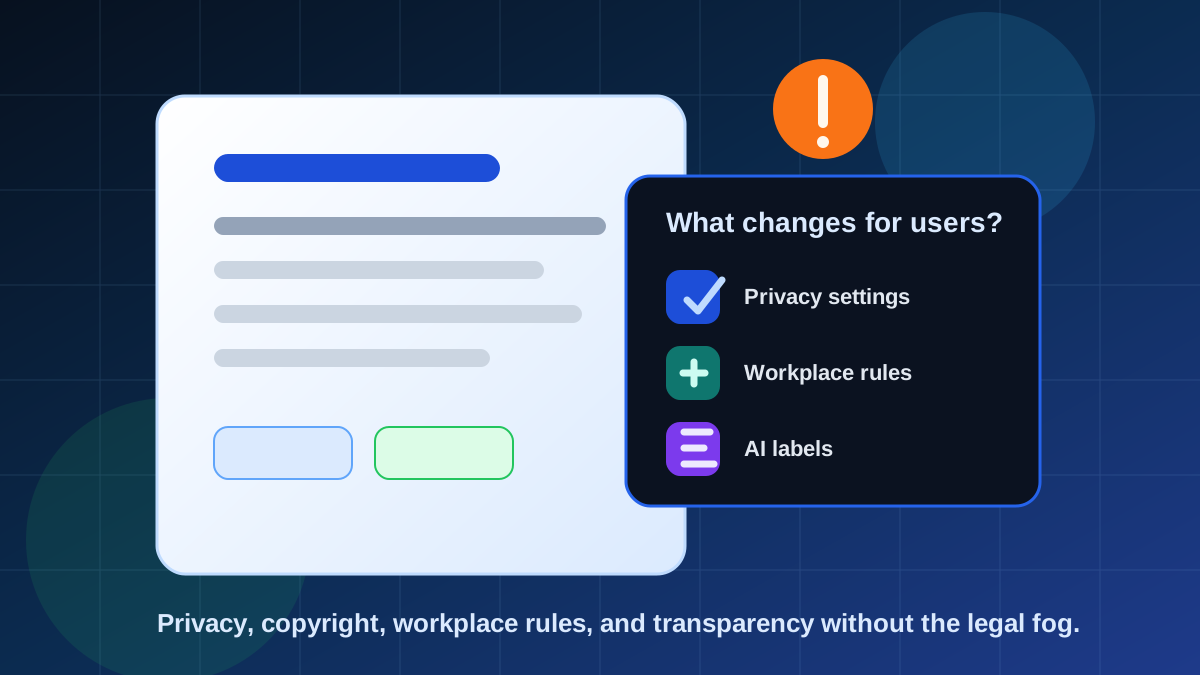
You do not need to read every AI bill to make smarter decisions. You need to know which policy changes affect your data, your work, your content, and your risk when using AI tools.
The simplest way to think about AI policy is this: governments are trying to decide when AI must be disclosed, when it is too risky, who is responsible when it causes harm, and what companies must reveal about powerful models.
The Five Areas That Matter Most
Most ordinary users will feel AI policy through product changes, workplace rules, and platform defaults. These are the areas worth watching.
Privacy
Whether your prompts, uploads, call transcripts, documents, or customer records can be used for training or review.
Copyright
Whether AI-generated work is accepted by platforms, clients, publishers, schools, and marketplaces.
Workplace Rules
Whether your employer allows AI, requires disclosure, blocks certain tools, or restricts customer data.
What Is Already Changing
The European Union's AI Act is the clearest example of a phased AI rulebook. Some pieces already apply: prohibited AI practices and AI literacy obligations started on February 2, 2025, while general-purpose AI model rules started applying on August 2, 2025. More transparency and enforcement obligations continue to phase in through 2026 and beyond.
In the United States, federal policy has shifted toward AI leadership, procurement rules, and agency-level guidance. For everyday users, that means less of a single national consumer rulebook and more variation across agencies, states, employers, schools, and platforms.
In Canada, AI policy is still moving through a mix of federal initiatives, government guidance, safety work, and proposed legislation. That makes it important for Canadian users and businesses to watch official updates rather than assume rules are final.
What To Check Before Using AI For Real Work
- Data: are you entering private, customer, health, legal, financial, or employee information?
- Disclosure: do you need to tell a client, employer, teacher, or audience that AI helped?
- Ownership: are you allowed to use the output commercially, and do you need to check originality?
- Accuracy: could a wrong answer hurt someone, cost money, or create a compliance problem?
- Tool settings: can you turn off training, manage memory, restrict sharing, or use a business plan?
AI Labels Are Going To Matter More
Expect more labels around AI-generated images, audio, video, chatbots, and synthetic content. This does not mean every AI-assisted sentence will need a warning label. It means platforms and regulators are paying closer attention when people might mistake synthetic media for real events, real people, or real evidence.
Workplaces Will Move Faster Than Governments
Your employer's AI policy may affect you sooner than national law. Companies are already deciding which tools are allowed, what data can be pasted into them, whether AI can draft customer messages, and when employees must disclose AI assistance.
- Do not paste confidential data into personal AI accounts unless policy allows it.
- Keep human review for anything sent to customers, regulators, students, patients, or clients.
- Save source links and assumptions when AI helps with research.
- Use business or enterprise settings when handling sensitive work.
Simple Rule
If the AI output affects money, rights, health, employment, education, safety, or someone's reputation, slow down and review it like a serious business document.
Bottom Line
AI policy is not just something lawyers and lobbyists track. It affects what tools can remember, what companies must disclose, how synthetic media is labeled, and how safely you can use AI at work.
The practical move is simple: protect sensitive data, disclose AI use when trust requires it, verify important outputs, and keep an eye on official policy sources as the rules continue to settle.