
 Shift News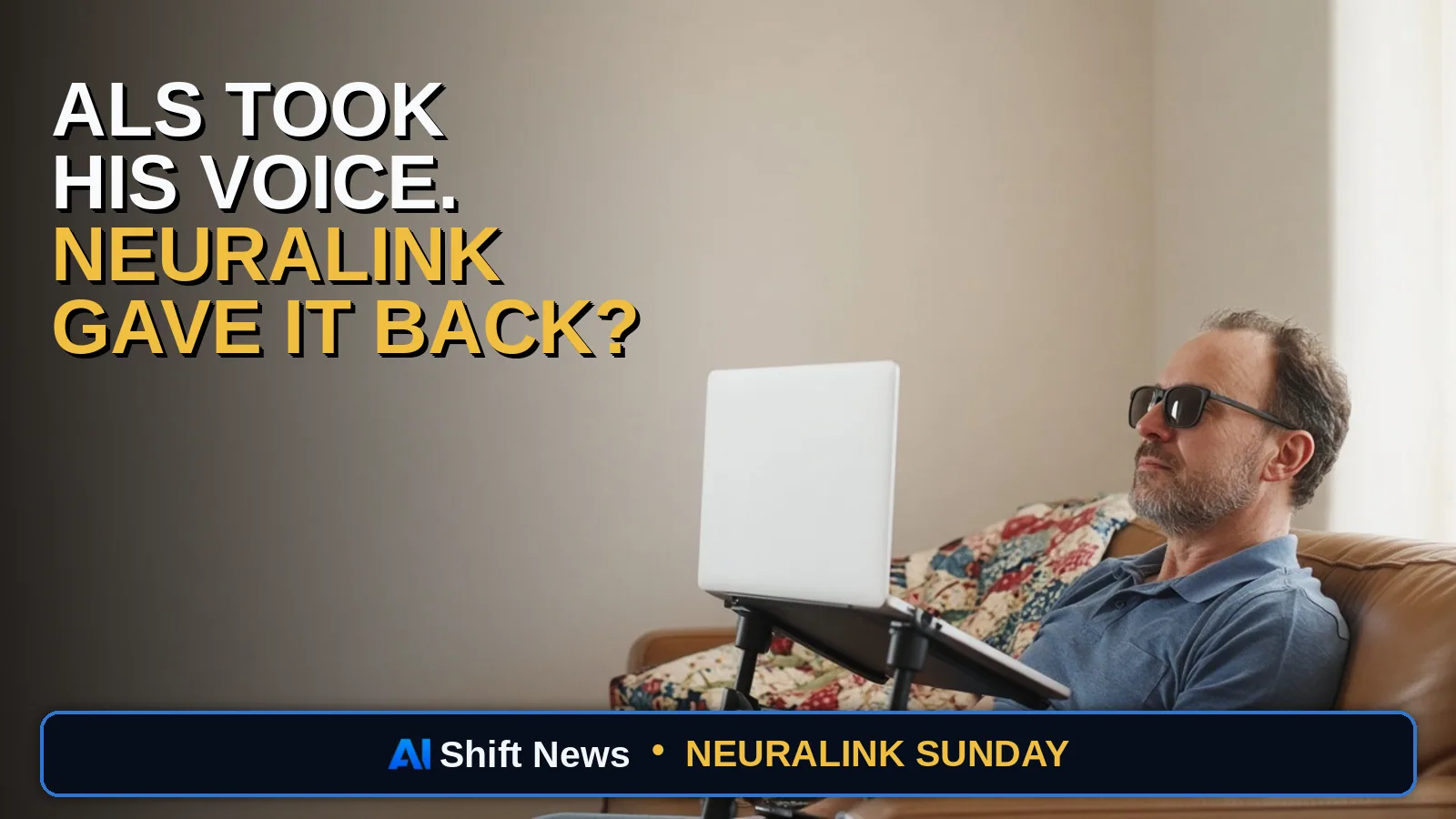
Honest fence (read first): This Neuralink Sunday flagship rests on two kinds of receipts. The first is Kenneth Shock’s own X posts from October 9–10. His bio reads “Neuralink p21 · VOICE2 (thought-to-speech) · Alberta. ALS sucks, my life doesn’t.” The second is Neuralink’s official film, “Translating Thought To Speech” (u8mmn9lOIyw), posted March 24, 2026. The film is older than our usual two-week window. We use it because it is Neuralink’s own account of this exact man, and he links it himself. What this is: a trial participant speaking for himself, in public, with nearly half a million people watching. What it is not: a trial readout. There are no published words-per-minute or accuracy numbers here, and no FDA approval. VOICE is an early feasibility study that lists an estimated 6 participants at one site.
Neuralink — “Translating Thought To Speech” (published March 24, 2026). Neuralink’s official film about Kenneth, the VOICE participant in this story. It predates his October posts; he says they have “made big strides since then.” It is a company film, not trial data.
Editorial Thesis
Most brain-computer interface news arrives as a company video. This week it arrived as a reply thread.
On October 9 at 7:26 PM ET, Shock replied to an Elon Musk post with this: “10 years ago this might have sounded crazy but today I have a Neuralink N1 BCI in my head that allows me to talk without moving my mouth.” Musk reposted it about an hour later. By Sunday morning the post had passed 491,000 impressions and 207 replies.
Then Shock did something company videos never do. He answered the replies, one stranger at a time, in his own words. That is the story. Not a new decoder, not a new number. A participant in Neuralink’s speech study is now a public, checkable voice. And he is from Alberta.
Honest Verdict
Believe that Shock is a real Neuralink VOICE participant. Neuralink’s film names him and says he became “the second participant to receive a Neuralink implant for voice” in January 2026. His X bio matches. Believe that he is using the system to talk and text today. That is his first-hand account, and he says the software “keeps getting better.”
Do not turn this into a speed or accuracy claim. Neither his posts nor the film publish words-per-minute or error rates. Do not call it a treatment. VOICE is an early feasibility study. Its registry entry lists an estimated 6 people at UT Southwestern in Dallas. And do not read “big strides since March” as data. It is his honest description, and it is welcome, but it is not a measurement.
What the primaries actually say
Neuralink’s film (March 24, 2026). The captions tell the setup plainly. Shock was diagnosed with ALS in January 2024. In January 2026 he received the implant for voice. Surgery was in Dallas, and he went home the next day. His synthetic voice was rebuilt from old recordings, what the film calls “OG Ken from way back in 2020.” Early on, decoding worked “at half speed with mouthing.” The goal was for him to “simply just intend to move his mouth.” His line in the film: “I’m talking to you with my mind.”
Neuralink on X (same day). The company’s post, “ALS has gradually taken away Kenneth’s ability to speak…”, has drawn more than 42 million impressions. That is the audience Shock is now talking to directly.
Shock on X (October 9–10). His replies add details the film doesn’t:
| Question people asked | His answer (verbatim, X) | Date (ET) |
|---|---|---|
| Is the March video still current? | “This was made back in March 2026. We’ve made big strides since then.” | Oct 9, 9:43 PM |
| Does it say things he doesn’t mean to say? | “The BCI detects my intent to speak, so nothing leaks out.” | Oct 10, 1:01 PM |
| Is the implant in his forehead? | “Motor area for cursor control (PRIME) and speech (VOICE) is on the side of brain. My implant is on the left side. You can’t even see it unless you look hard.” | Oct 10, 8:38 PM |
| What does it let him do day to day? | “@BluetoothTerry and I can use dictation mode to text each other over our smartphones.” | Oct 10, 12:58 PM |
| Favourite thing / what to improve? | “It just works, and (along with the software) it keeps getting better. Improvements: Ask me again in the new year?” | Oct 10, 3:50 PM |
The registry. ClinicalTrials.gov NCT07224256, “VOICE: An Early Feasibility Study,” is recruiting. It started October 3, 2025, uses Neuralink’s N1 implant and R1 surgical robot, lists an estimated enrollment of 6, and names one site: UT Southwestern Medical Center, Dallas.
Why the “nothing leaks out” answer matters
The most common fear about a speech implant is that it will read thoughts you didn’t mean to share. Shock’s answer is the clearest public statement on that from anyone inside the trial. In his words, the system responds to his intent to speak, not to everything he thinks. That fits what Neuralink’s film describes: the decoder is trained on attempted speech, starting with mouthing.
It is still one participant describing his own experience. It is not an independent test of privacy. But it is a better answer than most of the speculation in his replies.
Claim vs proof scoreboard
| Claim | Who says it | Proof level |
|---|---|---|
| Shock has a Neuralink N1 implant for speech | Neuralink film + his bio | Strong — company and participant agree |
| Second VOICE participant, implanted January 2026 | Neuralink film | Company-stated |
| He talks “without moving my mouth” today | Shock on X | First-hand, unverified independently |
| “Big strides since March” | Shock on X | Self-described — no numbers published |
| It only outputs intended speech (“nothing leaks out”) | Shock on X | First-hand description, not a privacy test |
| VOICE is approved or widely available | — | False — early feasibility, est. 6 people, one site |
| Specific speech speed or accuracy | — | Not published for VOICE |
The Terry connection
On September 27 we covered Terry, the first VOICE participant, and Neuralink’s thought-to-speech film. Shock’s reply about texting “@BluetoothTerry” suggests the two are using the system to talk to each other. That is a small detail, and a human one: the first two people in a speech-BCI study, texting each other by dictation.
Who should care
- People living with ALS and their families, especially in Canada. A fellow Albertan is answering practical questions in public.
- Clinicians and caregivers who get asked “is this real?” His posts are a first-hand answer, with clear limits.
- Neuralink watchers who want proof over promos. A participant who answers follow-up questions is a better receipt than another montage.
What to watch next
1. Shock’s X Live. He wrote on October 9 that after a choking scare he “pushed back the Live for 1 more week.” A live, unedited session would be the strongest public look yet at VOICE in use. We wish him well.
2. Any VOICE numbers from Neuralink. Words per minute, error rate, or hours of use. None are public yet.
3. The registry. If the estimated enrollment of 6 changes, or more sites appear on ClinicalTrials.gov, that is real expansion. Rumours of a bigger FDA go-ahead have circulated on fan sites this week, but we found no Neuralink or FDA primary, so we are not reporting them.
4. A Canadian site. Neuralink’s CAN-PRIME study runs in Canada, but VOICE lists only Dallas. Watch for any change.
Bottom Line
Believe that Shock is a real Neuralink VOICE participant. Neuralink’s film names him and says he became “the second participant to receive a Neuralink implant for voice” in January 2026. His X bio matches. Believe that he is using the system to talk and text today. That is his first-hand account, and he says the software “keeps getting better.” Do not turn this into a speed or accuracy claim. Neither his posts nor the film publish words-per-minute or error rates. Do not call it a treatment. VOICE is an early feasibility study. Its registry entry lists an estimated 6 people at UT Southwestern in Dallas. And do not read “big strides since March” as data. It is his honest description, and it is welcome, but it is not a measurement.
Sources
- Kenneth Shock (@Cyborg21) on X — 'today I have a Neuralink N1 BCI in my head that allows me to talk without moving my mouth' (Oct 9, 2026, 7:26 PM ET)
- Neuralink — Translating Thought To Speech (official film, Mar 24, 2026)
- Neuralink on X — 'ALS has gradually taken away Kenneth's ability to speak…' (Mar 24, 2026)
- ClinicalTrials.gov NCT07224256 — VOICE early feasibility study (Recruiting; est. enrollment 6; UT Southwestern, Dallas)
- Kenneth Shock on X — 'This was made back in March 2026. We've made big strides since then.' (Oct 9, 9:43 PM ET)
- Kenneth Shock on X — 'The BCI detects my intent to speak, so nothing leaks out.' (Oct 10, 1:01 PM ET)
- Kenneth Shock on X — 'My implant is on the left side.' (Oct 10, 8:38 PM ET)
- Kenneth Shock on X — choking scare; X Live pushed back a week (Oct 9, 7:07 PM ET)
- AI Shift News — Neuralink VOICE Trial Shows Thought-to-Speech Demo (Terry; Sep 27, 2026; context)