 Shift News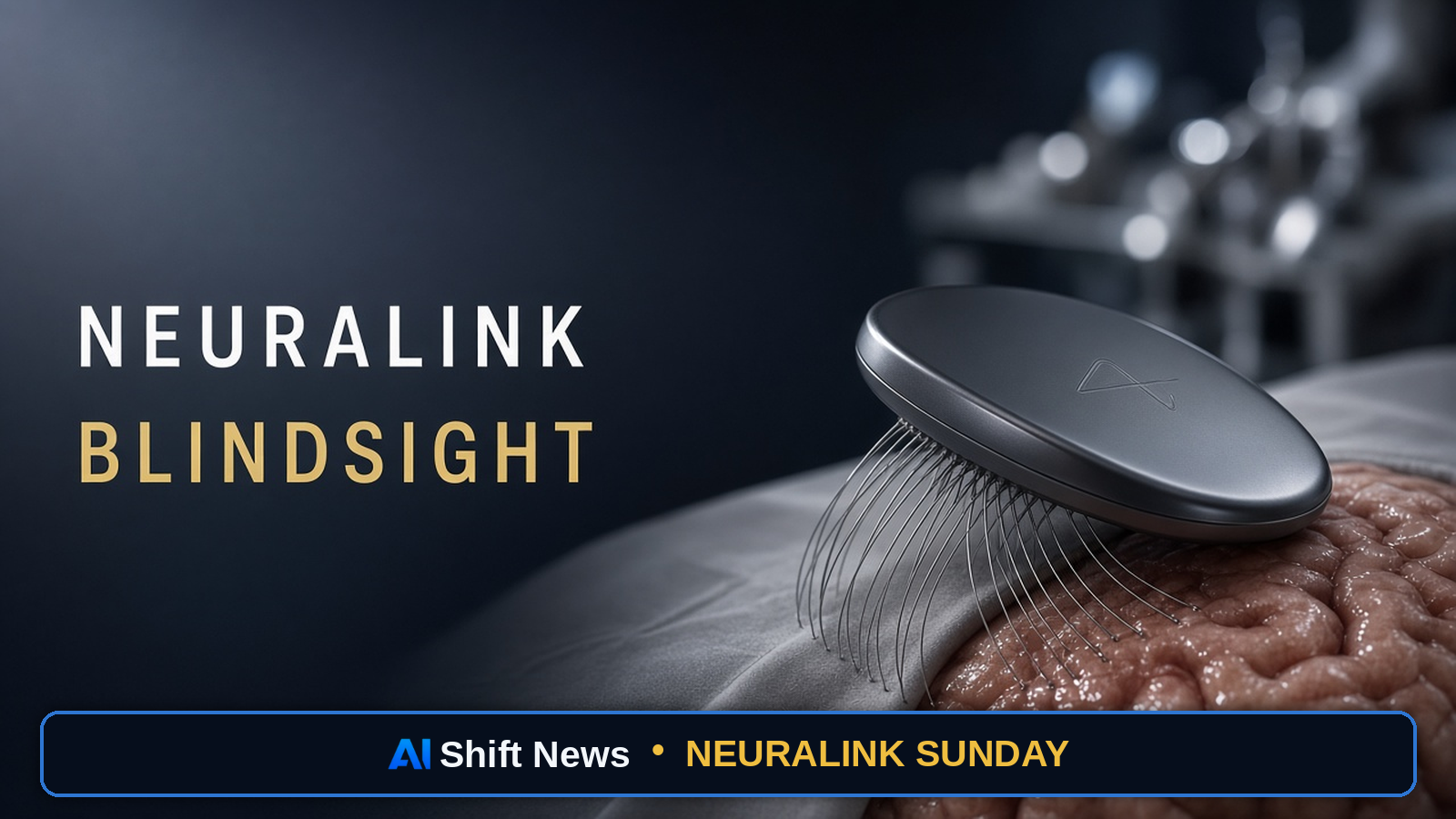
Neuralink’s own pages describe Blindsight as a future visual-prosthesis trial program with FDA Breakthrough Device Designation and a Patient Registry invite. There is no publicly verified human Blindsight implant or restored-vision clinical result in this package. Musk and secondary timing claims stay fenced pending regulatory steps.
Neura Pod — Neuralink Blindsight: Giving Vision Back to the Blind · Neura Pod
What the video shows
Required embed for this package: Neura Pod — “Neuralink Blindsight: Giving Vision Back to the Blind.” House note: this is creator/explainer packaging, not a Neuralink company upload and not a ClinicalTrials.gov readout. Use it to orient readers on the intended pathway — camera capture, wireless transmission, cortical stimulation — and on why blindness with an intact visual cortex is the claim class Neuralink and Musk emphasize. Do not let the title’s “Giving Vision Back” line upgrade into AISN’s factual claim that vision has already been restored in a verified human Blindsight recipient. Prefer this embed with hedges over NONE because it matches the locked Neuralink Sunday mix and keeps the vision indication distinct from Telepathy cursor demos.
What is new
AI Shift News has already covered Neuralink’s paralysis-focused Telepathy / PRIME lane: participant portraits, wheelchair demos, Canadian study framing, and the demos-to-durable-evidence test. Those packages document an investigational computer-control interface with named human participants and company-reported use. Blindsight is a different indication.
What is new for this Sunday flagship is not a fresh peer-reviewed vision paper. It is the honest public status of the vision program itself: Neuralink maintains a dedicated visual-prosthesis trials page, still talks in future-trial language, still routes interest through a Patient Registry, and still points to Breakthrough Device Designation announced in September 2024. Secondary explainers and Musk posts keep recycling capability and timing rhetoric — including January 2026 “pending regulatory approval” language that secondary outlets packaged toward an end-of-2026 first implant. The editorial job is to separate that rhetoric from what primary pages actually show.
Soft-re-cover note: this is not a redo of the site’s transdural scaling-test package, and it is not another Telepathy “what it feels like” cursor story. Lead with vision-program evidence fences.
What evidence supports
Neuralink visual prosthesis page (primary). The company’s trials URL for visual prosthesis states the purpose plainly in structured metadata and page framing: learn more about future visual prosthesis clinical trials, with Patient Registry recruitment creative. That wording matters. A company that already had a publicly verified Blindsight human cohort with restored-vision endpoints would not need to sell the story as future-trial education alone. Registry language is contact infrastructure for possible later screening — not enrollment, not randomization, not a benefit guarantee.
Neuralink Breakthrough Device update (primary, Sep 17, 2024). Neuralink announced it received Breakthrough Device Designation from the FDA for Blindsight for individuals with vision impairment, and pointed readers to the Patient Registry and careers page. Breakthrough designation is a real FDA program interaction class aimed at devices for serious conditions; it can mean more interactive review. It is not marketing approval and not a finding that Blindsight is safe or effective in humans.
Reuters (Sep 17–18, 2024) — secondary confirmation of the announcement. Reuters reported Neuralink’s Breakthrough Device claim for the experimental Blindsight implant, explained the program’s purpose (speed development/review for certain serious-condition devices), and recorded that Neuralink did not immediately detail human-trial timing while FDA did not immediately comment to Reuters. Useful as independent amplification of the company announcement — not as a trial-start receipt.
IEEE Spectrum (Sep 27, 2024) — secondary expert/regulatory fence. Spectrum reported an FDA spokesperson’s emphasis that Breakthrough designation does not mean the device is yet considered safe or effective; full clinical trials remain ahead of any approval. The piece also catalogs Musk’s claim set (eyes/optic-nerve loss; congenital blindness if cortex intact; Atari-like early resolution; eventual better-than-natural / other-wavelength rhetoric) and quotes vision-prosthesis researchers warning that cortical implants are unlikely to deliver “natural” sight and are better framed as assistive, not a cure. Use Spectrum for expectation-setting and regulatory literacy — not as Neuralink’s current IR.
Musk / CNBC TV18 timing chain (claim fence). On January 28, 2026, Musk posted that, pending regulatory approval, Neuralink was also ready to do a first Blindsight “augment,” describing low resolution first and higher resolution over time (quoted via CNBC TV18, January 29, 2026). Secondary headlines compressed that into “by end of 2026” human-implant packaging. House voice keeps the operator’s own hedge visible: pending regulatory approval. No primary Neuralink clinical-result page in this package documents a completed human Blindsight implant or a restored-vision endpoint table.
How the intended pathway is described (still not a human result). Secondary explainers describe Blindsight as a camera-to-cortex prosthesis: capture a scene, encode it, and stimulate visual cortex so someone with an intact cortex — even after eye or optic-nerve loss — might perceive a useful field. IEEE Spectrum’s 2024 survey notes prior cortical/retinal programs that reached human research and then struggled commercially. Neuralink is not inventing artificial vision from zero — and prior hard parts (resolution, stability, long-term support) remain the bar Blindsight has not publicly cleared in humans.
Monkey claims stay preclinical. Founder posts have asserted Blindsight-like function in monkeys with low early resolution. That can justify preparing a human protocol; it cannot be cited here as a restored-vision result in a blind human. Keep species and evidence class visible beside Breakthrough headlines.
What is still missing (confirmed fence). No publicly verified named Blindsight human recipient; no peer-reviewed Blindsight efficacy paper cited here; no FDA marketing approval; no ClinicalTrials.gov Blindsight efficacy readout in this draft’s source set; no independent verification that monkey claims transfer to human functional vision. Telepathy/PRIME computer-control footage does not fill that gap.
What it does not prove
- It does not prove a human has received a Blindsight implant. Future-trial and pending-approval language is not a surgical receipt.
- It does not prove vision has been restored. Capability posts and explainer titles are not clinical endpoints.
- It does not prove Breakthrough Device Designation equals approval. FDA-sourced caution via Spectrum still applies.
- It does not prove Patient Registry members are enrolled in a Blindsight trial. Registry ≠ study participation.
- It does not prove Musk’s resolution roadmap (Atari → better-than-natural / other wavelengths).
- It does not prove Neura Pod’s narrative is Neuralink IR. Creator packaging only.
- It does not let Telepathy demos stand in for Blindsight evidence. Different sensory goal, different proof bar.
Why this matters
For practical readers, vision restoration is among the highest-stakes claims in neurotechnology. The cost of sloppy language is not abstract: it lands on people living with blindness who must decide whether a registry form is hope, marketing, or a real near-term trial path. Primary Neuralink pages currently support a careful reading — program exists; designation exists; human Blindsight outcomes are not yet a public verified result.
It also matters because Breakthrough Device headlines travel farther than FDA footnotes. Markets, social feeds, and secondary tech desks often collapse “designation” into “approved” or “works.” IEEE Spectrum’s reporting is a useful corrective: novelty and serious-condition potential can earn a faster conversation with regulators without answering safety or effectiveness.
Finally, Blindsight sits next to Neuralink’s better-documented Telepathy work. That adjacency creates a category error risk. Cursor control for people with paralysis is an investigational assistive channel with named participants and company progress updates. Cortical visual prostheses face a different biology problem — phosphenes, resolution, long-term cortical interface stability — and a different disappointment mode if expectations are set to natural sight. Keeping the files separate is the journalistic job.
Vision stories attract maximal title language — “giving sight back,” “see for the first time,” “better than natural.” Left unfenced, those phrases turn a Breakthrough designation and a registry CTA into a false impression that the clinical finish line has moved. AISN’s job is slower: name the program, name the designation, name the absence of a verified human Blindsight outcome, and name which clock (regulatory authorization, trial registration, independent follow-up) would change the file.
What happens next
- Any Neuralink primary notice that a Blindsight human trial has regulatory authorization to begin — with protocol identity, not only a social post.
- ClinicalTrials.gov or equivalent registry entries specifically for the visual prosthesis / Blindsight investigation, distinct from PRIME computer-control studies.
- Named first recipient reporting from Neuralink plus independent clinical follow-up — not explainer YouTube alone.
- Outcome definitions — what “low resolution vision” means in measurable tasks (orientation, navigation aids, object detection) versus cinematic claims.
- Whether Breakthrough interactions produce public review milestones short of approval — still not the same as restored sight.
- Amplifier hygiene — outlets that keep “pending regulatory approval” versus those that declare vision restored ahead of evidence.
Bottom Line
Neuralink’s Blindsight visual-prosthesis program is real: Breakthrough Device Designation is on the company’s primary update record, and the trials page still invites registry interest for future studies. What is not on the public record reviewed here is a verified human Blindsight implant or a restored-vision clinical result. Musk and secondary timing claims — including pending-approval / end-of-2026 packaging — stay in the claim column until regulators and primary trial disclosures say otherwise. Neura Pod can explain the pitch. It cannot close the evidence gap. That is the Neuralink Sunday flagship: program status, not miracle vision.
Sources
- https://www.youtube.com/watch?v=qU7XlqDBIZk
- https://neuralink.com/trials/visual-prosthesis/
- https://neuralink.com/updates/neuralink-receives-breakthrough-device-designation-for-blindsight/
- https://www.reuters.com/business/healthcare-pharmaceuticals/musks-neuralink-receives-fdas-breakthrough-device-tag-brain-implant-2024-09-17/
- https://spectrum.ieee.org/neuralink-blindsight
- https://www.cnbctv18.com/technology/elon-musk-neuralink-to-implant-blindsight-vision-chip-in-humans-by-end-of-2026-what-it-means-ws-l-19835492.htm
- https://aishiftnews.ca/news/neuralink-s-transdural-procedure-is-a-scaling-test-not-a-safety-verdict/
- https://aishiftnews.ca/news/what-neuralink-actually-feels-like-is-now-the-real-scaling-question/