
 Shift News
Workflow Build
How I Set Up a Hermes Agent Team for AI Shift News
I wanted Hermes to feel less like one chatbot and more like a small publishing team. So I gave each agent a clear job.
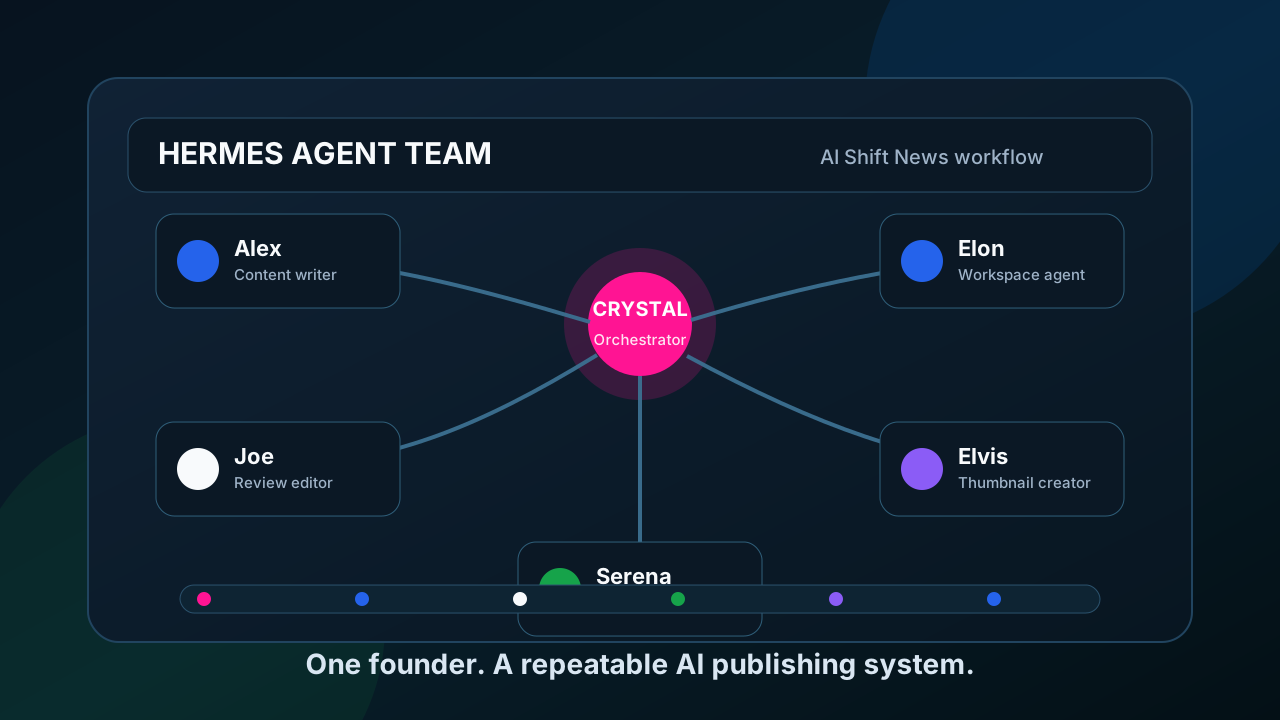
The most useful part of AI agents is not that they sound impressive. It is that they can take a messy project and move it through repeatable steps: idea, draft, review, SEO, thumbnail, files, and final approval.
That is what I wanted for AI Shift News. I did not want a pile of random outputs. I wanted a system I could come back to every time I had a story, a video idea, a tool review, or a workflow worth explaining.
Why I Did Not Want One General Agent
A single AI assistant can help, but it also tends to blur the job. One minute it is writing, the next minute it is reviewing itself, then it is trying to organize files, then it is making SEO suggestions. That can work for small tasks, but it gets messy when you are trying to build a real content pipeline.
So I split the work into roles. The idea is simple: each agent should know what it owns, what it should not do, and who gets the handoff next.
The Agent Team
Crystal: Orchestrator
Crystal is the main coordinator. Her job is to break the request into lanes, route work to the right agent, and make sure the final package is usable.
Alex: Content Writer
Alex writes the first draft. His job is to explain what changed, why it matters, who should care, and what the reader can do next.
Joe: Review Editor
Joe is the fact-check and quality gate. He checks sources, claims, risk, clarity, and whether the piece is ready to move forward.
Serena: SEO Editor
Serena packages the draft for search, newsletter reuse, YouTube metadata, internal links, and the right AI Profit Lab call to action when it fits.
Elvis: Thumbnail Creator
Elvis owns the visual direction. The thumbnail should match the article, not feel like a random image dropped on top at the end.
Elon: Workspace Agent
Elon keeps the files organized. His job is to make sure the draft, thumbnail, source notes, and review package are easy to find.
The Workflow Order
The order is what makes this useful. Without the order, the agents are just helpers. With the order, they become a production line.
- Research and source collection: gather the story, links, dates, claims, and practical angle.
- Drafting: Alex writes the first version with source notes and a clear reader takeaway.
- Review: Joe checks facts, weak claims, risk, hype, and publish readiness.
- SEO packaging: Serena creates titles, slug, meta description, keywords, newsletter angle, YouTube copy, internal links, and CTA notes.
- Visual direction: Elvis creates or recommends the thumbnail concept and text direction.
- Workspace packaging: Elon organizes the files and creates a clean handoff.
- Human approval: nothing gets published or marked ready until I approve it.
What Serena Adds
The SEO editor role is important because search packaging is not the same as writing. A good draft still needs a useful title, a clean slug, a meta description, internal links, newsletter reuse, and sometimes a YouTube description.
Serena's job is not to stuff keywords into the article. Her job is to make the work easier to find while keeping the voice human. That matters because AI content can get generic fast if nobody is protecting the tone.
Serena's Publishing Package
- SEO title and page title
- Slug and meta description
- Excerpt or dek
- Primary and secondary keywords
- Search intent
- Internal link suggestions
- Newsletter subject line ideas
- YouTube title and description when relevant
- AI Profit Lab CTA recommendation when it naturally fits
The Big Lesson
The breakthrough is not just "using AI agents." The breakthrough is giving the agents a workflow they can follow. Otherwise, you still have to babysit every output and remember every handoff yourself.
I am still keeping humans in the loop, especially for fact-checking, investing-related claims, and anything that goes on the website. But this setup gives AI Shift News a more organized way to move from idea to publishable package.
Bottom Line
If you are building with AI agents, start with roles before tools. Decide who writes, who checks, who packages, who designs, who organizes, and who approves.
Once those lanes are clear, AI starts to feel less like a novelty and more like a working system.
Want to learn how to build this kind of AI workflow?
If you want to learn how to implement this process, build practical AI systems, and use AI for content, automation, and online business, check out the AI Profit Boardroom.
Join the AI Profit Boardroom: https://www.skool.com/ai-profit-lab-7462/about?ref=52fc33ca1c3246b2be6344b2670e9e4f