
 Shift News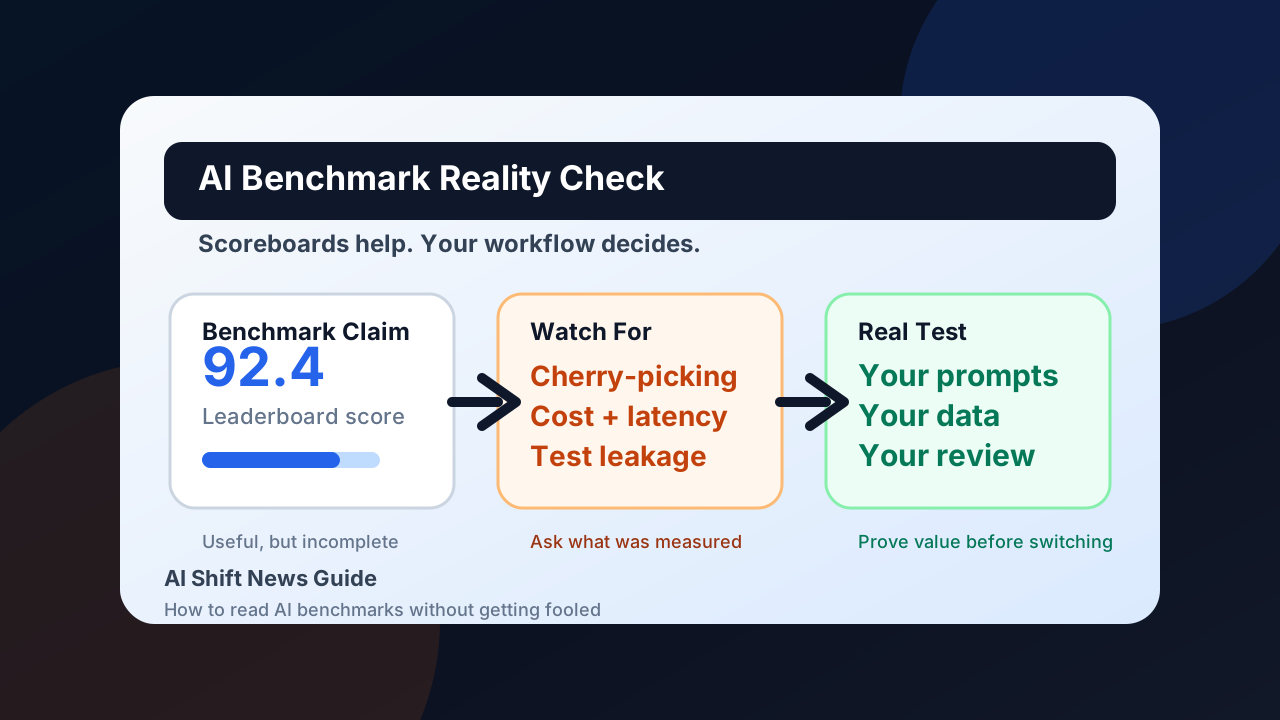
AI benchmarks are useful when they help you narrow the field. They become dangerous when they are treated like proof that one model, tool, or agent will be better for your actual workflow.
A leaderboard can tell you that a system performed well on a specific test. It cannot tell you whether it will handle your messy prompts, your customer data rules, your publishing style, your budget, or your need for reliable human review.
Why Benchmarks Matter
Benchmarks are not useless. They give researchers and buyers a shared way to compare systems. They can show progress in coding, math, reasoning, image understanding, tool use, safety behavior, or long-context work.
The smart way to use them is as an early filter. If a model consistently performs poorly on the kind of task you care about, it may not be worth testing. If it performs well, it earns a spot in your own practical test.
Where Benchmarks Mislead
The problem is not that benchmarks exist. The problem is that benchmark scores often get used as marketing shortcuts. Before you believe the headline, look for the traps.
Test Set Leakage
If model training data includes examples similar to the benchmark, the score may reflect memory more than general skill.
Cherry-Picked Metrics
A company may highlight the test it won while ignoring speed, price, failure rate, formatting, or weaker categories.
Benchmark Saturation
Once many models score near the top, the test stops separating useful differences. Your workflow matters more.
Model Routing Can Hide The Real Answer
Some AI products route different prompts to different models behind the scenes. That can be helpful, but it makes simple comparisons harder. You may think you are testing one model when the product is quietly choosing another depending on the task, account tier, load, or feature.
For operators, the practical question is not only "which model won the benchmark?" It is also "which model will I actually get when I use this product, and can I rely on that behavior tomorrow?"
Cost And Latency Are Part Of Quality
A model that scores higher but costs four times more, responds slowly, or breaks your automation budget may be worse for your business than a slightly lower-scoring option.
Quality is not just answer quality. It is answer quality plus speed, cost, consistency, limits, privacy, tooling, and how much human editing the output still needs.
AI Shift Benchmark Reality Test
- Pick real tasks: choose 20 to 50 prompts from work you already do.
- Use the same inputs: run each model or tool against the same prompt, files, and constraints.
- Score the boring stuff: accuracy, structure, tone, citations, formatting, speed, and edit time.
- Track failures: note hallucinations, refusals, broken JSON, missed instructions, and weak summaries.
- Measure cost: include subscription price, API spend, usage limits, latency, and retry volume.
- Keep humans in the loop: require review for anything public, customer-facing, financial, legal, medical, or operationally sensitive.
- Decide from evidence: switch only when the winner is clearly better on your actual work.
What To Trust
Trust benchmarks more when the test is transparent, recent, hard to game, relevant to your work, and backed by independent evaluation. Trust them less when the score appears only in a launch graphic with no method, no task examples, no cost context, and no failure discussion.
Simple Rule
Use benchmark scores to decide what deserves testing. Use your own workflow results to decide what deserves money, migration time, or trust.
Bottom Line
Benchmarks are useful signals, not final answers. They can show which AI systems are worth watching, but they cannot replace testing against your own prompts, data, budget, review standards, and real deadlines.
The best AI tool is not the one with the loudest leaderboard win. It is the one that makes your real work faster, cleaner, cheaper, or more reliable after human review.