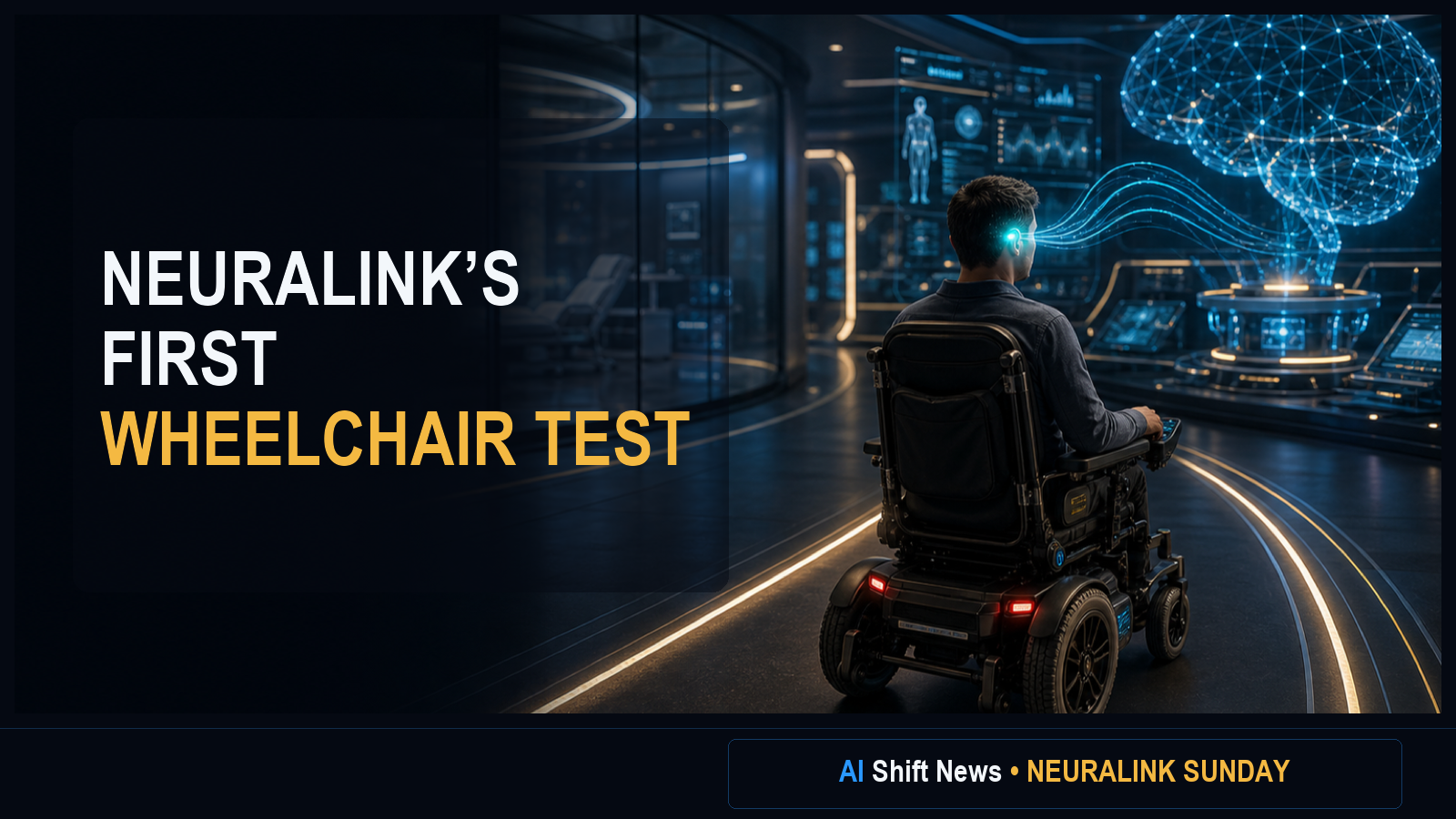
Neuralink has published a short demonstration of clinical-trial participants controlling powered wheelchairs through its brain-computer interface. The milestone matters because moving from a screen cursor to real-world mobility raises the standard for reliability, safety, and useful independence. It is meaningful early evidence—not proof that the technology is ready for broad use.
Telepathic Wheelchair Control | Neuralink · Neuralink
Neuralink’s new wheelchair-control demonstration is not important because it looks futuristic. It matters because it tests whether a brain-computer interface can move beyond a computer screen and help someone act in the physical world.
That is a much harder bar.
In a July 23 video, Neuralink showed clinical-trial participants using its system to control powered wheelchairs. The company frames the work as an early look at telepathic wheelchair control for people with paralysis. The footage is short, and the company has not published a peer-reviewed study tied to this demonstration. Still, the direction is worth taking seriously.
A cursor is useful. A wheelchair can change the shape of a day.
For someone with severe paralysis, controlling a screen can restore communication, work, entertainment, and connection. Controlling a powered wheelchair could eventually restore a more basic form of autonomy: getting across a room, changing position, moving toward a person, or choosing where to go without waiting for another person to operate the chair.
That is the practical promise. It is also why the standard of proof gets tougher from here.
AI Shift News tracks the AI developments that change real workflows—not just impressive demos. Subscribe for clear updates on what is useful now, what is still early, and what deserves skepticism.
Quick Take
Neuralink appears to be extending its brain-computer-interface work from digital control toward mobility. That is a meaningful expansion of the problem it is trying to solve.
But the right reading is not “mind-controlled wheelchairs are here.” The right reading is: Neuralink has shown an early clinical demonstration that makes its existing cursor-control story more relevant to daily independence. The unanswered questions are now more important than the visual impact of the demo.
What Neuralink actually showed
Neuralink’s official YouTube video is titled “Telepathic Wheelchair Control.” It presents the work as an early look at using its brain-computer interface to support independent mobility for people with paralysis.
The company’s earlier January update helps explain the foundation beneath that video. Neuralink says its Telepathy product aims to let people with paralysis control computers, phones, and robotic limbs using thoughts. Its update also said it had 21 participants.
The company’s clinical-trial record gives the cleanest description of what this is: PRIME is a first-in-human, early-feasibility study evaluating the initial safety and device functionality of the N1 implant and R1 surgical robot. It is not a completed pivotal trial. It is not listed as an approved consumer medical product. And it is not framed by the registry as evidence that every eligible person can use the technology safely or effectively.
That distinction matters.
A first-in-human study exists to answer early questions: Can the system be implanted? Can it function as intended? What safety events occur? Can the researchers learn enough to improve the next version?
The registry lists device-related and procedure-related adverse events among the study’s outcome measures. Its estimated completion date is in 2031. That long timeline is not a sign of failure. It is a reminder that implanted medical technology needs more than a successful demonstration. It needs time.
Why a wheelchair is a bigger operational challenge
Moving a cursor and moving a wheelchair both require translating a person’s intent into machine action. But the consequences are different.
A cursor error is frustrating. A wheelchair-control error can be physically consequential.
That does not mean wheelchair control is impossible. It means the technology has to be judged on a more demanding set of questions:
- How reliably does the user’s intended command match the wheelchair’s action?
- What happens when the system is uncertain about the intended command?
- How does the chair stop safely?
- Does control remain stable across hours, days, and changing environments?
- How much setup, calibration, caregiver support, and supervision does the system require?
- Does the system work consistently for a broad enough range of people with paralysis?
The public video does not answer those questions. It should not be expected to. A two-minute company demonstration is evidence of a capability, not a full clinical report.
Still, the move is strategically important. A brain-computer interface becomes more valuable when it controls devices that matter outside a laptop. The route from cursor to wheelchair is not simply a bigger screen. It is a move into a setting where reliability, user trust, safety design, and integration with existing assistive equipment become central.
The benefit is not “telepathy.” It is fewer bottlenecks.
The most useful way to understand this category is not as mind reading. Neuralink’s system is designed to decode neural activity associated with intended movement and turn that into commands for an external device.
For a person with very limited hand and arm movement, the bottleneck is often not willingness or knowledge. It is the lack of a dependable input method.
A standard computer mouse assumes hand control. A joystick assumes sufficient arm or hand movement. Voice control can be useful, but it may not fit every environment or every user. A brain-computer interface could provide another control channel.
That is why the value proposition is so concrete. The system is not trying to make a healthy person faster at checking email. It is trying to give people with serious mobility limitations another way to operate tools and devices.
The biggest potential win is choice. Choice of when to move. Choice of where to point a camera. Choice of when to open a computer, contact a friend, operate a robotic limb, or change position.
Those are small actions when they are easy. They become large when another person must help make every one of them happen.
What has succeeded so far
Neuralink has now publicly connected three ideas that fit together:
- An implanted interface intended to capture signals related to movement.
- Software that turns those signals into control of an external device.
- A practical destination beyond a computer cursor.
The company’s January update described users controlling computers, phones, and robotic limbs. The new wheelchair video broadens the visible use case to mobility. That makes the story easier to evaluate because the intended benefit is no longer abstract.
The company also has a formally listed clinical study rather than only a concept video. ClinicalTrials.gov identifies Neuralink as the sponsor, describes the N1 implant and R1 robot, lists the relevant patient population, and identifies the work as an early-feasibility study.
That is real progress. It is more substantial than a speculative product announcement.
What remains uncertain
The biggest unanswered issue is independent evidence.
Neuralink’s own video and updates are valuable primary sources for what the company has built and demonstrated. They are not substitutes for independently reviewed clinical results. The public material does not provide a full dataset on performance, complications, long-term implant stability, training time, user drop-off, or comparative results against other assistive-control methods.
The trial registry is clear that this is an early-feasibility effort. Its listed enrollment is 15, while Neuralink’s separate January company update says 21 participants across its broader program. Those are not necessarily contradictory numbers: a company can operate more than one study or update public participant totals separately from an individual registry record. But they should not be blended into a single clinical-performance claim without more documentation.
There is also a human-factor question. A technically capable system is not automatically a good everyday system. Users need a control method that is comfortable, dependable, understandable, safe, and practical to maintain. Caregivers and clinicians need to know what happens when a system misreads intent, loses connection, needs calibration, or encounters an unfamiliar device.
The technology will earn trust through boring evidence: repeatable use, good safety reporting, clear failure modes, and long follow-up periods.
That is how serious medical technology should work.
Who should care now
People who build AI tools should care because this is a sharp example of AI’s most useful role: translating a difficult human signal into a practical action.
Operators and business owners should care for a different reason. The exciting part of AI is increasingly not the model alone. It is the full system around the model: the input signal, the safety layer, the hardware, the workflow, and the real result for the user.
Neuralink’s wheelchair demo only works as a story because it connects all of those layers. Brain signal in. Decoding system in the middle. Wheelchair action out. Safety requirements around every step.
For readers interested in disability technology, the key is to remain hopeful without getting ahead of the evidence. This is an early demonstration in a clinical setting, not a general-availability treatment or a promise of restored walking.
What to watch next
Three developments would make this story materially stronger.
First, watch for detailed clinical outcomes: not just footage, but information about safety events, consistency, duration of use, and functional gains.
Second, watch for clarity on wheelchair integration. A helpful system needs to work with real mobility equipment and real safety requirements, not just a controlled demonstration.
Third, watch for independent scrutiny. Peer-reviewed studies, regulator-facing disclosures, and data from multiple clinical sites will tell us more than any launch video can.
The honest verdict is simple: Neuralink’s wheelchair-control work is a credible reason to pay attention, not a reason to declare victory.
The demo suggests the company is pursuing a more meaningful target than screen control alone. But the measure of success will be whether the system becomes safe, durable, and dependable enough to give people more control over ordinary life.
AI Shift News will keep separating the headline from the proof. Subscribe if you want the useful version of AI news: what changed, what it can do, and what still has to be earned.
Sources
https://www.youtube.com/watch?v=78m32VSOMBk https://neuralink.com/updates/two-years-of-telepathy/ https://clinicaltrials.gov/study/NCT06429735
Bottom Line
Neuralink's wheelchair demonstration moves brain-computer interface testing toward consequential real-world mobility, while safety, reliability, and long-term clinical evidence remain the real test.
Sources
- https://www.youtube.com/watch?v=78m32VSOMBk
- https://neuralink.com/updates/two-years-of-telepathy/
- https://clinicaltrials.gov/study/NCT06429735
- https://www.youtube.com/embed/78m32VSOMBk?feature=oembed
- https://i.ytimg.com/vi/78m32VSOMBk/hqdefault.jpg
- https://www.youtube.com/watch?v=78m32VSOMBk","publisher":"Neuralink","title":"Telepathic
