
 Shift News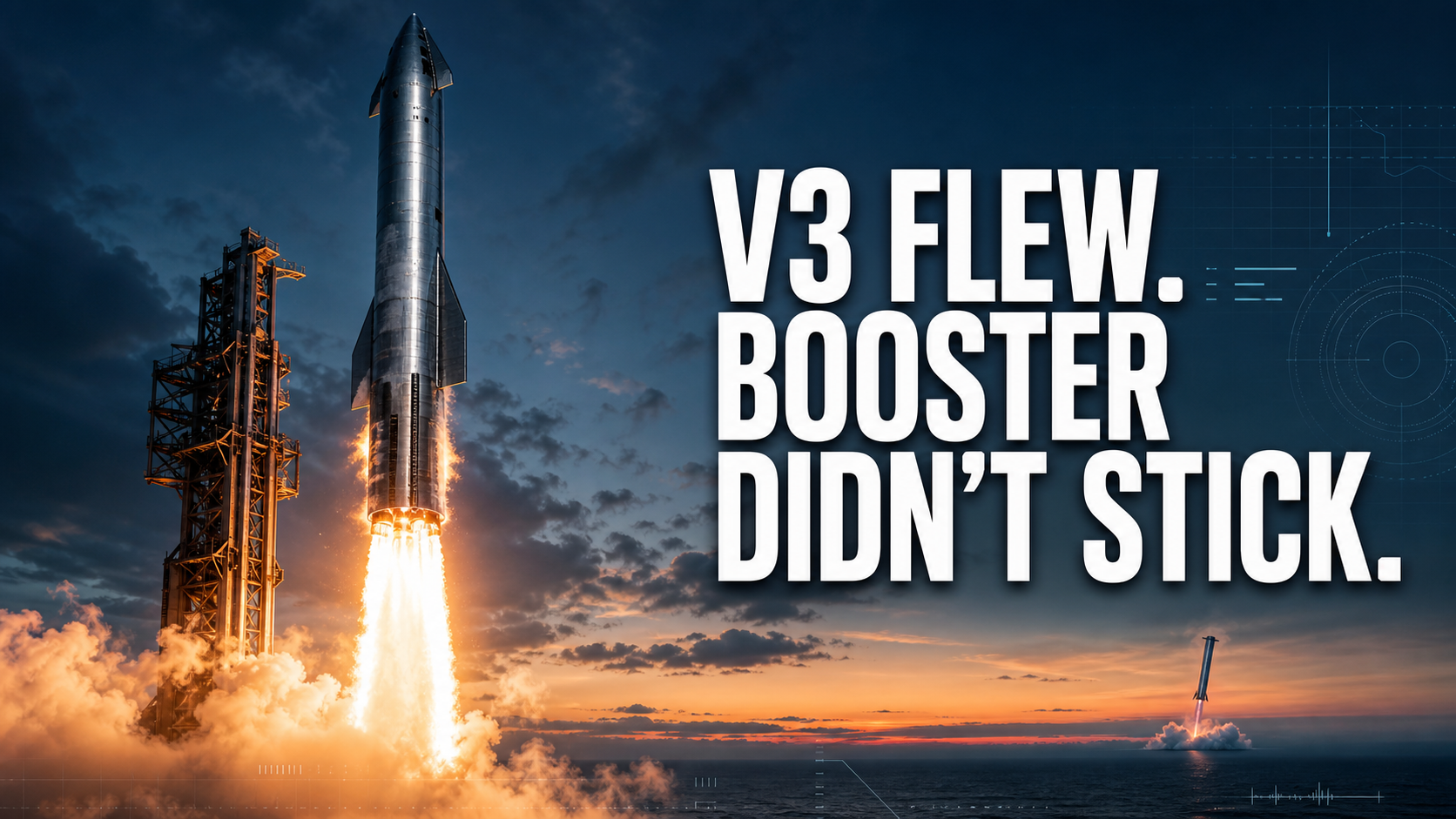
On May 22, 2026, SpaceX launched Starship's Twelfth Flight Test from Pad 2 at Starbase, Texas. This was a big configuration step, not a routine repeat.
SpaceX described it as the first flight of the V3 Starship and Super Heavy stack, the first flight using Raptor 3 engines, and the first Starship mission from the new Pad 2 infrastructure. Before we even get to outcomes, Flight 12 was already testing a new vehicle generation and a new launch setup at the same time.
Wins
The biggest technical win is that the mission still achieved its planned trajectory despite engine losses. During ascent, one Super Heavy engine shut down. SpaceX also reported losing one Starship Raptor Vacuum engine during ascent. Even so, Starship stayed within planned trajectory bounds and continued the mission.
Payload operations also mattered. SpaceX reported deployment of 20 Starlink simulators plus two modified Starlink satellites. Those modified satellites imaged Starship in space, which is an important capability-building step for future inspection and turnaround workflows.
Reentry and terminal flight profile were also meaningful. SpaceX says Starship gathered critical data on heatshield and structure performance, then guided itself to the planned Indian Ocean splashdown zone and completed landing flip and landing-burn operations, touching down on two engines.
In short: Flight 12 validated that this V3 architecture can keep executing mission objectives even when parts of propulsion performance are off-nominal.
Issues
The mission did not deliver a clean booster return profile. SpaceX reported Super Heavy attempted boostback but could not light all planned engines, performed only a partial boostback burn, and ended with a hard splashdown in the Gulf of America.
Engine reliability was the other clear issue. One booster engine dropped during ascent, and one Starship vacuum engine was lost during ascent. SpaceNews also reported SpaceX skipped the planned in-space Raptor relight demo due to the earlier engine issue.
After splashdown, SpaceNews reported Starship tipped over and exploded, which SpaceX treated as expected/acceptable for this water-landing test profile.
Regulatory follow-up is still a variable. SpaceNews reported the FAA was assessing the booster anomaly and had not yet determined whether it rises to a mishap investigation threshold.
Why It Matters
For business and infrastructure readers, Flight 12 should be read as mixed but meaningful progress, not a binary success/failure.
What got de-risked
The V3 stack can fly a full suborbital profile, deploy payloads, and complete targeted ship-side end-of-mission guidance under degraded engine conditions.
What is still at risk
Booster return reliability and engine relight consistency remain central to fast reuse economics and higher-cadence operations.
This is exactly how major transportation systems mature: subsystem setbacks, system-level learning, then objective reshaping on the next flights.
The AI Angle
Important boundary first: there is no basis here to claim "AI flies Starship."
The real autonomy story is more practical and more credible. Systems like Starship and Starlink rely heavily on autonomous flight software, guidance, telemetry, fault-handling logic, and decision rules running in real time. Flight 12's engine-out continuation and guided terminal profile are examples of robust automation behavior, not evidence of unconstrained AI command.
On the satellite side, Starlink's operator documentation describes active conjunction coordination, ephemeris sharing, and 24/7 collision-avoidance operations. That is a supervised-autonomy model: software-heavy orbital safety workflows with humans in operational control loops.
Flight 12's modified-satellite imaging of Starship is especially relevant to AI operations over time. As these inspection data pipelines mature, this creates a path toward more automated condition assessment for reuse decisions, while still keeping hard go/no-go authority with engineering and flight teams.
What To Watch Next
SpaceX has not announced an official Flight 13 date.
Best current framing: watch for a next attempt in weeks, not months, if SpaceX and regulators clear the post-flight review quickly.
Also watch objective design. Booster relight and recovery gaps from Flight 12 are likely to shape what Flight 13 is optimized to prove first. If booster return robustness improves and relight testing is reintroduced successfully, confidence in near-term Starship mission cadence will rise materially.
Bottom Line
Flight 12 did not prove everything, but it proved a lot. SpaceX demonstrated first-flight V3 stack performance, first-flight Pad 2 operations, payload deployment, heatshield inspection imaging, and controlled Indian Ocean ship splashdown profile completion.
At the same time, booster recovery execution and engine reliability remain the core technical constraints to solve next.